

An ICE Agent Accidentally Shot Him. He’s Still Detained, Nearly Four Months Later
A judge dismissed ICE's case against Carlitos Ricardo Parias, but despite being shot he's still languishing in ICE detention since October.
Photo courtesy of Carlitos Ricardo Parias Splinter ICE
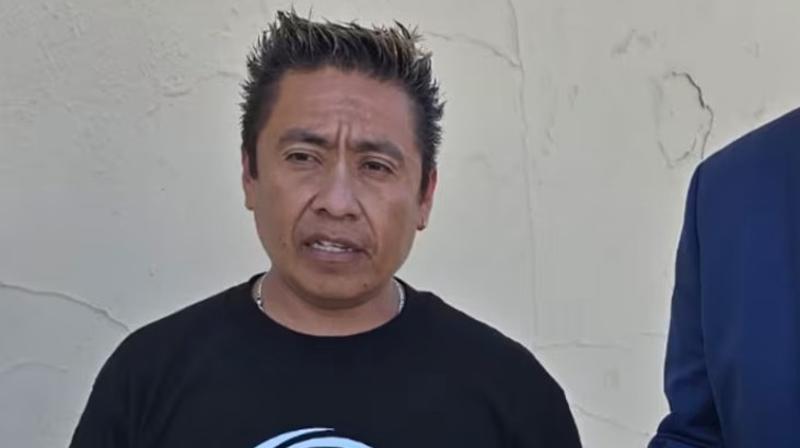
On the afternoon of Oct. 21, 2025, Los Angeles resident Carlitos Ricardo Parias, a TikTok content creator and citizen journalist with more than 130,000 followers who was known for providing real-time documentation of the city’s immigration enforcement purge, was shot and wounded by an agent of U.S. Immigration and Customs Enforcement (ICE). In the wake of that shooting—which appears to have happened in entirely clumsy, unintentional fashion, also errantly wounding a U.S. Marshal in the process—Parias was charged with attempting to assault and kill federal officers. Those charges have subsequently been dismissed by a judge, who ruled that the U.S. government had repeatedly violated Parias’ constitutional rights … but Parias remains in ICE detention anyway. Nearly four months after being accidentally shot by a reckless immigration agent, the victim is still languishing and awaiting a likely deportation, at a detention center where detainees plead that “they treat us like dogs in cages.”
That continuing detention is because Carlitos Ricardo Parias is himself an undocumented migrant, one who has been living and working in the United States for more than 20 years. Since 2024, he has become a well-known figure among L.A.’s citizen journalists, known as “El Senor Richard” or “TikTokquero,” shooting short-form breaking news coverage from street level, in his native Spanish. In 2025, that coverage unsurprisingly turned to the immigration enforcement surge in L.A. led by DHS’s ICE and Border Patrol, which undoubtedly put Parias on the agency’s radar. In fact, Parias was awarded a certificate of recognition by the office of City Council member Curren Price only two months before the shooting, with the office praising how Parias’ “unwavering commitment to keeping the South L.A. community informed, empowered and protected.”
The shooting incident stemmed from ICE’s attempted apprehension of the “subject of an administrative immigration arrest warrant,” something they for some reason decided to do while Parias was driving down the street, despite the obvious danger this presents to all parties. Boxing his car in from all sides, ICE officers and U.S. Marshals attempted to break Parias’ windows to reach him, while Parias looked for an angle to flee. The official DOJ statement claimed that due to Parias’ “aggressive” driving, the following occurred: “during today’s arrest a federal agent opened fire, wounding Parias and a deputy marshal, who was struck by a ricochet bullet.”
Consider the wording of “a federal agent opened fire,” a phrase that implies that a conscious and decisive action was taken by the agent to neutralize a threat. In what became one of her favorite phrases, just-resigned DHS spokesperson Tricia McLaughlin claimed that the agent fired “defensive shots” because he “feared for the safety of the public and law enforcement.” In phrasing the incident this way, the government attempts to paint its agent as someone who was acting clearly and decisively within the boundaries of his duties.
But then you watch the actual video of the incident, as captured by the ICE agent’s body camera. In it, a group of agents surround the vehicle and begin bashing its windows with glass-breaking tools. Parias does seem to be attempting to move the car, but is unable to because he’s completely boxed in, and no actual movement of the vehicle can be seen. The agent breaking the window repeatedly yells at Parias, who holds up his hands, but when the agent shifts his gun from his right hand to his left hand, he seems to fire it accidentally. The shot goes off, hitting Parias in the arm while also wounding a deputy U.S. Marshal on the other side of the car. The clearly surprised agent reacts by audibly saying “oh fuck!,” while the other assembled agents are confused by what just happened or who fired. The entire incident can be viewed in the embedded post below. Watching it, you can see why “ICE agent opened fire” would be seen as a better PR move to frame the shooting than “incompetent agent accidentally shoots both immigrant and colleague.”
After the shooting, Parias spent nearly a week in the hospital, having surgery for the gunshot, before then being turned over to ICE agents who moved him to a detention center in Adelanto, California, despite the fact that he was still in “severe pain” and “did not have access to medication except ibuprofen,” according to his lawyers. There he awaited his trial on charges of assaulting a federal officer.
But the trial was never to be, thanks to the federal government’s unique combination of incompetence and violation of Parias’ rights as a defendant. While being held at the Adelanto ICE detention center, lawyers for Parias’ were completely unable to schedule legal visits or work with their client on his defense. With three weeks to go before the trial, the Los Angeles Times wrote that Parias’ lawyers still hadn’t been able to meet with him. Simultaneously, the government failed to produce discovery for the case until nearly a month after the initial deadline according to U.S. District Judge Fernando M. Olguin, and “has continued to produce discovery to the defense well beyond the discovery cutoff.” No longer willing to put up with such an unprofessional and unconstitutional display, Judge Olguin dismissed the assault case with prejudice (meaning it cannot be brought again) in a 28-page, late December order, although the DOJ is currently attempting to appeal.
“In short, because the deprivation of Mr. Parias’s access to counsel during the critical period prior to his trial caused him actual and threatened prejudice, and because no other remedy could adequately cure his deprivation, the court agrees with defendant that dismissal of the indictment is warranted,” Olguin wrote. “Here, defendant’s detention in Adelanto has effectively denied him access to his counsel for nearly the entire month preceding trial. In short, the obstacles and roadblocks that ICE has put in place at Adelanto make it difficult, if not impossible, for defendant to meet with his attorneys, and have caused defendant to suffer demonstrable prejudice or a substantial threat thereof. Moreover, the prejudice to Mr. Parias has been exacerbated by the government’s conduct especially as it relates to meeting deadlines and producing discovery.”
— Arghavan Salles, MD, PhD (@arghavansallesmd.medsky.social) Jan 25, 2026 at 1:23 PM
But even the dismissal of those charges wasn’t enough to actually free Carlitos Ricardo Parias, even in advance of further immigration proceedings. It doesn’t matter that the man suffered a gunshot wound for no good reason. It doesn’t matter that he’s been rehabbing a gunshot wound while in prison for the last four months, which cannot be the healthiest place to do that. It doesn’t matter that the government’s case against Parias fell apart due to them depriving him of his constitutional rights. They still won’t release him, because doing so would make Donald Trump’s DHS look in some way weak or fallible. The agent who shot Parias, meanwhile, has never been named.
“They’re basically free while they shot my dad,” said 19-year-old son Ulises Parias to NYT. “How is that fair?”
It’s not, obviously. In a fair world, one wouldn’t get accidentally shot by a trigger-happy ICE agent. In a fair world, federal agents attempting to serve an immigration warrant would probably choose to do so when their suspect was somewhere less dangerous than behind the wheel of a car. In a fair world, someone shot by agents would be allowed to rehab at home while their immigration case progresses through the system, given that the person in question has never been a genuine threat to anyone, or owned a criminal record. That’s how a fair system would operate. Guess how ours operates instead?
 Keep scrolling for more great stories.