

I’m on Team “End MLB Blackouts Forever”
Imagine, being able to buy a single subscription to watch baseball games. Revolutionary!
Photo via Unsplash, Owen Lystrup, Wikimedia Commons SplinterSports baseball
The upcoming collective bargaining agreement (CBA) that must be achieved between owners and players (via the MLB Players Association or MLBPA) in Major League Baseball hangs like a dark cloud over the ongoing 2026 baseball season. It threatens the viability of the 2027 season, with doomsayers predicting potentially huge numbers of games lost, as in the infamous 1994 strike. That mid-’90s work stoppage was, uncoincidentally, the last time that owners made a real push toward implementing features such as a hard salary cap and salary floor, and we now find ourselves back in the same spot, with all the old wounds and grievances just as fresh as ever. But screw all that! The CBA bargaining will be filled with thorny issues on all sides for owners and players to sort through, but let’s stop for one second to consider what the most valuable victory would be for the actual consumer, the rank and file Major League Baseball fan.
How about this proposal: Viewers should be able to pay money for a single subscription to watch the vast majority of baseball games. Revolutionary thinking, right? But this has long been an impossibility for many users depending on their geographical location, thanks to the utterly despised system that has long dictated MLB “in-market vs. out-of-market” broadcast blackouts. Regardless of whatever else happens during these coming CBA negotiations, the most pressing fan priority ought to be killing off the era of blackouts once and for all. Anything that makes access to games slightly less complicated and overwrought is a win, in my book.
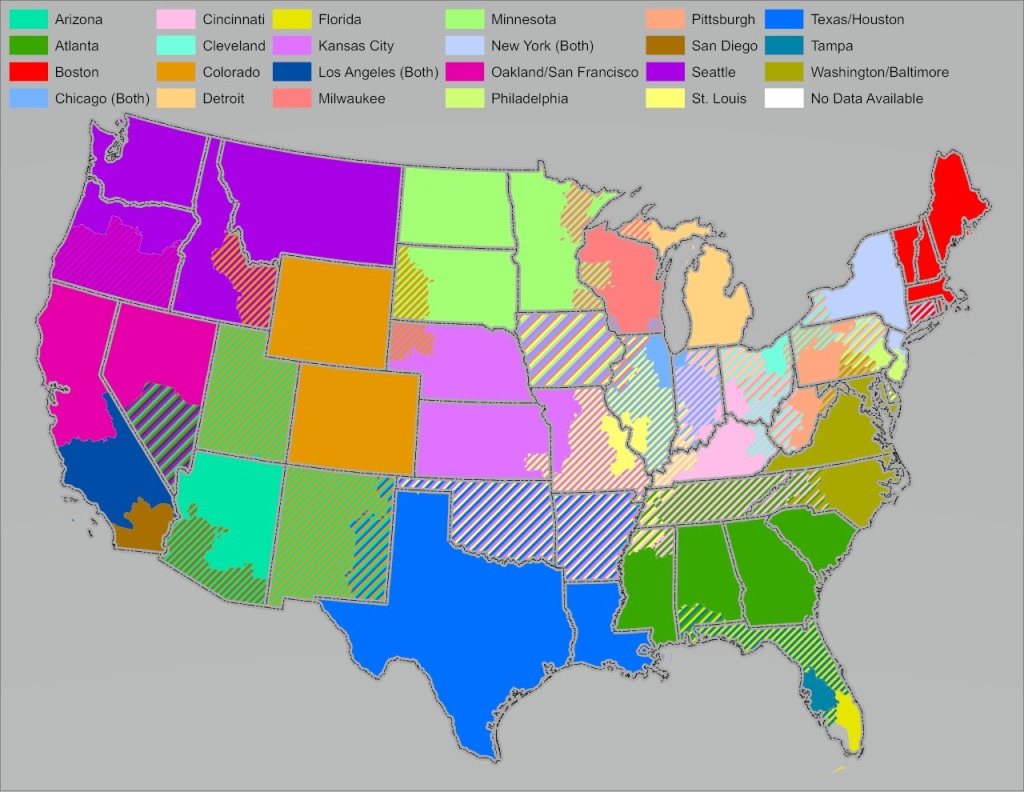
Because rest assured, there are millions of potential fans out there who have been getting screwed for years by the existing system. It breaks down like this: Every MLB game is, depending on your location, “in market” or “out of market.” A fan of the Yankees living in New York can either watch their in-market games by getting a traditional cable package that includes the team’s YES Network, or by paying for a digital package from MLB or the YES Network that specifically gives access to those games (and no others) while in market. When the consumer is out of market for the team they want to watch–say, a Dodgers fan currently living in New York–they can purchase a package via MLB.tv that allows them to watch out-of-market games for every team in the league … most of the time. Because when that Dodgers fan’s own team actually comes to New York to play the Yankees (or the Mets), the Dodgers fan won’t be able to watch those games with the MLB.tv subscription they bought for $120-150 at the start of the year, because the games will be blacked out. They would instead need an additional Yankees subscription, Mets subscription, or local cable TV subscription on top of what they’re already paying to actually see those games. This absurd-looking map gives you an idea of how arcane these in-market and out-of-market areas are.
In this way, actually watching MLB baseball (particularly for league-wide fans or fantasy enthusiasts) becomes a constant game of being nickeled and dimed, with endless exceptions in which the consumer is expected to either add yet another superfluous subscription, or be unable to watch. On top of this, games are further randomly segmented into “national” broadcasts, which can only be seen with access to networks like FOX, or ESPN, or streamers like Apple TV+, Netflix or Peacock. In a quest to see every game from just a single home team, a fan could easily spend many hundreds of dollars on access to every place that team’s games will be broadcasted over the marathon that is a six-month regular baseball season.
In-market blackouts, however, are still the most onerous burden for some fans in particular, and they serve no purpose except protecting the profits of regional sports networks. For a long time, the entire state of Iowa has been the most perfect clusterfuck of an example: It has no team of its own, but is close enough to a handful of others that it is considered “in market” for the Cubs, White Sox, Cardinals, Royals, Twins and Brewers simultaneously, which is why it looks like a plaid nightmare on the map above. That means a baseball fan in Iowa paying $150 per year for an MLB.tv subscription can see zero games from the six closest teams in the league, making the service borderline useless to someone living in that area. The only choice that a fan in Iowa has is to seek out and pay for digital access to a sole team of their choice … or explore the natural crossover between MLB fandom and Virtual Private Network (VPN) usage.
Because I’m petty and like spreadsheets, I made one to tally up all the service fees you’d ACTUALLY need to pay to watch “EVERY out-of-market game” with MLB.TV or “without blackouts” for team-specific streaming: docs.google.com/spreadsheets…
Sorry, Phillies fans.
#mlb #mlbtv #streaming
— Matthew (@ironmaus.bsky.social) 10:00 PM · Mar 29, 2026
That’s why it’s so significant that in their first public proposal for the new collective bargaining agreement, Major League Baseball and team owners specifically offer an end to local blackouts … tied, of course, to the players union accepting a salary cap and floor system. The proposal would centralize revenue from all 30 local media markets, distributing it equally among the 30 teams. Even the biggest spending teams such as the Los Angeles Dodgers, which have the most lucrative TV broadcast contracts, are seemingly on board with the idea, likely because they’d already be seeing significant savings by reducing their payroll for the salary cap. The league argues in general that this system, including both the salary cap and revenue sharing, would serve to bring more parity to a league where winners have been more tied than ever to payroll within the span of the last decade.
“When you’re centralizing media rights, the focus on local territories goes way down,” said commissioner Rob Manfred. “Who cares, right? Because it’s all going into one pot, and it creates flexibility in terms of dealing with the blackout issue. I think that the Dodgers understand that there is a need to update the overall economic model in the industry.”
The MLBPA, naturally, has quite a different read on the entire situation, as they inevitably must have. They vehemently oppose the way a salary cap and floor would no doubt reduce the absolute max earning cap available to the sport’s biggest superstars, and the organization frequently criticizes MLB’s sincerity in negotiations and objects to how MLB’s owners would seek to define things like “revenue,” conveniently leaving out billions for things like stadium expenses and various fees. And frankly, you don’t need a business degree to recognize that there are elements of truth to every objection–the billionaires who own these sports teams didn’t get to be billionaires by leaving money on the table any time they could snatch it up. Greed is a necessity in being where they are.
Free Game. But it’s in blackout. But I can watch it on the MLB mobile app. But I can’t watch it on the MLB Roku app.
— Maxwell Overstreet (@kawasakidream.bsky.social) 7:48 PM · May 15, 2026
That said, the Players Association could find itself in a difficult position in the court of public opinion if they’re seen as being the ones opposing something like the end of in-market broadcast blackouts. MLB owners may be disingenuous in tying the promise of ending blackouts to their true aim of a salary cap and floor, but they have the advantage of that being a carrot that practically any passionate MLB fan really wants to obtain. Both sides naturally want the maximum cash benefit to themselves; that much is inevitable. But which side wants to make it easier for me to just pay a single damn subscription to watch the majority of baseball games? How many more seasons must I sit in my home in Virginia, unable to watch games from any team that happens to be playing the Washington Nationals or the Baltimore Orioles … two teams in entirely different states than the one where I reside?
When the current system has been engineered to extract every possible dollar from the consumer via overlapping, arduous subscriptions, don’t be surprised if the masses line up behind Team “end the blackouts.” Now figure it out, save the 2027 season, and let me pay to watch baseball in peace.
 Keep scrolling for more great stories.