

Lord, Protect My Family from “Autopilot” Teslas Slamming Into Our Homes
Whether or not features like Tesla's self-driving are dangerous on their own, it seemingly can't help but empower reckless, stupid drivers.
Photo via Wikimedia Commons Splinter Tesla
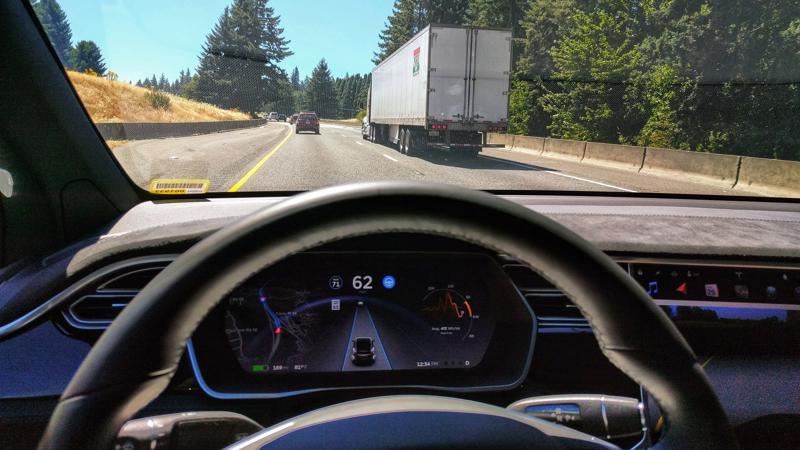
Imagine, for a moment, that you’re sitting on the couch in your home one evening, perhaps watching TV, minding your own business, when you hear the distant roar/whine of a fast-approaching vehicle. Perhaps you have just enough time to be vaguely annoyed that someone is driving far, far too fast through your residential neighborhood … before the vehicle you just heard punches through the brick walls of your home and slams into the living room, killing you instantly. Certainly, there’s no time to be shocked, or angry. One moment you’re sitting there safe in your domicile; the next there’s a 4,000 lb sedan in the space you were just occupying. And the driver of that Tesla vehicle (who does not die) explains to police that it’s not his fault–he had the self-driving mode engaged!
Talk about your profoundly unfair ways to die in America. This particular injustice was experienced by a family in Katy, Texas, outside of Houston this weekend, when a driver reportedly traveling at more than 70 mph smashed into their front room, killing 76-year-old grandmother Martha Avila. There were multiple other people present in the same home, including children, who were thankfully uninjured, although they’re now simultaneously left with both a wrecked home and a lost loved one. The footage from outside the house, meanwhile, is utterly horrifying–you will not believe just how fast the car comes barreling into view, like it had been shot out of a cannon straight at this family’s living room.
Immediate news coverage of the story predictably zeroed in on the most juicy, hot-button topic: The fact that the seriously injured driver, identified as a man named Michael Butler, apparently told police/investigators in the hospital that he had been using the Tesla Model 3 sedan’s self-driving feature before the crash. There is no specific, official statement from Tesla on the incident as far as I can tell, although Elon Musk himself predictably leapt into the debate on his own CSAM-generating social media platform to insist that the story “makes no sense” because “FSD drives slowly through neighborhood streets and this was a high speed crash.” In all fairness, that does seem like the sort of safety feature one would want the tools to possess.
The reality is that even a few days after this incident occurred, we don’t possess enough details to genuinely say what happened here. The original “Tesla Autopilot” feature was actually discontinued earlier this year after 13 years in service, in response to a California judge ruling that the “Autopilot” name could constitute deceptive marketing. That presumably means the driver of the car in Texas was claiming he was using the Full Self-Driving (FSD) premium upgrade that can completely take over driving operations. But we don’t truly know if the driver was honest at all, or had any of these systems engaged, although police at least noted that the driver displayed no signs of intoxication. Both the local police, and national auto-safety regulators from the National Highway Traffic Safety Administration have opened probes into what happened here, to determine what settings the driver was actually using leading up to the crash, which could be necessary in determining various aspects of his legal culpability. Their findings will reshape the tone of who is perceived to be most at fault in this incident.
Here’s the thing, though: Regardless of whether a feature like Tesla Autopilot/FSD was ultimately responsible for aiming this car like a missile at a home, or whether it boils down to simple user error and the scapegoating of such a feature as a defense mechanism, the existence of these types of features runs the risk of empowering already dumb, already reckless drivers with unearned confidence and a dangerous lack of responsibility for their own actions. If such features did not exist on this man’s car, or if he was driving a standard sedan, would he have been traveling 70 mph down a residential suburban street? Or was he only traveling in this reckless, crazy way because he was idiotically assuming that his car’s technology would somehow intervene if necessary to keep him from killing anyone? Can fools be trusted with this tech, even when its limitations are constantly spelled out to them in user manuals and fine print? Does this type of technology encourage safer driving, or does it empower an already unsafe driver to throw caution to the wind and surrender responsibility to their onboard computer, with the ready-built (and obviously incorrect) rationale that anything the car does from that point forward is no longer their fault? Are we saving more lives, or taking more of them, and even if it’s the former, how much of the latter should we accept?
A Tesla, reportedly in autopilot mode, crashed into the front room of a home in Texas, killing a 76-year-old woman, according to authorities.
— CNN (@cnn.com) 11:52 PM · Jun 21, 2026
It’s not like there’s a lack of data suggesting that driverless vehicles are ultimately safer than human-driven ones, in terms of the rate of serious accidents per mile driven. But at the same time, high-profile instances continuously demonstrate just how catastrophic the frequent oversights can be: Look at Texas, where several driverless Waymo vehicles were swept away entirely or incapacitated themselves recently by repeatedly driving into floodwaters, causing the company to suspend service as it attempted to build in a software workaround to keep its cars from becoming watery tombs. Are you willing to roll the dice as a passenger that you’ll be one of the uneventful drop-offs, or the small fraction where your driverless car encounters an unusual scenario and can no longer determine what qualifies as “road”? At what point does it finally feel safe enough to you?
Back in 2023, Tesla recalled nearly every car it had ever manufactured specifically to address issues with the Autopilot system, after Virginia officials concluded it had contributed to a fatal crash. Three years later, that system has been sunsetted, but how much has really changed, if it’s still somehow providing the rationale for the man driving 70 mph into a family’s living room? Maybe we should just consider “believing in Elon Musk” as a disqualifier for being eligible to drive in the first place?
 Keep scrolling for more great stories.