

The Protein-Obsessed Fast Food Industry’s Latest Innovation: Big-Ass Cups of Plain Meat
There's nothing like a cup of plain meat for when you want to entirely remove "cuisine" from the experience of eating, in service of "protein."
Photos via Chipotle Mexican Grill, Arby's, Chic-fil-A In Depth fast food
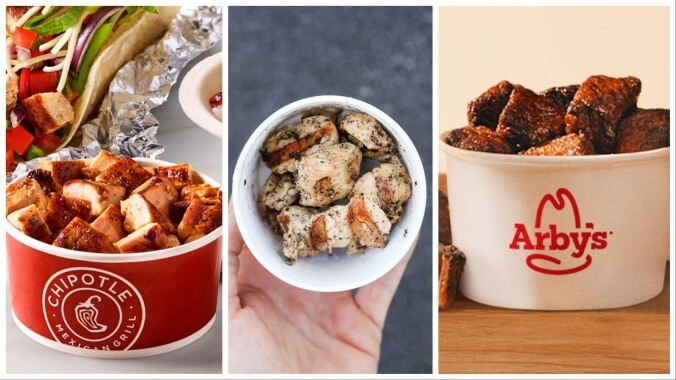
If there’s one thing the fast food industry, as a whole, loves more than anything, it’s selling you the exact same product they’ve already offered for decades, but with a new marketing spin. In the last few years, our ever-expanding national obsession with protein consumption has afforded them just that opportunity.
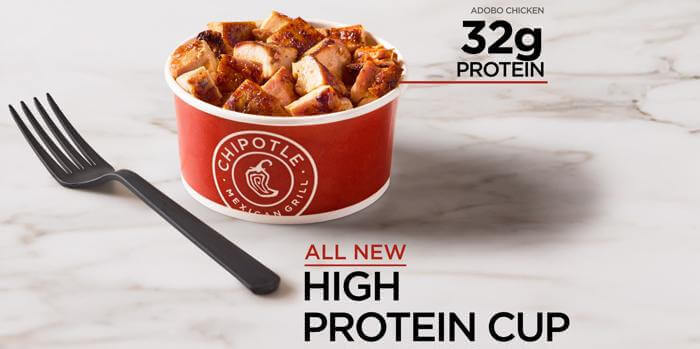
A single-minded protein obsession once associated with the likes of bodybuilders, gym rats, and supplement-pounding members of the manosphere has given way to a culture in which the average person increasingly believes they need more protein in their diet. That belief recently ascended to a newly enshrined level within the federal government itself, given RFK Jr.’s wildly contradictory new dietary guidelines and “inverted” food pyramid. And that’s how we end up with fast food giants launching entire “protein menus,” like Chipotle touting new menu items like…cups full of plain meat scooped from the steam trays?
Oh, wait, sorry, I meant Chipotle Snack-Ready High Protein Cups, which in no way look like something one might serve to a picky child or a person in a federal penitentiary.
But Chipotle is not the only company lusting after a protein-chasing demographic. Brands like Sweetgreen have launched bowls packed with an absurd amount of protein, including one boasting 106g of protein (and an eye-popping 1,120 calories) that costs a perfectly reasonable $21. Subway also has an entire Protein Bowl menu. Even Arby’s, famed purveyors of middling roast beef sandwiches, found a more direct route to protein delivery with cups of “Steak Nuggets.”
One might be tempted to correlate the ethos of this new generation of offerings with the “bowl” movement that was first born from KFC’s legendary Famous Bowl in the mid-2000s, but that level of carbs and additional elements—mashed potatoes, gravy, breaded chicken, etc.—would be anathema to the current wave of protein fetishization, which has reduced the concept down to its most primal and stupid form. It’s not enough now to just eat a large bowl from a fast food restaurant that contains meat; the avant-garde is bowls of just meat and nothing else. Arby’s even sprang for a Keegan-Michael Key voiceover to talk up their simultaneously smoked and grilled morsels of beef.
You’ll often notice the word “snack” being thrown around in the marketing for these types of products, which acknowledges that they’re something less than what we tend to think of as a traditional, complete meal. They’re amusingly positioned by marketers as some sort of “on the go” option akin to protein bars or shakes, as if you’re going to be driving down the road, in a board meeting, or sitting at the bus stop, digging into a cup of adobo chicken or “tender nuggets of steak.” Does it seem like a reasonable “snack” to you? Do you know people who are going to be stopping in at Chipotle, somewhere between lunch and dinner, just to grab a quick cup of steak?
Talk to an actual nutritionist, meanwhile, and they’ll likely tell you there’s scant scientific evidence to suggest that human beings need anywhere close to the amount of protein that many are now attempting to work into their diets. Overall recommendations have consistently hovered between 50-70 grams per day, depending on weight. And frankly, this isn’t hard to get through a very average, very normal American diet. Did you have some meat with lunch or dinner? Or some eggs, beans, or yogurt? Great, you’ve probably gotten all of the protein you theoretically need in a day. Half a pound of chicken breast contains 70 grams of protein, all on its own, and only 374 calories! It is much, much harder to get, say, enough fiber in one’s diet, rather than protein, but fiber isn’t a component of viral TikTok meal-planning videos.
The levels of consumption that Americans are aspiring to may even have health dangers of their own, with some researchers drawing links between excessive/imbalanced protein consumption and conditions such as metabolic syndrome and heart disease—and that’s in addition to more traditional protein powders potentially containing dangerous levels of lead.
This makes the current protein craze in the U.S. seem more ridiculous, particularly when you look to the grocery store aisles and see newly launched, protein-infused variants of everything from breakfast cereal, to ice cream, to frozen waffles, to Pop-Tarts, soda, and even freaking PROTEIN CANDY, advertised as “candy that works as hard as you do,” all trying to profit off this increasingly wide demographic. It’s also never been made into a health villain in the same way as fat, carbohydrates, or sugars—allowing the likes of Chipotle to label meals with other buzzwords evoking the cutting edge of health and weight loss, such as calling their meat cups “GLP-1 friendly,” whatever that’s supposed to mean.
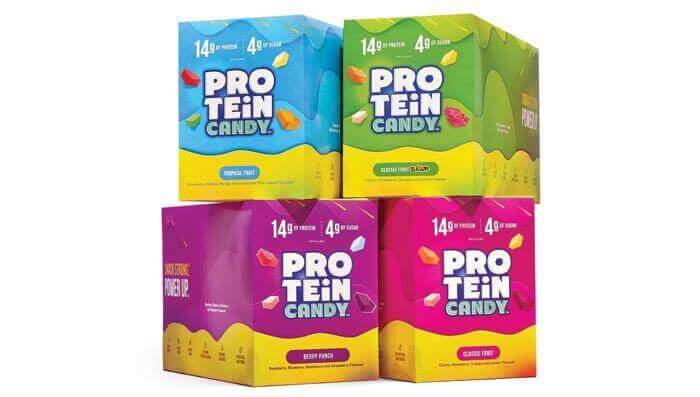
No really, protein candy.
You might even call this a golden age of brand-redefining PR for big, gluttonous fast food meals like the McDonald’s Double Quarter Pounder with Cheese, given that they’ve got clickbaiting publications targeting fitness-conscious consumers (thanks, Men’s Journal!) writing in glowing terms about how one burger can offer “an impressive 48 grams of protein in a 740-calorie meal,” as if you’re not about to eat another 400 calories in fries as well. They’re all united in the fallacy of acting as if protein is all that matters, likely no different from the ’90s-era obsession with eschewing fat as the key to good health. This style of cynical nutritional pseudoscience is thriving across social media, powering YouTube clickbait videos from creators with massive followings, and titles like “Eating The Highest Protein Item At EVERY Fast Food Chain,” although I do appreciate that it gave me such inspiring evaluatory language as “the burger is a lot more burger-y,” as the host compared two McDonald’s sandwiches. Enlightening stuff!
For Chipotle, the newly launched “High Protein Menu” is the latest in a series of marketing gimmicks in a year that has seen their stock price decline by roughly 30%, effectively trying to tempt the American consumer into ordering the same things that were already available to them. The “Double High Protein Bowl,” for instance, is a burrito bowl with “double Adobo Chicken, white rice, black beans, fajita veggies, tomato salsa, Monterey Jack cheese, and extra romaine lettuce,” which is another way of saying “the same bowl that you ordered last year, if you said ‘extra chicken.'” The new High Protein Cup? Well, I hate to break it to you, but there was never anything stopping you from ordering an extra cup of meat at Chipotle, other than the pitying looks that the employees would probably give you.
Far be it from me to simply rant about all this without trying it myself, though! With that thought in mind, I rolled into my local Chipotle Mexican Grill the other day, to find that…no one working there had any idea of what the “High Protein Menu” was. That’s right! Despite this being a new nationwide initiative, and despite the Chipotle online ordering system offering the protein menu items at this exact location, no one had apparently thought to actually tell the staff about any of it, or put up any in-store signage or advertising about it, etc. But as if the universe had wanted to prove my point, I still got my cup of chicken, because that was always something you could do, and they simply rang it up as an extra 4 oz portion of meat. It just might have seemed somehow “weird” to order a cup full of meat in days of yore, but now that RFK Jr. has signed off on the idea, I can suddenly see the allure! BEHOLD, my meat vessel.
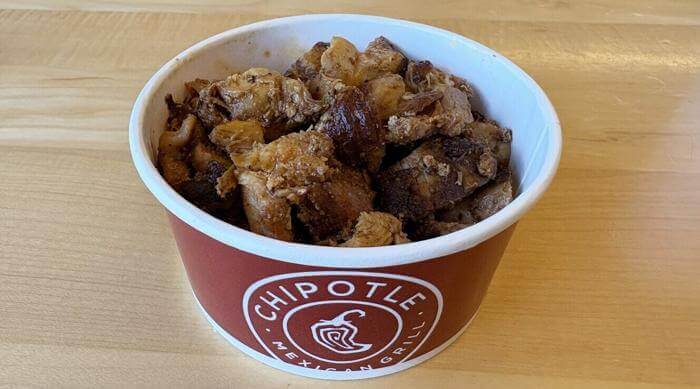
But here’s the thing, eating a cup full of plain adobo chicken from a Chipotle on a weekday afternoon doesn’t exactly paint the product in the best light. When you order a burrito or tacos from Chipotle, you’re treated to a variety of different textures and flavors that are designed to complement each other. A single taco may have elements that are crunchy/crispy, meaty, spicy, creamy, salty, tangy, etc., considering all of the cheeses, sauces, veggies, and more that may be involved. A cup of meat? It has none of that. It mostly draws the consumer’s attention to all of the places where your average Chipotle probably wouldn’t want your attention to be drawn. You might find yourself thinking “Hey, this chicken has a distinctly spongy texture, and isn’t particularly warm.” You might become quickly bored with the mild spice and chile flavor, or the lack of seasoning. Your thoughts might instead turn to wondering how exactly the chicken is prepared, that it has retained what seem to be tiny, hard bits of bone or tendon fragments. From where does said poultry hail? Is this all white or dark meat chicken? How is it all chopped up into irregular but generally same-sized knobs? None of this is an internal monologue that is preferable for corporate Chipotle, but what the fuck else are you conceivably going to be thinking about while you down a cup of meat like a caveman who ventured into a fast casual restaurant?
Not satisfied with only one example of meat-in-a-cup madness, I left Chipotle and headed directly to a nearby Arby’s, my innate sense of journalistic fairness demanding that I obtain some Steak Nuggets and compare them while the blandness of my Chipotle chicken cup was still fresh in mind. I arrived to find shock and disappointment waiting for me: Despite the Steak Nuggets having been all over the internet and broadcast TV advertising in October, it seems that they’ve already been retired. What is a quivering mass of potential muscle like myself to do? From where will I get my macros now?
Before leaving, I asked the man behind the counter if the Steak Nuggets were such a hasty retreat because they were unpopular with his diners. He said the following: “Well, we were one of the last stores to have those things, because nobody bought ’em.”
It seems that even the allure of protein, in a delivery vessel as pure and elemental as “meat in a cup,” may have its limits. If you’re curious enough to check out a High Protein Cup at your own Chipotle, remember that it doesn’t matter if the workers there know that the protein menu exists: You can just demand a cup of meat from them as a totally normal person would.
 Keep scrolling for more great stories.