

It’s Only a $13 Billion Aircraft Carrier, Why Would We Expect the Toilets to Work?
Call us crazy, but "a single loose valve can cause all toilets to fail" seems like a pretty significant design bug.
Photo via Unsplash, Vidar Nordli-Mathisen Splinter military
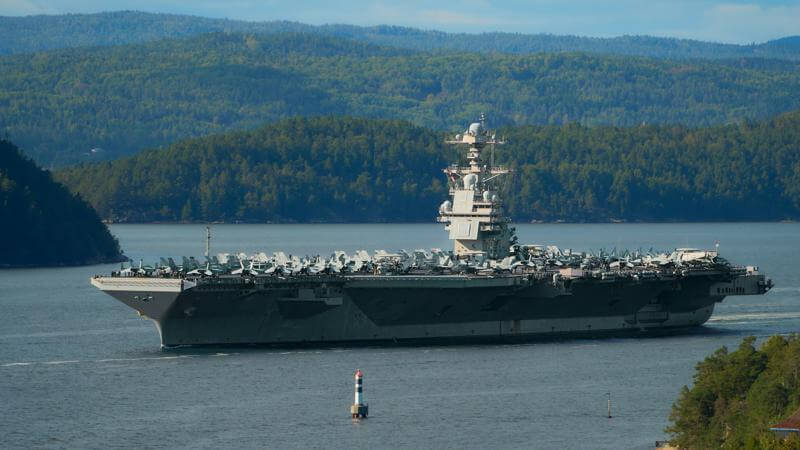
How many working toilets would you think that $13 billion should reasonably be able to buy? Quite a few, I imagine most of us would answer–except, of course, if those toilets happen to be on a floating city of an aircraft carrier that is also transporting 90 or more functional warplanes and 4,500 sailors, most of whom are the age (and presumably the temperament) of a college freshman. In that case, it turns out it doesn’t matter if you spend the GDP of a small nation on the largest warship ever built; you’ll still be lucky if any given toilet actually manages to flush. The 600 toilets aboard the USS Gerald Ford, the “most advanced” and most recent aircraft carrier in the U.S. fleet, have represented a near incalculable headache for the Navy during its just finished, nearly unprecedented 11-month deployment, and their constant breakdowns have already become the stuff of military legend. The ship has now finally returned to port in its original shipyard of Norfolk, Virginia, to undergo complete rehabbing and upgrading of its cantankerous septic system, and to answer the enduring question: How many more billions of dollars will it take to get these toilets flushing?
From the moment that the USS Gerald Ford set sail in 2023, it was seemingly apparent to engineers that something was wrong in its plumbing innards. In fact, there was reason to suspect that toilets were going to be a persistent problem before the damn thing was even finished being built, as a report from the U.S. Government Accountability Office described its septic system as undersized and inefficient in 2020. The previous Nimitz-class supercarrier USS George H.W. Bush had been built with a similar “high tech” vacuum suction system, and it too had a reputation for disastrous breakdowns, rendering every toilet on the entire ship inoperable on several occasions. The system on the Ford likewise has the added bonus of being a new design untested at this scale in the field: The Vacuum Collection, Holding and Transfer (VCHT) system is unique to the new Ford class of aircraft carriers, with this ship being the first of its kind.
So naturally, the best thing to do was to send the ship out on an incredibly long series of missions without returning for any maintenance! What could go wrong? The floating latrine left Norfolk in June of 2025 for a deployment that would be continuously hijacked by President Donald Trump’s latest international imbroglios, first sending it to Europe, then to Venezuela to participate in the capture of ousted President Nicolás Maduro, and then to the Middle East to participate in Operation Epic Fury attacks upon Iran. While there, it suffered a devastating laundry fire on March 12, 2026 that burned for 30 hours and injured more than 200 sailors, and eventually limped to Crete in disgrace to undergo emergency repairs. Now, it returns to Virginia for more in-depth repairs related to the laundry room fire, and to address the persistent bugaboo that generated headlines during its entire deployment: The fact that hundreds of its toilets were routinely inoperable at any given time.
Exclusive video obtained by CNN shows extensive damage on the USS Gerald Ford, after the ship’s fire control system failed, sources say. One sailor told CNN that it was “either fight or die” during the battle to stop the fire.
www.cnn.com/2026/06/04/p…
— Shipwreck (@shipwreck75.bsky.social) 6:15 PM · Jun 4, 2026
And when I say “inoperable,” I mean “incredibly easy to fuck up.” Really, it’s difficult to overstate just how fragile the toilet system aboard the USS Gerald Ford has ultimately proven to be, as detailed in a few pieces in NPR that published emails and communications from the ship itself, sourced via the Freedom of Information Act.
“Our sewage system is being mistreated and destroyed by Sailors on a daily basis,” complained one hull maintenance technician (HTs), the class of engineering department worker tasked with responding to an endless series of trouble calls. “My HT’s are currently working 19 hours a day right now trying to keep up with the demand.”
According to NPR, the single most common problem is “a valve at the back of the toilets that can be knocked loose, and cause all of the toilets in one of 10 zones to lose suction.” Yes, you’re reading that right–if a sailor happens to sit on the toilet wrong, or bumps into it, it can result in dozens or hundreds of other toilets throughout the ship immediately becoming inoperable. This is essentially plumbing as interpreted by Clark Griswold’s Christmas lights–one bad bulb, or one bad toilet valve, and they all go down. And they’re always going down–a document reviewed by NPR stated that every single day at sea since 2023 with a full crew has resulted in a trouble call to repair or unclog at least one portion of the VCHT system. The hull maintenance techs essentially live in ceaseless toilet repair mode. At one point in March, 2025, the engineering department noted to its chiefs in an email that there had been 205 breakdowns over the course of FOUR DAYS. Has anyone actually successfully relieved themselves on this ship, or do they all just get used to holding it?
Many of the problems, as you might expect, end up being the sort of foolishness you would expect from a crew of thousands who might otherwise be shotgunning beers in a dorm, if they weren’t here. Technicians report finding all manner of wrongfully flushed objects blocking the especially narrow vacuum pipes, including T-shirts and “a 4-foot piece of rope,” according to an August 2025 complaint.
The sailors on the USS Gerald Ford who keep stuffing their t-shirts into the toilets so the bathrooms flood and the carrier can’t deploy to Iran should be awarded a collective Nobel Peace Prize
— Asher Wolf (@asherwolf.bsky.social) 6:35 AM · Feb 27, 2026
The Navy’s response, meanwhile, has essentially been to say that shit happens–just not as efficiently as they would like for shit to happen. Upon the ship’s arrival back in Virginia, Chief of Naval Operations Adm. Daryl Caudle claimed it had been operating within “expected parameters,” and that “the sanitation systems on board any ship, submarine, destroyer, cruiser, carrier, all have challenges. It’s not whether or not that happens, it is when it does. How do we attack it, fix it, get it back online? And the team on Ford is very good at that.”
Still, it would surely be a more desired system if less daily poop triage was a necessity, would it not? After spending $13 billion to build the USS Gerald Ford, and billions more in R&D and development of it, is it not reasonable to hope that a top-of-the-line, brand new design meant to show off American engineering brilliance might gleam with space-aged efficiency in the most basic of logistical areas like waste management? Even Donald Trump himself has reportedly been consistently underwhelmed with the vessel, publicly questioning the ship’s actual military effectiveness and its next-generation (but apparently buggy) jet-launching technology. I doubt he was forced to use one of the bathrooms. But if even Donald Trump isn’t interested in polishing your turd and proclaiming its greatness, one would think it must be pretty egregiously ugly.
Now that it’s back in the shipyard, the USS Gerald Ford will reportedly be subject to the same types of jury-rigged “upgrades” to its septic system that were once employed upon the USS Bush. Amusingly, the solution will apparently not be a permanent fix for the root problem, but rather a patch that makes the aircraft carrier plumbing system even more fiendishly complex by further subdividing it up into more zones … meaning that when any given toilet inevitably breaks, it simply drags fewer additional toilets down with it in a plumbing suicide pact. Or as shipyard supervisor Rear Adm. Kavon Hakimzadeh put it: “The new system subdivides it significantly further, so that a problem in one bathroom doesn’t cut off a quarter of the ship.”
Does that make sense? Absolutely. Although you know what might have been even better? Designing a toilet system where one loose valve on one toilet doesn’t instantly “cut off a quarter of the ship.” Somehow, our government can spend $13 billion on one of those ships, and still be left without a pot to piss in.
 Keep scrolling for more great stories.