

The Grand Irony of ABS Coming to MLB Is That the Umpires No Longer Suck
It took 150 years of pro baseball for umpires to get good at calling balls and strikes. Then we introduced the robo umps.
Photo via Unplash, Mark Duffel, Major League Baseball SplinterSports baseball
Historically, there have likely been few jobs in the sports world more stress inducing and challenging than that of a home plate umpire in Major League Baseball. Here is a man—and hopefully with increasing frequency, a woman—who is tasked with observing a 100 mph fastball (.375 seconds to reach home plate) or sweeper with two feet of horizontal break, in order to determine if that pitch ticked the corner of an invisible box and is thus designated a strike. This person has a split second to make their decision, and then gets to hear a real-time referendum from the home field crowd about whether they got it right, complete with raucous cursing from incensed sports gamblers. And oh, they only arrive at this position after putting in a decade of toil umpiring in the minor leagues, for miniscule pay, all for a chance to one day earn about a quarter of the minimum salary of an actual major league player. Only a true lover of the game would endure the long journey and the abuse the job entails. And now, like the rest of us, they’re being replaced by robots.
Well, not entirely. Just as AI can write a news article, but it wouldn’t necessarily be one you want to read, robots can absolutely make calls on a baseball field, but where’s the fun in that? Few sports romanticize their own traditions and aesthetics as much as baseball does, but the push-pull between doing things the traditional way and, well, getting the calls right has steadily led to the infiltration of technology into the game, in order to correct calls when umpires inevitably blow them. Fans seem to prefer to keep umpires, but they simultaneously want checks on them. Following the success of instant replay for potentially blown out-safe calls in the last decade, the question of balls and strikes has long been the final frontier, the sacred purview of umpires and umpires alone. That is, until 2026 with the introduction of the Automated Ball-Strike system, or ABS. A clear compromise between the futurists and the traditionalists, ABS is being introduced to MLB this year through a challenge system, where each team will be able to challenge ball or strike calls when they feel a call has been missed. It will no doubt have immediate, dramatic effects on such calls as game-ending strikeouts.
But here’s the thing. The creation of ABS was in response to not just decades but centuries of frequently blown calls from Major League umpires, a human element of the game that was always simply accepted as a facet of baseball. In the last two decades, however, advances in everything from umpire training, to social media, to the retirement of some particularly problematic ball-strike callers, has led to a veritable renaissance in the rate at which umpires accurately call balls and strikes. The ABS system is here, and it’s likely here to stay, but it ironically arrives at the moment when after 150+ years of toiling away at it, umpires finally no longer suck at calling balls and strikes. Just look at this dramatic evolution that has occurred over the last 19 years, posted in a recent reddit thread by user u/avondice, for an idea of how much things have changed in a relatively short span.
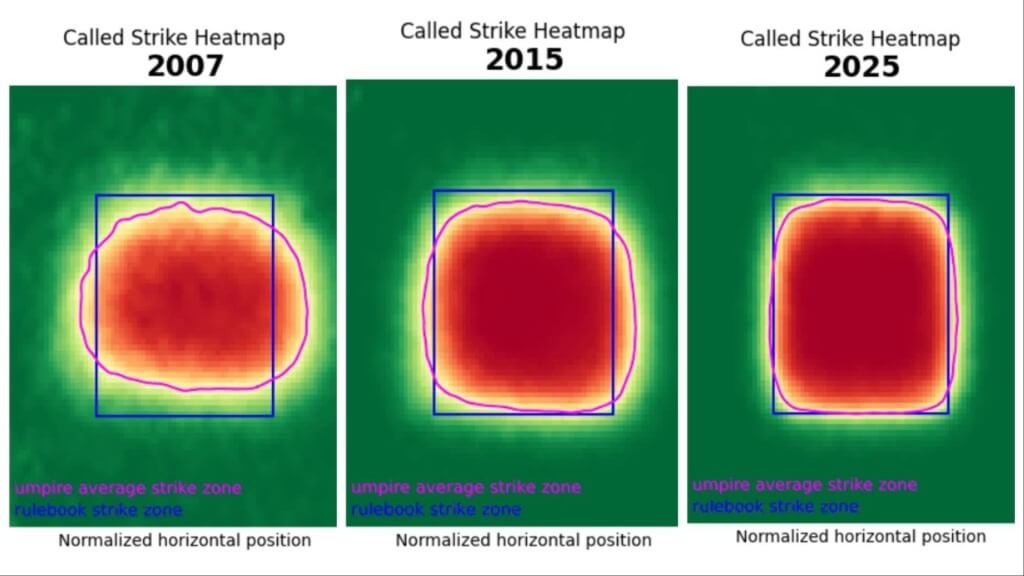
Look at the wild west we were living in, back in 2007! The MLB strike zone of the era, as dictated by a generation of scraggly old umpires, was an amorphous blob in which high strikes and low strikes that were technically in MLB’s stated strike zone simply didn’t exist in practice, because they weren’t being called. At the same time, those mid-2000s umpires were frequently calling problematic inside strikes on right-handed batters, or unhittable sliders tumbling away from left-handers. Professional baseball leagues had existed since 1871, and THIS was the best we could do after all that time.
But look what the called strike zone has become, 19 years later. Umpires got much, much better at calling the low and high strikes they had been ignoring, while steadily reining in the tendency to call inside and outside strikes. As a result, the heat map goes from being a vaguely circular blob, to approximating the exact rectangle of the reference strike zone.
How did this happen? It’s likely to be a number of factors simultaneously, starting with the fact that umpire training and performance evaluations have changed, employing technology to measure and greatly reduce the margin of error on pitches outside the zone that is considered acceptable. Umpires responded by being less generous on their strike calls on the edges of the zone, until a new cemented zone steadily became established. Social media likely played a role here as well, as fan outrage over blown calls is much louder now than it was in days past, given that a single missed strike call can be splashed all over Twitter within moments of it happening, or cut into clip reels of umpires’ worst moments on YouTube, rather than forgotten. This no doubt incentivized umpires to train harder at mastering the strike zone, or contributed to the retirements of particularly notorious ball-strike callers like the oft-referenced Angel Hernandez. It was effectively a culling of the umpire herd, although Angel went out with a bang: Watch this at-bat from April 2024 where he utterly victimizes hyped prospect Wyatt Langford with three blown calls in a row, each worse than the last, including a final “strike” nearly 7 inches outside the zone. Hernandez would retire mid-season, less than two months later, clearly seeing the writing on the wall. The new MLB was not going to tolerate these kinds of outrageous calls.
That leaves, ironically, an umpiring core that is now far better and more skilled than it’s ever been, about to be under yet another layer of rigorous overview in the form of ABS challenges in each game. Their job has arguably only gotten harder, with the types of misses that would have been totally acceptable and unremarked on a decade ago now subject to immediate challenges from the pitchers or hitters they’re working with. These umpires have to be on the ball, all the time, in a way that probably feels like they’re performing the baseball equivalent of an air traffic controller’s duties.
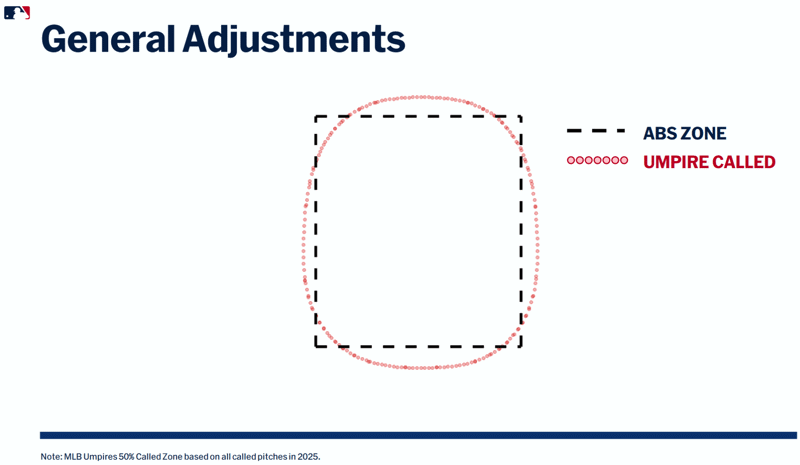
It also means, by the way, that the official “strike zone” is being freshly codified all over again for the 2026 season. Some things are the same for every batter, such as the official width of the strike zone, which is 17 inches from the inner edge to the outer edge of the plate, for everyone. But the top and bottom of the zone as called by ABS in challenges/reviews is capable of being significantly different for every hitter depending on their height–something that was always theoretically part of umpire strike zones, but never truly codified. Officially, for ABS purposes, the bottom of the strike zone is at 27% of a player’s height, while the top is at 53.5%. That means for two players with dramatically different heights, such as Jose Altuve (5’6”) and Aaron Judge (6’7”), the total size of the strike zone varies dramatically. It’s just another thing that umpires will be juggling this season as they adjust to a sudden new standard they’re being judged against. Major League Baseball even produced the below graphic to compare how the shapes of human and ABS zones might differ.
To be clear, I’m not inherently against ABS, or some kind of baseball purist or truther—although there is a certain irony in the fact that MLB has spent the better part of a decade introducing as many ways as possible to speed up the course of a baseball game, only to now voluntarily give back a (hopefully small) chunk of that time to ABS challenges. Getting calls right is ultimately a good thing. I merely empathize with those increasingly skilled umpires who are attempting to thread a needle here, and am grimacing in advance at how embarrassing it will end up being for some of those umpires when they have a genuinely bad night of calls. Because teams retain their challenge when they’re successful, this could result in very large numbers of challenges if an umpire is having a rough night—already in spring training this year we’ve seen an incident where an ump had no fewer than five calls overturned in just the first three innings of a game. The crowd was not particularly empathetic. With 162 games in the marathon of the MLB season, there’s going to be a game or two there eventually where a home plate umpire ends up questioning why they even wake up in the morning. It’s just a matter of statistics.
To be certain, the advent of ABS will also provide some really fascinating moments as the league develops strategies around it, or players react in novel or amusing ways. Already this spring, we’ve seen a batter so confident that his ball four challenge would be successful that he immediately walked to first base to take his walk after making it, rather than waiting for the result. We’ve also seen the ABS system fail on the field, resulting in an umpire and players standing impatiently in place for 60 seconds before simply deciding to resume play. Naturally, the pitcher then immediately gave up a two run double … because he had his rhythm broken by an equally broken ABS system? Who can say?
Ultimately, everyone will adjust. Hitters, catchers and pitchers will learn when and where they’re most likely to be successful when challenging, and the rate of successful challenges may rise. There will likely be fewer home plate screaming matches between managers, players and umpires about balls and strikes, another proud MLB tradition largely gone by the wayside. And the proud umpires, one step closer to obsolescence, will continue their noble work. Maybe they’ll ultimately survive the robot apocalypse, or maybe they’ll join us in the rubble. If we all end up in a Field of Dreams-style baseball heaven together, perhaps we can simply agree to allow for a little human error.
 Keep scrolling for more great stories.