

Kentucky Police Ignore State Law to Arrest Woman for Allegedly Self-Managing Abortion
After the woman told a healthcare clinic she took abortion pills to end an unwanted pregnancy, authorities charged her under a law that explicitly exempts pregnant people.
Photo: Getty Images AbortionPolitics
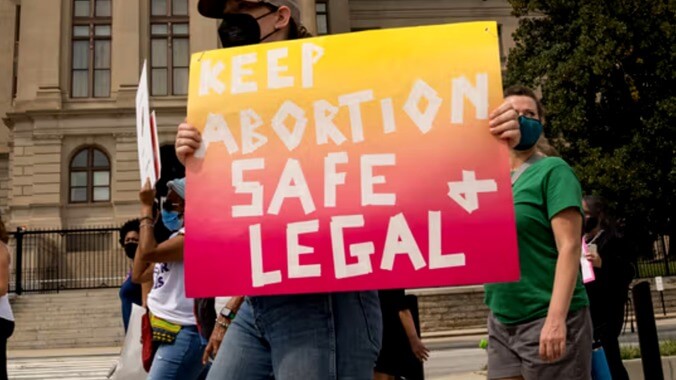
In a horrific story out of Kentucky, a 35-year-old woman was arrested and slammed with three bogus charges after she self-managed an abortion. Not only does the case underscore the growing influence of the fetal personhood movement, but it exposes how willing and eager authorities are to simply ignore or misinterpret their state’s laws.
The woman, whom Jezebel is choosing not to name, reportedly went to a healthcare clinic last week, where she told staff she’d recently taken abortion pills she’d ordered through the mail to end an unwanted pregnancy, and buried the fetal remains in her backyard. According to the Kentucky State Police (KSP), someone at the clinic tipped off authorities, and the woman was arrested on Dec. 31 and charged with fetal homicide in the first degree, abuse of a corpse, and tampering with physical evidence. But Kentucky’s fetal homicide law states that it does not apply to pregnant people.
“While the facts provided by the police are vague and unclear, if we accept their account for this moment as true, what has happened to [the woman] is a travesty,” Karen Thompson, a legal director at Pregnancy Justice, told Jezebel. “We have a woman arrested and thrown in jail for doing what is perfectly legal for her to do in Kentucky, which is to self-manage her own abortion. The law with regard to the fetal homicide law that [she] was charged under could not be any clearer.”
That law is 507A.020, which the state passed in 2004 and which considers “fetal homicide” a capital offense—but it explicitly exempts any pregnant woman who causes “the death of her unborn child.” It’s also important to note that there are no legal standards or universal guidelines for how to dispose of fetal remains after an abortion, miscarriage, or pregnancy loss.
Since the Supreme Court overturned Roe v. Wade, telehealth abortions have been on the rise, allowing people in abortion-banned states to safely access abortion care. According to #WeCount, in the first half of 2025, telehealth abortions accounted for 27% of abortions across the U.S. That same report also found that shield laws allowed for nearly 15,000 abortions per month. The Bluegrass State’s near-total abortion ban doesn’t include any exception for rape or incest, with only a vague exception to save the life of the mother. But Kentucky does not ban people from accessing telehealth abortions.
According to legal experts, laws to incriminate the “murder” of a fetus, however, have the chilling effect of establishing fetal personhood—the idea that embryos and fetuses constitute separate lives to the pregnant person carrying them. “This is not normal,” explains Thompson. “The idea that she has ‘desecrated’ a corpse is a slippery slope towards criminalizing any woman who loses a pregnancy—the mere fact of a loss is now enough to make a woman’s body a crime scene.”
Pregnancy Justice—which counts pregnancy-related prosecutions—has tracked a growing number of people who’ve faced pregnancy-related criminal charges since the death of Roe. Between June 2022 and October, more than 400 people faced criminal charges for any offense associated with “pregnancy loss, or birth”—in 16 of those cases, the pregnant person was charged with homicide.
“This is a very tangible outcome of what happens when we give embryos and fetuses personhood rights,” Dana Sussman, the organization’s senior vice president, told Jezebel in October. “Not only does it create a situation where women are not able to get [emergency care] before they bleed out and lose their uterus or potentially lose their life, not only does it mean that they can’t get abortion fundamentally, because fetal personhood and abortion rights do not—cannot—coexist.”
In March, a woman in Georgia was wrongly jailed and nearly charged for having a miscarriage and placing the fetal remains in a dumpster. Police eventually dropped the charges in April amid massive public pressure. In 2019, a woman in Virginia was convicted of “concealing a dead body” and briefly jailed after she disposed of the remains of her stillbirth. In January 2025, Brittany Watts filed a lawsuit against the Ohio hospital and healthcare workers who mistreated her before reporting her to the police for a miscarriage in 2023.
“As our research shows, women are being thrown in jail for pregnancy losses, even when those loses are unintentional,” Thompson said. “In a moment where health care premiums are soaring for most people in the U.S. and the ability to take care of the children we have is becoming increasingly economically threatened, arresting people is a misguided response to what is a healthcare question and is a clear threat to women’s liberty in Kentucky and across the United States.”
Like what you just read? You’ve got great taste. Subscribe to Jezebel, and for $5 a month or $50 a year, you’ll get access to a bunch of subscriber benefits, including getting to read the next article (and all the ones after that) ad-free. Plus, you’ll be supporting independent journalism—which, can you even imagine not supporting independent journalism in times like these? Yikes.
 Keep scrolling for more great stories.