

Are Non-Alcoholic Beer, Wine, or Spirits the Least Depressing Dry January Choice?
We are now surrounded by non-alcoholic options, but what actually scratches the itch?
Photo: iStockphoto Drinks alcohol

I love pretty much everything about alcohol: The flavors, the conviviality, the global subcultures it fosters, and its power to blast the synapses of the human nervous system in such a way that it makes us feel warm and full of cheer even in a time when the world is melting down around us. That said, there are a few things about alcohol I don’t particularly celebrate with a similar ardor. Hangovers, for one. A constellation of negative health associations, for two. Are any of those things going to stop me from choosing to consume ethanol? Probably not. Still, I’ve just launched myself into Dry January for the second time, following a successful first voyage in 2025.
Last year, I found I rather liked Dry January, the unexpected legacy of a British woman who first gave up drinking for a month in January of 2011 as part of her training for a half-marathon. She couldn’t have known at the time that her own little personal challenge would grow into a massively popular tiptoe into modern teetotaling, one that potentially up to a quarter of all Americans now engage with, although self-reported participation here probably deserves to be taken with a margarita’s worth of salt. But I don’t find Dry January onerous—if anything, it’s nice to deprive yourself of a certain pleasure for a while, give your liver a break, and reevaluate your relationship with liquor, making you perhaps more appreciative of the (perhaps less frequent) joys of tippling once February rolls around. And, it must be said: The quality of modern booze replacements makes the task so much more interesting than it would have been only 10 (or even five!) years ago.
But ah, which booze replacements are the way to go? In terms of most fully capturing or mirroring the experience of drinking at your favorite bar, or on the couch at home, which proves most satisfying? We’ve previously recommended some specific non-alcoholic brands, so allow me to fill you in on just how far categories like non-alcoholic beer, wine, spirits, and cocktails have come in recent years—and which of them still have a long way to go.
[ad]
Non-Alcoholic Beer
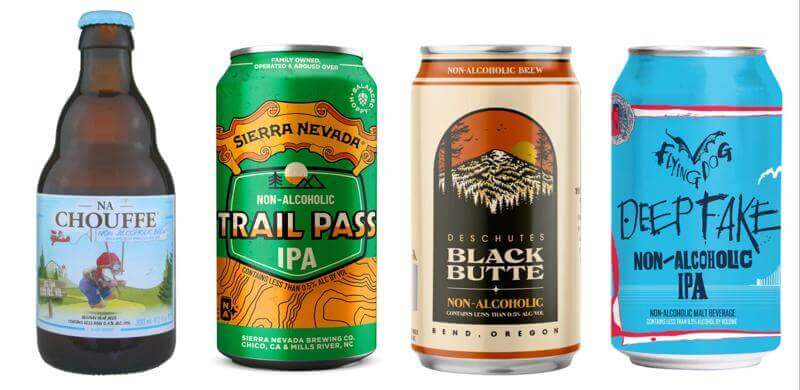
NA beer is the most mature of the booze-replacement categories, not in terms of its clientele but in terms of the evolution of its product. This makes perfect sense, given that NA beer has been around forever—it’s just had decades to innovate and grow, not that it did this for much of its early existence, mind you. Non-alcoholic beer was the butt of constant jokes through the 1980s-2000s, depicted as something only for alcoholics and problem drinkers. But as the craft beer wave crested in the 2010s, it brought a slow improvement in NA beer, helping the category to finally begin to resemble the historic beer styles that had inspired it. In the 2020s, the floodgates truly opened, and a huge new variety of NA beer brands and styles hit the market, helping to wash away the old NA beer stigma.
Which is to say, non-alcoholic beer has gotten way, way better! Even some of the market-leading brands, like The Athletic, have notably improved their flagship products over time in order to keep up with the rapid pace of improvement, rather than just resting on their laurels. And when I say “improvement,” I mean that more than ever, these beers taste genuinely very similar to the styles they’re mimicking. Where a decade ago, it would have been almost impossible to find any non-alcoholic beer that wasn’t a vaguely watery, malty sweet lager, you can now find juicy or piney-bitter IPAs, delicately noble hopped pilsners, roasty stouts, crisp lager, and even non-alcoholic fruited sour ales or Belgian ales. It’s a godsend to those of us who love classic beer styles, but don’t always want the alcohol. You can even increasingly find more 0.0% ABV offerings, for those who can’t have even a tiny amount of residual alcohol.
Some drinkers may be miffed by the thought of paying near normal price for a non-alcoholic beer (this will become a recurring theme), but NA beer is still among the more affordable Dry January options compared with the costs of NA wine or especially NA spirits alternatives. It’s also become widely available at restaurants and bars, making it perhaps the easiest option to find away from home. All in all, it’s something I’ve been happy to work into my rotation all year round: There’s a shelf in my fridge dedicated to non-alcoholic beer, something I never would have thought I’d be saying a decade ago. As for specific options, try the balanced, resinous hop profile of Sierra Nevada Trail Pass IPA, the nutty-cocoa flavors of Deschutes NA Black Butte Porter, or the crisp, bare bones simplicity of Heineken 0.0, which might actually be more satisfying than the all-too-often skunked original Heineken.
[ad]
Non-Alcoholic Wine
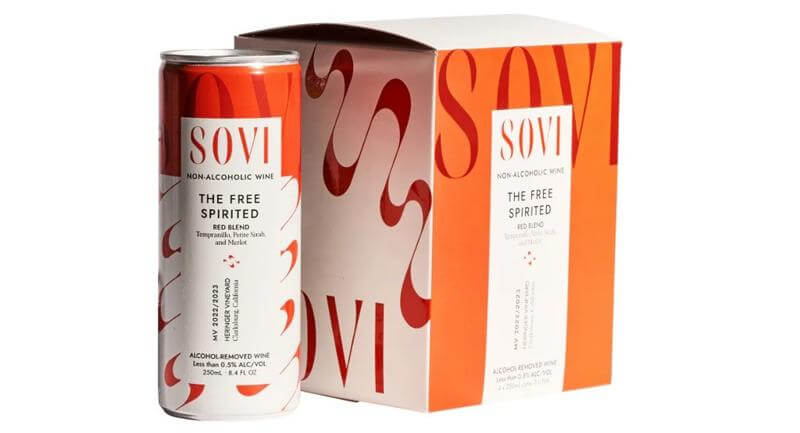
Of the major non-alcoholic categories, NA wine is the one I often have the most difficult time rationalizing as a purchase. There are horrendous (often inexpensive) NA wine brands out there, which vary from “this is just sparkling grape juice in a nicer bottle,” to “this tastes like grape jelly and smoked oak chips.” At the same time, there are other NA wine brands that genuinely get pretty close to the real experience … but all too often, a 750 ml bottle of those better brands is going to run you $20, $30 or $40, which feels like a lot to ask of the consumer, especially if that person is only giving up alcohol temporarily. Even in comparison to NA spirits bottles that may cost $40 or more, an NA wine bottle intended to be consumed in a single night (booze-free bottles generally do not keep well) struggles to feel like it provides much value in comparison with an NA amaro that you might be able to drink over the course of six months or more. It’s a tough economic proposition, especially when comparing to how excellent a bottle of standard wine you could buy for the same $30 or $40.
White wine styles are arguably slightly easier for brands to accurately channel, whether or not they’re sparkling. I find many NA wines retain a distinct grape-y-ness that can be less off-putting when it’s a white wine grape. Red wine, meanwhile, can be a challenge, both in conveying an appealing fruit flavor and in the decision of how to potentially employ oak. Far too many non-alcoholic red wines I’ve tasted end up being overwhelmed by wood when dealcoholization happens, and the experience becomes akin to licking the inside of a barrel. The best ones manage to retain the flavor transformation (away from just “grapes”) that happens during fermentation, while subtly augmenting themselves with oak.
If you’re looking for value, give something like Fre Non-Alcoholic Wines a shot, but you may find yourself underwhelmed. The best bet for a quality experience here is accepting that it’s going to cost you: On the higher end, Sovi makes some surprisingly high-quality expressions that avoid most of the uncanniness of the category. Still, with that said, Sparkling grape juice is very cheap and perfectly pleasant. Just saying.
And please don’t ask me about the oxymoronic concepts of “non-alcoholic hard cider” or “non-alcoholic hard seltzer.” We’re trying to preserve brain cells here, not kill them.
[ad]
Non-Alcoholic Spirits
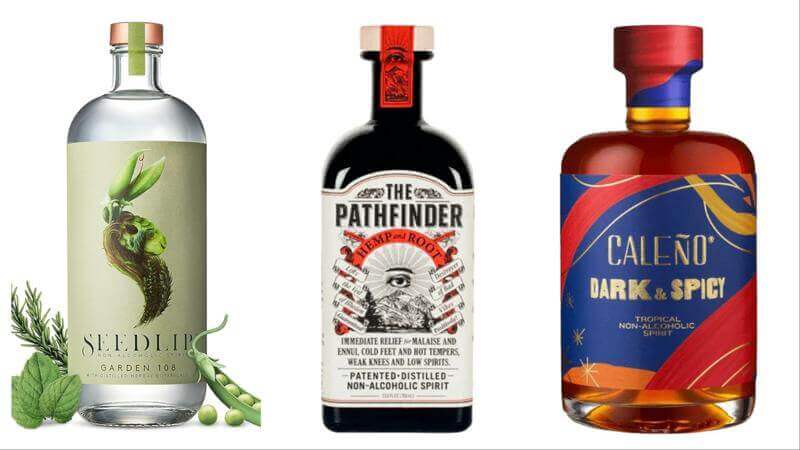
NA spirits is a wide and rather confusing category, because really: What makes something a “spirit,” other than that it contains alcohol produced through distillation? The simplest way to approach it is to say that these are essentially flavored tinctures; some intended to be consumed neat, and others to be used as components in simple mixed drinks (often with soda, tonic, seltzer, etc.) or more ambitious cocktails. You’re perhaps familiar with a brand like Seedlip, which was the first big innovator in the space. Their flagship products are relatively mild and fit basic flavor profiles like “herbal,” “citrusy,” or “spicy,” and can be used in making easygoing mixed drinks that might help to scratch a G&T-sort of itch.
The most common pitfall of NA spirits, in my opinion, is in brands that attempt to market themselves as anything akin to 1:1 replacements for specific types of traditional alcoholic spirits … especially those that are aged in oak. I have had some “non-alcoholic whiskeys” in this vein that are truly noxious; science experiments gone wrong that reek of artificial caramel, vanilla, and wood flavoring in a way that goes far beyond uncanny. Another pitfall is often present in attempts to modify the mouthfeel of these spirits (away from “watery”), which can result in unnaturally slick, oily, or tart offerings. Likewise, with NA spirits that want to replicate the “burn” of alcohol, and try to do so by employing literally spicy additions like capsaicin. Some things are better left non-emulated!
The best NA spirits, on the other hand, aren’t the product of trying to literally produce “non-alcoholic bourbon” or “non-alcoholic tequila,” but instead simply involve bringing together interesting flavor combinations that can mix well with other alcohol-free mixers. One of my favorites is the bittersweet and complex profile of The Pathfinder, a hemp-based herbal spirit that includes botanicals like ginger, saffron, sage, wormwood, and Douglas fir. It has a pronounced but not overwhelmingly resinous flavor profile and nicely dialed-in bitterness that blends beautifully with citrus, seltzer, and other fruit additions in an adaptable variety of mocktails, perfect for Dry January. Especially recommended to lovers of juniper-forward gin or amaro such as Fernet or Montenegro, and vastly superior to a product that is just trying to be an inherently disappointing mimic of a familiar spirit.
[ad]
Non-Alcoholic Cocktails
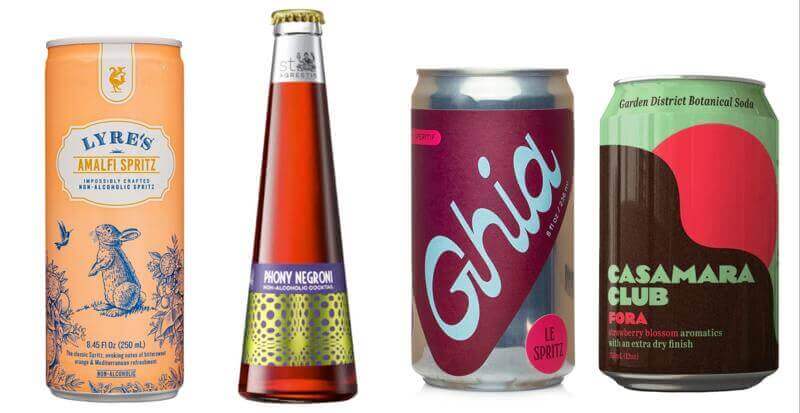
Pre-made (typically canned) NA cocktails are perhaps the most convenient and no-fuss way to experiment with the aforementioned NA spirits. These are nice because they allow the consumer to experiment with new flavors without having to shell out $40 or $50 for an unknown bottle of NA spirit, and many shops specializing in or focusing on NA spirits will have a singles rack where you’ll be able to purchase one can at a time in order to give them a try.
That said, you’ll often find that brands in the NA cocktail world have a tendency to play things pretty safe, and you’ll see many variations upon spritzes, margaritas and the like, many of which are a tad on the boring side … although I have to say, Lyre’s Amalfi Spritz is a particularly nice offering here, especially for folks who love Aperol.
One particular hero in the category? That would be the stalwart St. Agrestis Phony Negroni, which has been a category leader for years now, recognizable for both its immaculately designed, triangular bottle and the dramatic citrus and bitter flavors it brings to play. Where many of these NA cocktails can be timid and dominated by added flavors, Phony Negroni packs the honest-to-god assertiveness of actual Campari, making for a surprisingly satisfying bittersweet delight. It’s little wonder that the company has expanded into many other offshoots, such as NA versions of “mezcal negroni” or “white negroni,” although you should definitely start with the original.
All told, it’s really rather incredible to look back on how barren this niche of the market was a decade ago, at a time when few were catering to the idea of sophisticated or mature flavors for consumers who chose not to drink alcohol. Gone are the days when you’d be hard-pressed to find anything that fit the bill other than the sugar-laden Shirley Temple. Categories like NA wine and spirits in particular still have some improvement ahead of them, but for non-drinkers (or just Dry January practitioners), it’s an exciting moment of discovery.
[ad]
 Keep scrolling for more great stories.