

How the Humble Bean Plant Chemically Calls in Wasp Airstrikes on Caterpillar Attackers
The battle of survival reaches down to the cellular level, and plants are hardly helpless.
Photo via Unsplash, Yiju Cheng Splinter Nature
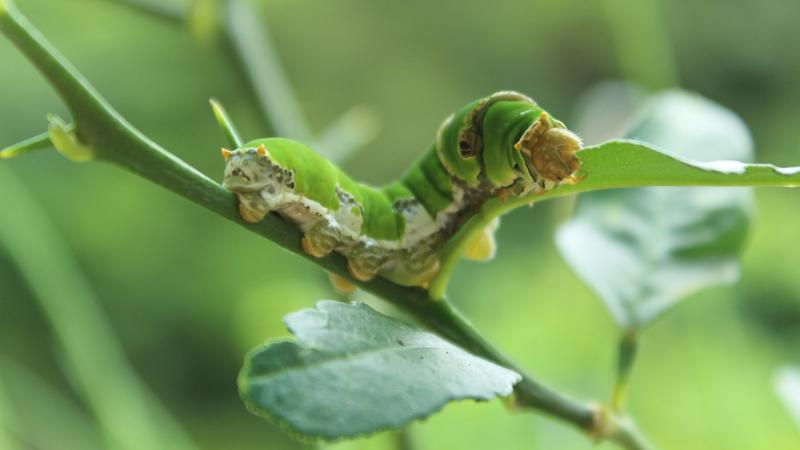
In our mental hierarchy of lifeforms, we have a tendency–as animals ourselves–to automatically assign animals, even the likes of spineless insects, into a higher order of importance and agency than unmoving, faceless plants. And yet, many plants have just as much capacity to deal with threats as your average animal, even if it’s not always as dramatically visible as a venus flytrap clamping down on some hapless bug that just became its slowly dissolved dinner. Sometimes, a plant is fighting back in a way that is more or less invisible–such as summoning help from another creature to do its dirty work for it. Got a caterpillar munching on your leaves, threatening your ability to produce energy via photosynthesis? Well, just send out a chemical SOS to nature’s perfect insect hunter-killer, the predatory wasp, like a marine calling in a surgical airstrike. Now, after years of study, researchers from the University of Washington have finally pinpointed exactly how some plants such as the common garden bean manage to do exactly that.
Granted, these are the kinds of observations that naturalists could long make with their eyes, without understanding the exact mechanism at play. When caterpillars attack the leaves of common bean plants, the plants respond by creating a chemical cocktail that pulls in wasps in the area, directly notifying the flying killers that there are caterpillars there for the taking. Gardeners and naturalists have observed the likelihood of such a defense mechanism for a long time; what we didn’t know was how the plant could first detect that its leaves were being eaten, and how it could translate that data into a response that certainly seems to indicate a certain savvy cunning for self preservation. After all, what does such a capability imply about your garden beans? That they understand, on some level, what wasps are, and what a caterpillar represents? How does this upend how we think about the very idea of consciousness, if the beans can respond so proactively to harm?
the very hungry caterpillar generated a military-industrial complex
— Evan Bernick, a finite mode with a smol hooman and a lorg floof (@evanbernick.bsky.social) 7:29 AM · Jun 3, 2026
The University of Washington researchers, working both in the Pacific Northwest and in experimental agricultural fields of Oaxaca, Mexico, ultimately had to spend years answering this question, thanks to the thorny genetics of the bean itself. What they found, first of all, was the starting gun for the whole reaction: a peptide present in the saliva of the caterpillar called inceptin, and an “11-amino acid fragment” of inceptin called In11, according to a report in Ars Technica. The common beans, as it turns out, have evolved a special receptor in the surface of their leaf cells that detects In11. When that saliva containing In11 spreads over these receptors in the leaf, it initiates a wide array of immune responses designed to ward off the caterpillar.
In order to specifically prove that this action was tied to the chemical production that calls wasps, however, the UW team needed a control, in the form of a version of the beans that didn’t have the receptor to detect In11. That control plant of the same species didn’t seemingly exist, leaving the team forced to do things the labor-intensive, old-fashioned way: They selectively bred beans for literally years in order to produce a separate mutant that was almost genetically identical, other than lacking the functioning In11 receptor. Or in other words: The truly unglamorous, nitty-gritty business of doing genuine science.
Then, it was simply a matter of taking the sibling plants into settings with both caterpillars and wasps, to watch how the reaction played out in the wild. In the experimental agricultural fields of Oaxaca, they found the expected result: The plants with the working In11 receptor called in wasps to defend them, with the flying insects disproportionately attacking and disabling the caterpillars on those plants. Side note: Does this mean we can weaponize wasps by spraying this stuff on society’s most obnoxious chuds? Has it already happened, and this is what led a swarm of bees to descend on the White House recently?
A good takeaway from this type of story, in which we do tend to invite ourselves to inflate man’s understanding of the natural world around him: These researchers may have cracked the code of how these plants summon their wasp protectors, but in the process they also realized just how many aspects of plant defense they still don’t understand. Even when tested in conditions with zero wasps present, the plants with the working In11 receptors–ie, the ones that evolved naturally–still repelled caterpillars much more efficiently than the ones the researchers selectively bred to not have the receptor. The caterpillars eating the latter grew much bigger, and decimated the bean plants much more thoroughly, suggesting that in addition to a flying hit squad of wasp terminators, there are other defense mechanisms being employed by the humble bean that we don’t understand at all. And that, of course, is how it always goes with nature: Learning one thing only reinforces how many others remain a mystery.
Here’s hoping that our beans never grow wily enough to sic a swarm of wasps on us.
 Keep scrolling for more great stories.