

Congress Is Now (Much) More Unpopular than the IRS
Could it have something to do with historic inactivity, gridlock and expulsion of corrupt House members?
Photos via Unsplash, Mike Stoll, Gallup PoliticsSplinter congress
The U.S. Congress is in shambles—marked by historic inactivity and an abdication of its most basic responsibilities granted by the Constitution, wracked by personal and professional scandals, resignations and the threat of expulsions, and generally not giving a fuck about the welfare of the American people it is meant to serve. Unsurprisingly, those American people are almost entirely united in their loathing of the legislative branch. And I mean genuinely united in at least believing, for one reason or another, that Congress sucks at its job.
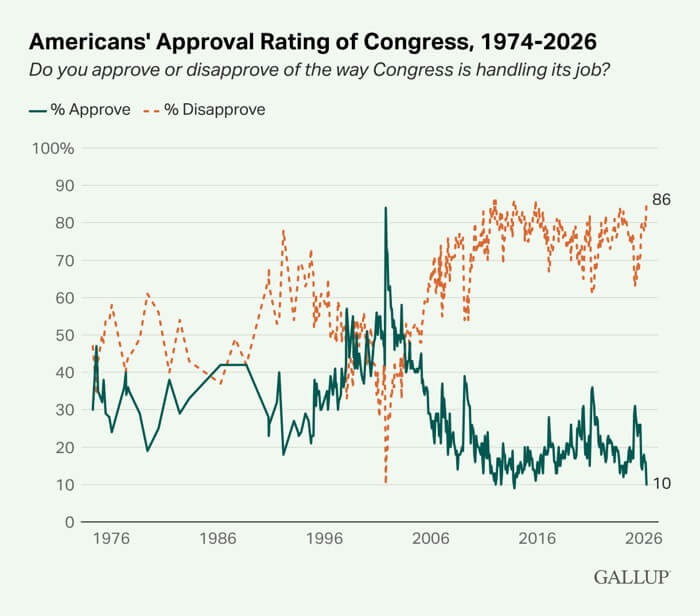
According to Gallup, which has been tracking congressional approval since 1974 (but recently and suspiciously stopped tracking Presidential approval), the most recent polling period finds American approval of Congress is at only 10%, which is only 1% off the all-time low of 9% that was recorded amid a fall 2013 federal government shutdown. That’s even more unpopular–much more unpopular, in fact–than the likes of the IRS, traditionally the least popular governmental agency, which often runs approval ratings in the 30s.
As recently as March of 2025, Congress was still maintaining a dim approval rating in that range, at a less than inspiring 31%. That number was mostly buoyed by the support of Republican voters and poll respondents, giddy about the second Trump administration having begun with a rare trifecta of control in the White House, Senate and House of Representatives. That approval, however, has since nosedived, notably through the shedding of Republican support. Democrats, after all, hated this Congress from the start, and independents have bled out relatively mildly. Republican survey respondents, on the other hand, have gone from voicing 63% support for Congress in March of 2025, to only 20% now, a year later. Or in other words, the Republican congress has almost entirely lost the support of its base at this point.
On at least some level, that’s something you have to chalk up to the stunning inefficiency and inactivity of the 119th Congress, and its general lack of interest in performing what is meant to be the core of its job. This is all the more impressive for the fact that Trump was handed that trifecta–having total Republican control of not only the executive and legislative but also the judicial branch was meant to allow legislation to relatively easily sail through Congress and lead to a period of high productivity in bringing Trump’s terrifying wish list to life. Instead, however, the 119th Congress has been inefficient to degrees previously thought impossible, with the tenure of Speaker of the House Mike Johnson in particular standing out for just how little has been accomplished.
If anything, Johnson’s most notable achievement has been keeping the House from taking a stance on practically anything, whether it’s leaving the chamber out of session for eight weeks during a government shutdown to avoid swearing in a new member eager to release the Epstein files, or avoiding votes on the extension of healthcare subsidies or Trump’s deeply unpopular tariffs. He’s presided over a Congress that has willingly given away its power to the President as frequently as it possibly can, watching as Trump simply refuses to fund programs that Congress has already allocated money for, and declining to exert their authority over declarations of war even as Trump plunged the United States into conflicts in Venezuela and Iran, while threatening numerous other wars simultaneously. In any way you’d measure it, this Congress has just sat on their hands despite the control of both wings: the House cast only 362 total votes in 2025, which is the second-lowest vote count in the last 25 years, surpassed only by 2020 during the early pandemic when Congress wasn’t regularly meeting. It passed only 64 total bills in 2025, a low surpassed only by 2023, in another Republican House of Representatives that sacked their own speaker Kevin McCarthy for daring to try to get bipartisan legislation done with Democrats. What has the 119th Congress done instead? Well, they’ve mostly spent their time condemning and passing meaningless censures of each other.
Disapproval of Congress Ties Record High at 86%: Republicans’ approval has plummeted since spring 2025.
(Gallup)
More, via Opinion Today:
opiniontoday.substack.com/p/260422— Opinion Today (@opiniontoday.bsky.social) Apr 22, 2026 at 5:48 AM
Then there’s the more sordid side of recent Congressional failings in the House to contend with as well. Only two weeks ago, I wrote this piece with the headline “It Might Be Congressional Expulsion Season, on Both Sides of the Aisle,” focused on the potential for the expulsion from the House of Representatives of Reps. Tony Gonzales of Texas and Sheila Cherfilus-McCormick of Florida for sexual misconduct and campaign finance/fraud charges respectively. Not only have both of those lawmakers since resigned from Congress–Cherfilus-McCormick this week, 20 minutes before she was likely to face an expulsion vote–but another prominent member of Congress also stepped down in the form of California Rep. Eric Swalwell, whose own sexual assault allegations hadn’t even hit newspaper front pages at the time. But wait, we still might not be done–there’s yet another member facing the same expulsion threat in Florida Republican Cory Mills, who is simultaneously under ethics committee investigation for campaign finance law violations and has also been accused of assault. In general, record numbers of Republican Representatives are leaving the House, fleeing this dysfunctional shitshow.
No doubt, they smell blood in the water. Members of the Democratic party have been dominating special elections at all levels during the second Trump administration, exploiting a greater propensity/enthusiasm to turn out and vote in non-general elections. This has led to wide swings toward Democrats of as much as 20 points in areas won by Trump in 2024, making the prospect of the Democratic Party recapturing the House of Representatives in the 2026 midterms increasingly feel like an inevitability—especially after Virginia voters this week approved its newly redrawn congressional map, tipping a few more seats toward prospective Democrats. Even the U.S. Senate may now be in play given the size of the electoral swings we’ve seen, which is a sentiment that would have seemed insane to espouse only a year ago.
Of course, even if Democrats prevail at the polls in November, it’s not particularly likely to send congressional approval to even majority levels—not when that hasn’t even happened since 2003. We are, after all, a deeply jaded country at this point. But perhaps if Congress starts doing its job again as an equal branch of government, we can make it marginally more popular than the freaking IRS?
 Keep scrolling for more great stories.