

The True Poverty Line Is not $140,000, But It’s Still Shockingly High
The true poverty line sits somewhere between the preposterously high and low figures cited by armchair economists, but the precariousness Americans feel in their daily lives is very real.
Photo via Unsplash, Vitaly Gariev Splinter Poverty

There has likely never been a greater disconnect between how people feel about the economy and what the metrics say about it. Kayla Scanlon coined the term of the decade, perhaps century, in vibecession, as nothing describes the post-2020 vibes like that term does. Many believe we are and have been in a recession the last few years amidst steady GDP growth. Roughly 50% of people believe unemployment is rising while it sits around 50-year lows. The average American has always been misinformed about basic economic and political realities, but not to this degree. Something has fundamentally changed in how people perceive the economy, and this is far more than just media misinformation (which does play a big part). We can actually measure people’s sentiment in myriad ways, and with the holiday season on the horizon, the Conference Board’s Consumer Confidence Index fell to a seven month low of 88.7 in November, missing analysts’ expectations today of 93.2.
Payroll processing firm ADP released a report today stating that private companies lost an average of 13,500 jobs a week in November, providing some credence to the missed consumer confidence reading. Neither of these firms are considered gold standard reports, that’s what the Bureau of Labor Statistics’ reports are for, but the Conference Board’s Consumer Confidence survey is right in line with the gold standard University of Michigan Consumer Sentiment survey. Its October reading fell to 53.6, sitting at a similar figure to the low in the 2008 crisis in November at 55.3. Those grey bars on the chart below indicate recessions, and you can see dramatic falls in this survey track alongside them, except for the most recent one.
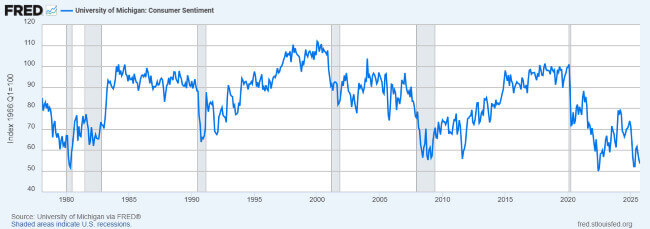
Chart by University of Michigan via FRED
It’s practically impossible to go on Tik Tok or Instagram these days without seeing someone finding their first ever FRED chart and subsequently telling you why the housing market is about to collapse. People feel very bad about the economy, and I unfortunately do have to give it to Will Stancil and admit he has a bit of a point about how this is a self-reinforcing point. GDP grew by 3.8% in the second quarter. We are not even remotely close to being in a recession right now, but this is where I can thankfully stop giving it to Will Stancil and point out that there are plenty of figures demonstrating how the precarity people feel is very real.
But not many of them come in this blog by the Chief Strategist and Portfolio Manager for Simplify Asset Management that is going semi-viral right now. It’s pointed in the right direction and the assertions it makes are salient, but Michael Green’s claim that “the real poverty line is $140,000” for a family of four and that “I’m being conservative,” is fucking absurd. This blog is like an object lesson in the difficulty of talking about the economy right now, because most of the points it makes are good and they touch on serious dynamics, but the topline figure is gobsmackingly preposterous.
I poked fun at the Tik Tokers discovering their first FRED graph earlier, so to satisfy the FCC’s equal time rule I have to take a shot at the Very Serious finance guy for this paragraph dripping in sarcasm. “I’m sure many of my left-leaning readers will say, ‘This is obvious, we have been talking about it for YEARS!’ Yes, many of you have; but you were using language of emotion (‘Pay a living wage!’) rather than showing the math. My bad for not paying closer attention; your bad for not showing your work or coming up with workable solutions.”
We do have workable solutions! They’re called Medicare for All and the jobs program known as the Green New Deal! The New Deal and FDR’s new Bill of Rights a century ago were workable solutions too! You just weren’t listening because your brain is poisoned by Cold War propaganda! Now that the fascist American oligarchy has accomplished their century-long project of dismantling many New Deal and Great Society-era protections, we now have the highest inequality since just before the Great Depression. I wonder what happened!
Only a fool with no historical knowledge would think that we have not already proven to have workable solutions. Being a lefty in America means always getting yelled at by the mainstream for being right too early and long after it’s too late to stop the bad guys.
For decades, lefty economists have been pointing out basic facts about how rich people stuffing money away forever in bank accounts is not as good for the economy as middle class people spending their wages in their local economies and having it circulate and replicate itself. The “jobs creator” bullshit that capitalists love to spew has always been a fallacy, as demand creates jobs. This guy is only now just discovering basic lefty economic precepts that have existed as long as Karl Marx’s writings have, if not longer. Green centers his blog on the poverty line, a “broken benchmark” he only just now discovered that is akin to Tik Tok baby’s first FRED graph.
Green correctly points out how the poverty line is “calculated as three times the cost of a minimum food diet in 1963, adjusted for inflation,” but somehow paints this as a secret revelation he only just uncovered. Welcome to my economics 101 class from 2005, buddy. It’s a stupid metric no serious economist has used for decades, and there are other far better measures out there, like the OECD’s poverty rate, which rates the United States as one of the highest in the developed world. Asset Limited, Income Constrained, Employed (ALICE) households is another good measure that economists have used to show how precarious life can be in America this century. The government even acknowledged that the poverty line is an outdated model when they came up with the Supplemental Poverty Measure in 2011. This is not some hidden secret that Green just unearthed, I was taught this stuff as a hungover freshman 20 years ago.
The poverty line for a family of four is defined as $32,150, a ridiculously small number that may be less serious than Green’s $140,000 figure. What measures like ALICE do is use the actual cost of living in the counties that people live in as a baseline, because you simply cannot use one cost of living figure for a big, diverse country like ours. They found that in 2023, “based on the Federal Poverty Level (FPL), 13% of U.S. households were defined as being in poverty. Yet this measure failed to account for an additional 29% of U.S. households — more than twice as many — that were also experiencing financial hardship.”
This is where the vibecession meets reality. Will Stancil is wrong. You are not hallucinating your own financial hardship because a Tik Toker told you to. There are 55 million American households—42%—who fall below ALICE’s financial hardship threshold.
But Mike Green is very wrong too. According to the United States Census Bureau, 26.1% of Americans were making more than $150,000 a year. That means that under Green’s financial hardship threshold, just less than three quarters of U.S. households are in poverty, per the Census Bureau’s income brackets. This is the kind of stuff that only makes Will Stancil more powerful. If you want to defeat him in a poster’s war, which is akin to trying to invade Russia in the winter, use ALICE’s figures, not this hysteric number.
But Green’s blog does touch on major themes of our vibecession that are threatening to talk America into a recession, one of which I have been writing about as long as rebooted Splinter has been around.
The Rent Is Too Damn High
The rent is too damn high for many reasons, but primarily one. Housing prices are at all-time highs, as a generation of NIMBYs stopped building and weaponized the supply and demand curve in service of their own net worths. It really grinds my gears when people use the word “inflation” to describe rising housing prices, because that’s not what inflation is—that’s a specific kind of economic dynamic, separate from the basic impacts of supply and demand. Americans have moved to urban areas and enclaves and away from the rural expanse in the past several decades, and our housing supply has not increased at the same rate as housing demand has. That’s not inflation, that’s economics 101.
“Following decades of underbuilding and underinvestment, the U.S. faces an acute shortage of available housing, an ever-worsening affordability crisis, and an existing housing stock that is aging and increasingly in need of repair—all to the detriment of the health of the public and the economy,” wrote the National Association of Realtors in June 2021. “While the total stock of U.S. housing grew at an average annual rate of 1.7% from 1968 through 2000, the U.S. housing stock grew by an annual average rate of 1% in the last two decades, and only 0.7% in the last decade.”
We simply just need to build more housing. It’s not a whole lot more complex than that. Anyone fighting against this notion is working against affordable housing and the basic laws of economics that were known long before the Transatlantic Slave Trade made capitalism world-famous. This basic pressure point is where all other housing problems that people acutely feel stem from.
Because we don’t build enough, home prices go up, and now they sit at all-time highs as the median age of the first-time home buyer has reached an all-time high of 40 years old, while the share of first-time home buyers also dropped to a record low of 21%. It’s all related, and it’s a rolling economic crisis for people who rent. “Over 21 million renter households spent more than 30% of their income on housing costs in 2023, representing nearly half (49.7%) of the 42.5 million renter households in the United States for whom rent burden is calculated,” wrote the United States Census Bureau last year.
Entire generations are getting priced out of the housing market for their young adulthood, forced into a renter class that is at the heart of the increasing precariousness in America. How are renters supposed to build wealth when almost a third of their paycheck is going into someone else’s investment?
This is a climate change story too, as 6.3% of homeowners paid $4,000 a year or more for homeowner’s insurance, warping the cost of mortgages, which then filters down to increased costs on renters. As the Census Bureau notes, this is really felt in regions heavily impacted by climate change like Florida, which “had the highest number (1.2 million) of homeowners paying $4,000 a year or more for homeowner’s insurance. Texas (784,000), California (560,000), New York (272,000), and Louisiana (215,000)” were the other most impacted states. The laws of climate change tell us this number will only rise with time, and in many parts of the country like Florida, home insurance is rapidly becoming a relic of a cooler past.
Interest rates are another big problem, as the death of zero percent interest policy (ZIRP) created a bifurcated housing market and put people in a position where trading their old mortgage for a new one adds additional costs to any new home purchase, and this further reduces the supply on the market. If you were lucky enough to buy a house before interest rates began rising in March 2022, you have a mortgage rate we may never see again (unless we get another big economic crash, which, well … okay we’ll probably see ZIRP again). Those who bought a house since the Fed pivoted to try to bring down inflation have much higher monthly housing costs.
In 2020, the 30-year mortgage rate was around 3%, and in 2023 it was around 7%. On a $500,000 home, assuming a 20% down payment, that comes out to be about an extra $1,000 a month for the 2023 mortgage. And that doesn’t include the recent explosion in insurance, which pushes that even higher, or adjusts for the fact that a half-million dollar house in 2020 is very different from one in 2025. You are not crazy; owning a home was much more affordable just five years ago, and the combination of all-time high home prices and higher interest rates is only making it worse.
A big cause of the vibecession is due to young people rightly feeling priced out of the so-called American Dream. This country is now asking people to scrap and claw in their 20s and 30s just to afford a starter home as they enter their 40s, all while the boomers lecture them that this is the way to build wealth while young people descend deeper into debt. This has never happened in modern, post-World War II America. People are growing up under a kind of precarity within prosperity never felt before, and high housing prices are part of the double whammy pushing roughly half the country to rightly feel like they are on the cusp of economic ruin.
Luigi Mangione Told a Bleak Story About America
The reaction to Luigi Mangione murdering UnitedHealthcare CEO Bryan Thompson in cold blood was shocking, yet instructive. No healthy country so openly cheers on an extrajudicial killing that way, but we’re not a healthy country. Among our peer countries, we have the lowest life expectancy at birth. A big part of this is due to medical bankruptcies, a foreign concept to most countries with universal healthcare coverage. Medical debt is the leading cause of bankruptcy in America, and companies like UnitedHealthcare whose business model is predicated on rejecting as many claims as economically feasible are making the conscious decision to push people into bankruptcy. This is an intrinsic part of life in America.
“Between 2019 and 2022, the U.S. experienced a sharper decline and a slower rebound in life expectancy than peer countries, on average, due to increased mortality and premature death rates in the U.S. from the COVID-19 pandemic,” wrote KFF earlier this year. “Updated life expectancy estimates in this chart collection show that in 2023, life expectancy in the U.S. returned to pre-pandemic levels, but remains lower than that of comparable countries.”
We have the highest maternal mortality rate in the developed world, three times higher than peer countries. We have the highest rate of chronic illnesses in the developed world and we spend “considerably more than any other country (USD 14,885 per person, adjusted for purchasing power) in 2024, and also spent the most when measured as a share of gross domestic product (GDP),” per the OECD.
An estimated 100 million U.S. adults (41%) have debt related to unpaid medical bills. We spend more money to die at earlier ages than other countries, and yet some people still wonder why there is such immense rage at our inherently immoral healthcare system.
If you are a renter with a median income and average healthcare costs, life in most American cities is one rejected insurance claim away from economic ruin. In that context, one healthcare CEO’s life can seem quite small, providing a window into the fervor around America’s most popular murderer. And if you still think this is all vibes, you’re not paying attention to credit markets right now.
America Is Defaulting On Its Obligations
The auto loan market has been telling a nervy story in the second half of the year. In September, Tricolor Holdings, a major subprime auto loan provider, went bankrupt amid allegations of fraud, further adding to the concern around a market that primarily services used car buyers. Subprime loans are a small portion of the auto market, but who receives them can be instructive, and rising “severely delinquent” auto loans and default rates amidst a larger pullback in credit all paints a disturbing picture for Americans who must take on debt to supplement their income.
NY FED: The rejection rate for all types of credit (auto loan, credit card, credit card limit increase, mortgage, mortgage refinance) over past 12 months rose to a series high of 24.8% in October.
(via Liz Ann Sonders)
— Carl Quintanilla (@carlquintanilla.bsky.social) November 25, 2025 at 5:16 AM
Lenders began tightening their standards once the Fed hiked interest rates in 2022, and that has begun to trap people in something of a vice grip. Debt is more expensive to service now, and Americans have a lot of it, further reducing their ability to save. The Will Stancils of the world will point to rising wages and say that things are fine, but as the Federal Reserve noted this year, “A sizeable share of adults said their family’s monthly income increased in 2024 compared with a year earlier. However, the share of adults who said their spending increased from the prior year was even greater.”
In this writeup, the Fed presents a chart of monthly spending relative to income, broken down into three buckets: spent more than your income in the prior month, spent equal to it, and spent less than it. Of the spent more than your income in the prior month bucket, it rose in 2022, and remained elevated at 19% of Americans while the other two fluctuated. As of 2024, 49% of Americans say they spend equal to or more than their income each month. Higher interest rates’ entire effect is to make credit more expensive, and this has the most acute impact among low and middle income Americans. You can literally see it in the charts.
The New York Fed found “4.5% of outstanding debt in some stage of delinquency” in the third quarter of the year, and that “Transitions into early delinquency were mixed with credit card debt and student loans increasing, while all other debt types saw decreases.” The overall delinquency rate is “stabilizing,” but in large part due to the low mortgage delinquency rate thanks to many people holding ZIRP-era mortgages. There are not and likely will not be a wave of mortgage defaults cascading across America to recreate The Big Short like so many Tik Tokers want to believe, but auto loans, credit cards and student debt are flashing warning signals.
America is defaulting on its obligations to its people, causing some to default on their own debts. Many take out mountains of debt to obtain the college degree our economy demands in return for most well-paying jobs, but most jobs don’t pay enough to cover student debt servicing, and now those delinquencies are rising. In the State of ALICE’s 2025 Report, they found that “Of the 20 most common occupations in the U.S. in 2023, 11 paid less than $20 per hour,” and that “of all workers in these 20 occupations, 33% lived in households below the ALICE Threshold, with rates as high as 53% for home health and personal care aides and 49% for cashiers.”
The vibecession is real because low-income households are in a recession right now, and middle-income ones aren’t far behind. We know that GDP is largely being held up by gargantuan AI capital expenditure spending, and consumer spending, the typical engine of the economy, is held up by wealthy people’s spending, which is partially boosted by the stock market’s wealth effect, which is boosted by AI capex spending. It’s not hard to see how this snake eating its own tail can run out of tail and eventually push the vibecession into a recession.
Life in America is precarious. Most of us are one medical emergency away from financial ruin, but that doesn’t mean we’re all in poverty. A true poverty threshold of $140,000 a year is a ridiculous figure, but an instructive one as well. Even if Green is off by half, and he probably is, that’s still a little under the median income in America ($83,730), and in line with the figure of 42% of households under the ALICE Threshold for financial hardship. It’s not hyperbolic whatsoever to state that somewhere around half of Americans live under conditions that could be classified as real financial hardship, where building savings for the future is seemingly impossible.
 Keep scrolling for more great stories.