

Sure, We Might Be in a Dystopian Hellhole, but at Least the Compliance Robots Are Dog-Shaped
As long as we can pet the thing surveilling us, it will no doubt all be okay.
Photo via Unsplash, Mika Baumeister Splinter Surveillance
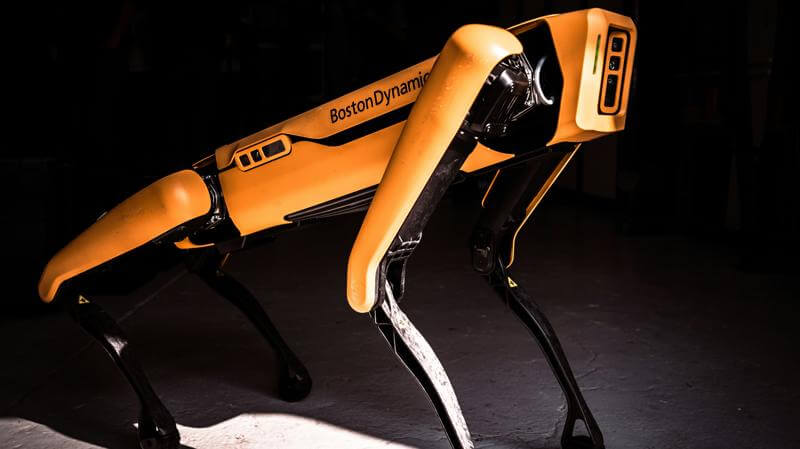
It’s an old observation in human psychology, but as true now as it ever was: If you want to dull the impact of something deeply disconcerting, simply repackage it with a friendly face. Or in this particular case, not so much a “face” as a friendly outline, a comfortably familiar shape that fits an archetype that human beings have associated with companionship for going on 15,000 years. Few of us would treat a roving surveillance sphere like the one from The Prisoner as a cute, friendly object for us to project our sense of security on to. But make that same device vaguely dog-shaped, and then double down on dog names and characterization in an effort to lock in that association with the public, and watch as the same tool of potential dystopian repression is instead embraced by entirely too many people as a harmless social media celebrity. It’s fun!

The so-called “robodog,” as a concept, is not new–in fact, leading producer Boston Dynamics, a spin-off from the Massachusetts Institute of Technology, cranked out its first prototype 20 years ago at this point. The company, acquired by Hyundai Motor Group in 2021, initially began developing their highly mobile quadruped robots for the military, before first transitioning them into a commercial branch in 2019. But it seems likely that this technology will be thrust back into the limelight and the discourse by the upcoming 2026 FIFA World Cup in the United States, if proliferating TikTok videos capturing the “security” robodogs approaching strangers near stadiums are to be believed. Observe the cute ‘lil guy in action.
@ogdaffle Dallas is using facial scanning robots to verify ticket holders for the FIFA World Cup! #worldcup #dallas #robotdog #fifa #fyp
Oh, it’s just so darling, is it not? Look at the adorable robodog, dancing and shaking its head in befuddlement. Sure, it’s also recording your image for posterity, whether or not you want to be approached by this thing, but who cares about that? The account that recorded that particular TikTok video claims that “Dallas is using facial scanning robots to verify ticket holders for the FIFA World Cup,” a concept that would imply that there’s a database of the faces of everyone who purchases a World Cup ticket that each image is scanned against, and that you could subsequently be approached/apprehended by security for not having a face that matches that of a ticketholder. Boston Dynamics, keen to how terrifyingly dystopian that particular idea sounds, refuted the TikTok creator’s claim, saying that the robodogs “do not have facial recognition capabilities,” without addressing why having these things around would be preferable to, I don’t know, let’s say human beings.
“Boston Dynamics Spot robots are being deployed at designated World Cup venues to perform perimeter security inspections and will be used to assist security personnel with investigating things like suspicious packages or other potentially hazardous materials,” the company added. Oh, so they’re a fleet of mobile bomb squad units?
Regardless, this feels like a calculated opportunity for the company, and the buyers employing this type of technology, to dip a toe into moving it into a more publicly visible space, seemingly in an effort to help acclimate people to the idea of encountering a robot performing “security inspections” or other activities in their vicinity in the course of everyday life. This is how the surveillance state creeps forward, starting with big public events like this where the deployment of a “robodog” can be packaged as a fun novelty with a concrete goal of keeping everyone “safe.” What would seem disturbing if you saw it patrolling down your street becomes an amusing tech demo at the World Cup. This intended response is expertly helped along by the natural affinity people feel toward an outline that evokes our feelings toward cherished family pets and lovable mutts around the world: You see this thing awkwardly trotting along, and the doofiness of its design is calculated to blunt the invasive potential it represents in reality. It tracks your movements just as efficiently as a non-dog-shaped robot would, but you instinctively trust it (and the company behind it) more than you would otherwise.
The media, meanwhile, is all too happy in many instances to play along in sanitizing and sane-washing the presence of these types of devices that are encroaching further and further into daily life. Look at a local news broadcast like the below one in Atlanta, where Mercedes-Benz Stadium became the first major American sports facility to employ a robodog to keep it “safe.” Safe from what, one might wonder? What nefarious plots has the Mercedes-Benz robodog managed to sniff out in the two years it’s been on the job? Somehow, I can’t find any reports on this. What I can find is that they named the thing “Benzie,” encouraged fans to post about and interact with the thing, and attempted to turn it into a “stadium mascot.”
As the unnamed stadium official puts it in the clip above: “Benzie’s an attention getter. I mean, everyone loves him! Unless you’re up to no good.” Of course in this case, “whether you’re up to no good” is something to be decided by … private stadium security, I guess? Hope they’re as gentle as the robotic dog.
Truly, it was an evil genius who deduced that one can build a walking monument to violated privacy, and it will be not only tolerated but actively embraced by some people as long as you can make the same device do a funky little dance in between the photos it’s taking of your children. Americans, already more likely than other countries around the globe to project anthropomorphized association onto our pets, are no doubt the perfect society for the robodog to attach itself to like a robo-leech, the most primed psychologically to see it as a toy, rather than some corporation’s latest effort to catalogue your every action in a quest to somehow extract more profit from you. So what if our military has already been experimenting with strapping guns onto them? It may be the dawn of dystopia, but at least the compliance robots can do an amusing trick or two.
 Keep scrolling for more great stories.