

Gaza Death Toll Continues to Mount Under Israeli Ceasefire
An eight-year-old and an eleven-year-old are among the latest casualties.
Photo by Stefano Guidi / Getty Splinter Gaza
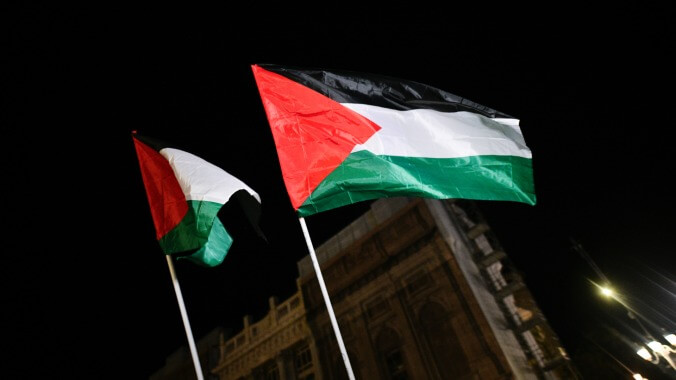
In the aftermath of an Israeli strike on the Bani Suheila neighborhood on the outskirts of Khan Yunis, two brothers—11-year-old Jumaa and 8-year-old Fadi Abu Asi—were killed. The boys had ventured into an “Israeli-controlled” area beyond what’s referred to as the “yellow line” in order to collect firewood for their father, who is wheelchair-bound. Their small bodies were carried back to their family, who beat their chests and wept in grief, their cries echoing through the air like a collective indictment of a world that has normalized Palestinian suffering to the point of abstraction. This is the stark reality behind what Israel insists on calling a “ceasefire,” a term that now functions less as a description of reduced hostilities and more as a political fiction masking a continuation of lethal force that has already taken at least 352 lives and left nearly 1,000 injured since October 11, according to Gaza’s health ministry.
Two Palestinian bothers the children, Fadi Abu Asi (8 years old) and Tamer Abu Asi ( 11 years old) were bothkilled today by the Israeli bombardment of Khan Younes in another Israeli violation of the ceasefire agreement. Since October 10th when the ceasefire agreement became… pic.twitter.com/6GkXtU4ZZO
— Mustafa Barghouti @Mustafa_Barghouti (@MustafaBarghou1) November 29, 2025
Mahmoud Hamad*, a 36-year-old former engineer in Khan Yunis, tells Jezebel/Splinter that he now watches over his only surviving brother with constant fear, terrified that an Israeli attack could take his life, just as one last year killed nearly his entire family. “I am entrusted to take care of my brother until the last breath leaves my body. I can’t bear to lose him. The thought of it keeps me awake at night. We’re surrounded by death in Gaza, and I’ve seen countless deaths, but if I lose my brother I would have lost everything.” For families like Mahmoud’s, the so-called ceasefire offers no reprieve and no easing of a suffocating siege; Gaza remains a territory where movement is restricted, and where any attempt to meet even the most basic of human needs can become a fatal risk. The conditions of siege have merely been repackaged under a different name, allowing Israel—and the United States—to claim de-escalation while maintaining structural pressures, from airstrikes and constant surveillance to the systematic deprivation of humanitarian aid. Palestinians in Gaza describe a chilling paradox: a ceasefire that has brought a slow trickle of death, and a truce that has left them without security or a way out of the Israeli killing machine.
The persistence of Israeli military activity after October 11 has raised sharp criticism from legal experts and human rights monitors, many of whom argue that the pattern of conduct in Gaza stands in direct violation of international humanitarian law, including the Fourth Geneva Convention’s explicit prohibition of collective punishment and the obligation of an occupying power to protect the civilian population under its control. Despite these binding legal frameworks, Gaza’s 2.2 million residents continue to endure a regime of restriction and deprivation that international observers have characterized as a form of “incremental annihilation,” where civilians are not only exposed to unpredictable bouts of lethal force but are simultaneously denied the conditions necessary for dignified human survival. This dissonance between Israel’s public claims of restraint and the documented realities on the ground exposes a deliberate strategy of managing, rather than resolving, the humanitarian catastrophe that the genocide and ongoing siege has produced, effectively transforming everyday civilian life into a protracted emergency with no foreseeable end.
Taken together, these realities reveal a painful truth: Gaza is not experiencing a ceasefire in any recognizable or lawful sense, but rather an ongoing campaign of enclosure and attrition that has been temporarily reframed to satisfy diplomatic optics while doing nothing to alleviate the suffering of the people trapped inside. The deaths of Jumaa and Fadi Abu Asi are not tragic anomalies but emblematic of a broader pattern in which Palestinians attempting to gather firewood, fetch water, or search for food are treated as expendable within a system designed to exert maximum pressure on an already devastated population. As long as the siege remains intact, as long as Israeli forces continue to exercise unchallenged coercive power over every aspect of life in Gaza, and as long as international actors accept a cosmetic version of calm in place of a real end to Israel’s siege, the people of Gaza will continue to live in a state of unrelenting precarity. The world may call it a ceasefire, but for Gaza’s families, it is nothing more than the continuation of war by other means, and the cost is measured not in abstract policy terms but in the small, fragile bodies of children like Jumaa and Fadi, carried home in grief through bombed-out streets.
*Hamad’s name has been changed for his protection.
Roqayah Chamseddine reports for Jezebel/Splinter from Lebanon.
 Keep scrolling for more great stories.