

Court Declares Pair of Goldfish Are “Sentient” and Possess Right to a Better Existence
The pair of goldfish at a sushi restaurant are the latest animals to find themselves with human-like rights to better treatment.
Photo via Unsplash, shuvrodeep dutta Splinter Animal Rights
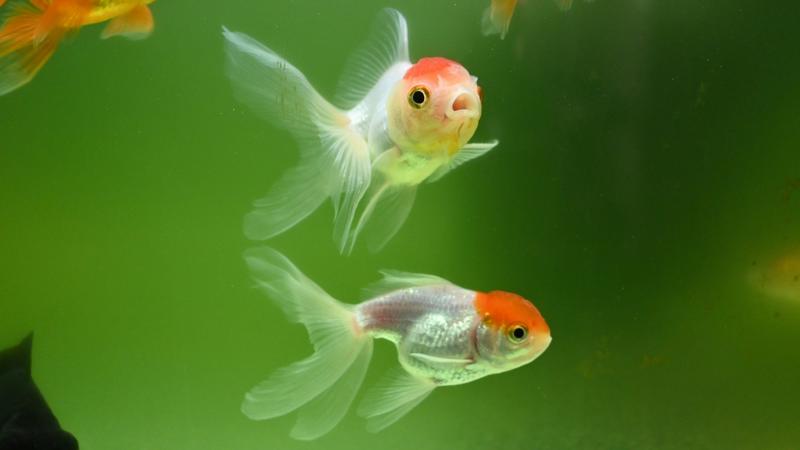
In my hometown of Richmond, Va., there’s a long-lived neighborhood dive bar that is charming enough, save for one feature that has always rubbed me the wrong way: a fish tank nestled against the window facing the street. This is a loud bar. On any given night, it is pulsing with EDM music, flashing lights, live performers and about a hundred people screaming over each other to be heard. By day, sunlight floods the same fish tank as the regulars knock back beers. And each time I’m there, I end up thinking the same thing: what an overwhelming, incomprehensible life of extremes and over-sensation this must be for those poor fish!
But hey, they’re just fish, right? It’s not like any of us are going to be held to account for giving the fish in a tank a not-particularly-nurturing place to spend their lives. Or will we? For the last few decades, various campaigns to confer rights–be they “human rights” or rights in a more general sense–have been waged by activists in the name of animal lives and dignity, with some notable successes. Perhaps the best-known example was that of Sandra the orangutan, who lived in the Buenos Aires Zoo for 20 years until 2014, when environmentalist activists succeeded in having her recognized as a “non-human person” by a judge, in a ruling that stated her captivity violated Sandra’s rights even though she didn’t specifically suffer from mistreatment or abuse. Sandra ultimately was relocated to an ecological reserve rather than a zoo where she was put on display. And this week, in Argentina, we have some more (unexpected and perhaps dubious?) movement on that front: A pair of goldfish living in a small tank at a Buenos Aires sushi restaurant were recognized by a court as “sentient beings” with rights to live in a more healthy environment. Which of course begs the question: if even a humble goldfish is a sentient being, then what animal would not be worthy of such protections?
In this particular case, the two goldfish, named Fede and Magui, lived in a small, 40-liter display case at a sushi restaurant, exposed to direct sunlight and street noise, none of which is conducive to good health for fish. Seeing this, activist Jaulas Vacías of the animal rights group Empty Cages decided to file a court complaint, claiming that the treatment and conditions of the fish violated Argentina’s animal abuse laws. The court agreed with the basis of the legal case, and the restaurant acquiesced to the ruling. Carlos José Aga, a wildlife specialist who was brought in as a consultant on the case, offered to adopt the goldfish, and they were ultimately moved from the 40-liter tank at the restaurant to a much roomier 2,500-liter fish tank at Aga’s home. In making their argument in court, the aggrieved party rather dramatically compared the treatment of Fede and Magui to “putting two polar bears in a cage inside a sauna,” in terms of the appropriateness of their setting.
“Fish are like astronauts, they travel in their own environment with careful monitoring of all their vital parameters, and when they arrive at the place, those conditions must be reproduced with great accuracy to avoid imbalances that could lead to a decrease in their immunity,” said Aga. “Now they are doing very well.”
If MAGA supporters are regarded as sentient beings, then I need no persuasion that goldfish must be.
However, I doubt the first proposition.
edition.cnn.com/2026/07/13/a…
— Laurence – highest score ever in the Neasden Cognitive Test (@laurenceineu.bsky.social) 12:17 AM · Jul 14, 2026
This is of course the sort of argument that can easily be argued as a slippery slope. Just how do we decide which animals are worthy of enhance protections from mistreatment, or what rises to the level of mistreatment? Is a large animal inherently more valuable or worthy of protection than a small one? Or is the bar based on relative animal intelligence? At what point does the vague idea of “sentience” begin? Animal activists obviously wish to blur these lines, as in a perfect world they would no doubt prefer to extend protection to nearly every creature of any kind. Practicality, on the other hand, suggests a certain level of absurdity: We are talking about goldfish that were living at a sushi restaurant, where hundreds of pounds of fish we’ve dragged from the sea are likely consumed every day. Does it really do any good to confer better living conditions on the pair swimming in this bowl, while we’re simultaneously scrubbing the bottom of the sea clean with giant nets and eating whatever we find?
The actual mechanic by which the goldfish were ultimately protected involved having them declared to be “subjects of law,” which is apparently how Argentina would define or classify “sentient beings.” This would officially recognize the fish not simply as physical objects, but as beings–and beings inherently have rights to a dignified existence. Matías Trufero, one of the lawyers in the case for nonprofit organization/animal sanctuary Jaulas Vacías, said that the result was not intended to instruct members of the public that they can’t/shouldn’t keep a tank with fish, but that there should be a level of expectation under the law to provide healthy conditions for those fish if you choose to keep them.
“It’s not illegal per se to keep a fish in a fish tank,” Trufero said. “However, it is illegal to keep them in conditions that cause mistreatment or cruelty. For example, inadequate space, insufficient food, and other acts punishable by law. Furthermore, if it’s an exotic species, keeping could be prohibited if it falls under local wildlife laws.”
Around the world, novel legal approaches have attempted to set variations upon this sort of precedent, with mixed success. For every case like that of Sandra the orangutan, there are more like that of Happy, an Asian elephant living at the Bronx Zoo, who activists attempted to free in the 2022 with a habeus corpus petition, arguing that the elephant was being unlawfully imprisoned. The nonprofit Nonhuman Rights Project (NhRP) demanded “recognition of Happy’s legal personhood and fundamental right to bodily liberty and her release to an elephant sanctuary,” but the New York Court of Appeals disagreed, ruling in June of 2022 that the elephant was not a “legal person” and did not possess such rights. Perhaps the pachyderm would have had better luck in Argentina, where even goldfish are worthy of empathy?
As Carlos José Aga, who ultimately adopted the fish argued: “A subject with a legal right can do little or nothing for themselves unless there are people who speak on behalf of those who cannot speak and enforce the law.” Perhaps even my neighborhood dive bar would be moved by such an argument, and improve the lives of their own poor, disoriented fish?
 Keep scrolling for more great stories.