

How Women’s Liberationists Occupied 3 Buildings in Copenhagen in 1971 and Declared Them Their Home
In her memoir My Seven Mothers, Pernille Ipsen recounts growing up in a feminist camp—and chronicles the spirit, struggle, and determination of the Redstockings as they tried to build “a true alternative to the male society.”
BooksIn Depth
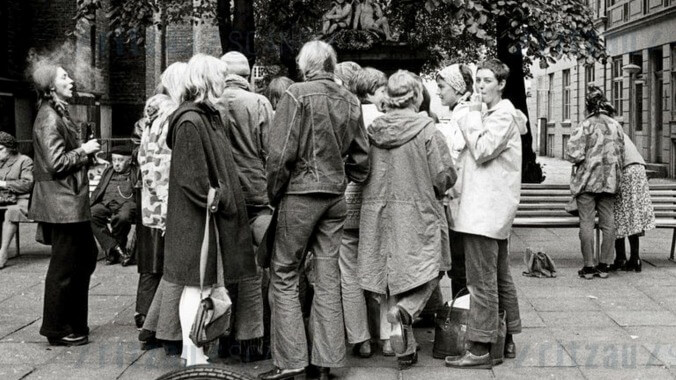

This is an excerpt from My Seven Mothers: Making a Family in the Danish Women’s Movement, a memoir by Pernille Ipsen.
Feet pound on the floor and Janis Joplin pulses in warm waves from the loudspeaker, which wobbles in time to the music atop a wooden beer crate. Exactly one month had passed since they occupied the buildings on the busy street called Åbenrå in the center of Copenhagen. Now they were having a party, and two Redstockings preserved the evening on 8-mm film. The film is silent. Sanne and Lotte leap joyfully on the dance floor—unsteady, no doubt a bit drunk, and clearly intoxicated by the space packed with people. Wearing a faded yellow T-shirt, Sanne leans against a wall, shaking with laughter. She tucks strands of her short pageboy haircut behind her ears before jumping back into the crowd.
All twenty-five women are dancing together, weaving in and out. Some flail their arms or swing their hair. Others clap, roll their hips, put their arms around one another, let go, and sink into the music. They melt together. Maybe for a moment they forget where they are, and then find themselves in a sea of women whom they know from Femø, in the middle of a vital community that can support them in their new life with women.
“We’re creating our own life,” Vibeke wrote in With Sisterly Greetings, which was published a few weeks before they occupied the buildings on Åbenrå. “Maybe your husband will eventually acknowledge that the only way you and he can ever be equal depends on you and your sisters building a community of women that gradually becomes strong enough to provide a true alternative to the male society.”
Like many other Redstockings, my mothers preferred to say “we” rather than “I.” “For several years I never said the word ‘I,’” Lotte recalls. Instead, she said: “We are going to the demonstration” and “we think legal abortion is a human right” and “we went to the bar.” Early in the 1980s, people began asking Lotte who she referred to with her “we.” But in the Women’s House, in the 1970s, use of the word “we” rarely had to be explained.
Outside the Women’s House, my mothers constantly had to explain themselves. “We always have to defend living in a commune when we talk to women in the movement, to the press, and even among ourselves,” Hanne wrote in a letter to a woman friend in 1972. “When you live with a man, everything is ‘meaningful’ and right, but our choice to live in a commune always must be justified.” Or, as Susanne wrote in her short bio in the pamphlet Lesbians: From Iso-lation to Movement, “Since I started saying that I’m a lesbian, there has been a real demand for me to present good arguments for why I even exist at all.” But inside the Women’s House, my mothers found a “we” that could sustain them, and by saying we out loud, over and over, they reminded each other that this was where they belonged.
After the first month there was a lot to celebrate. Every moment since taking over the buildings had been filled with purpose. The main goal was building a world for and by women, and within that project were all the smaller tasks, as Inger explains. “How should we set up the café? What other activities should take place in the house? How do we install windows? And so on. All of them were our projects, and we made the decisions. If there was something we didn’t know how to do, we had to learn.”
On a few occasions my mothers did seek help from the outside, such as when they smelled gas and couldn’t figure out where it was coming from. Hanne got on her bike and found a man she knew who could help. “We weren’t exactly bragging about that,” Vibeke recalls. “It was a little embarrassing,” Hanne says about the gas-smell episode. “But my friend politely made sure to show me how I could solve the problem myself if it happened again, so we wouldn’t be dependent on his help.”
In that way, every situation better prepared them to get along without men. They lugged around heavy items, swept and washed, took down some walls and constructed others; they laughed, painted, made coffee, argued, installed electrical wiring, repaired toilets, and slept very little.
“This time we’re going all the way,” wrote Vibeke and three other Redstockings in a manifesto for the Danish anthology Sisterhood. But it wasn’t as if they were setting out in a straight line on a long high-way. “We had no idea where we were headed,” says Inger. “We had to find our way from one day to the next. We’d never been there before.” “We simply got to work,” says Sanne in a tape recording from 2016 when all of us are gathered at Sanne’s place. “It never occurred to us that there was anything we couldn’t do.”
“Yes, we were really convinced that we could do everything,” Lotte confirms. “And we clearly could,” adds Else Marie. “If we wanted a building, we took it, and if we were missing something, we made it ourselves.”
“It was like jumping from one tuft of boggy grass to another,” Vibeke recalls. “The ground underfoot was really shaky, but once we’d got far enough out, we stopped looking back.” The road ahead was neither straight nor particularly visible, but my mothers were clearly moving away from the old and toward something new.
As a child I loved hearing their stories about how they just took over those buildings and then received permission to stay there. “How did you do it?” I would ask them. “Tell me again.”
When my mothers returned home from Femø, Hanne contacted the Slum-Stormers (the group she was already involved with) to ask if they might help the Redstockings find a suitable building. “We just couldn’t imagine going back to the life we’d been living before,” says Hanne. “We needed a building immediately.” After listening to remarks both for and against a building intended solely for women, the Slum-Stormers decided to help the Redstockings. They suggested three old and largely empty buildings on Åbenrå that had been constructed after the big Copenhagen fire in 1728.
Over the course of a few weeks the Redstockings held a couple of meetings to organize the occupation of the buildings. At the last planning session before they took action, they decided to designate the larger orange building at 26 Åbenrå as the Women’s House. The building would be open to everyone, and the Redstocking Movement would use it for activities and groups. The empty apartments in the smaller buildings at 28 and 30 Åbenrå would provide living space for those who would participate in running the Women’s House. This was where my mothers lived when I was born a year and a half later. On the day of the occupation—Wednesday, September 15, 1971—Inger, Hanne, Susanne, Sanne, Vibeke, and fifteen to twenty other Redstockings met at midday on the walking street near Copenhagen’s famous Round Tower (Rundetårn). They carried mops and buckets. Else Marie was working her shift at the hospital and didn’t dare call in sick because the event would undoubtedly be reported in the newspapers. But she joined the group as soon as she finished work in the afternoon. As far as Lotte can remember, she didn’t know about the plans.
“I ran on ahead with another woman,” Hanne recalls. She had previously inspected the buildings and knew that the back door was missing at number 26. Hanne and her companion ran into the neighboring back courtyard and climbed on several garbage cans so they could jump over the fence. “Then it was just a matter of walking through the building to the front door to let in everyone else.”
Susanne volunteered to unlock the doors inside. Hanne handed her a bunch of ordinary house keys that the Slum-Stormers had given her, explaining that they would probably open most of the locks. “And they did,” Susanne says. “But I quickly discovered that it was much easier just to kick in the doors. If I aimed for a spot right below the door handle, I could get the door open with just one kick. What a rush!”
Susanne stayed away from a couple of the apartments in numbers 28 and 30 because they still had tenants. The three buildings were all owned by Copenhagen University, which planned to use them to expand the premises of the Music History Museum, located at number 32. But funds had not yet been set aside for the renovation, and in the meantime a custodian and his family still lived in number 28. A bachelor lived on the third floor of number 30. According to Vibeke, as the Redstockings took the buildings the man slipped out and crept away along the wall of the building.
When all the doors had been opened, the Redstockings set about making themselves at home. One group made coffee and another started cleaning, while some of the women stood outside on the street, ready to speak to the authorities. A fourth group started preparing the rooms for a café and a clothing exchange while other women hung a large “Women’s House” banner out the second-floor windows. Inger and Sanne were in charge of getting the electricity running. In preparation for demolition, the electric meters had been removed in the completely empty building at number 26, but the electric panels were still there. The Slum-Stormers had instructed them how to restore power by installing electrical taps in the panels. “We easily restored electricity to the whole building,” says Inger.
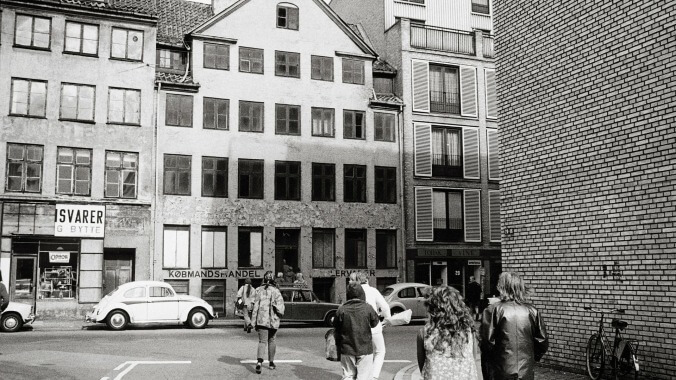
Women walk toward the future Women’s House on Åbenrå. Photo: Suzanne Mertz
But when Sanne and Inger get into more details, it turns out that they were quite lucky not to get burned. To put an illegal tap in the electrical panel near the front door on ground level, they first had to remove a big fuse from an even bigger group of fuses in the panel. When they took it out, a flame measuring a foot and a half long suddenly shot out toward them. But they weren’t particularly bothered. It never occurred to them that anything might go wrong.
In the meantime, Vibeke stood outside on the sidewalk with her group, waiting for the police and the building owners to show up. The women talked to the neighbors and other curious bystanders, and they handed out a flyer about why the buildings were being occupied. “Dear neighbors and other women,” the flyer begins. “We’ve learned from the Slum-Stormers that we can’t use negotiations to get ourselves a place to live, and so we have taken over a place—a place that has stood empty for two years…………….All women and children are welcome to have free coffee and tea in the café. Come over and let’s talk! Sisterly greetings from a group of women.”
The flyer worked. On the very first day a number of women neighbors accepted the invitation and dropped by the café to take a look at the buildings. The custodian who lived in number 28 (sort of a “biker-type,” according to Hanne) also politely greeted the Redstockings, and that evening he invited them over for coffee and aquavit in the apartment where he and his family lived.
“His children were happy to have neighbors again,” Vibeke told a journalist from the magazine EVA in January 1973. “Before we moved in, they often felt scared about being alone in that big empty building.”
On the following day, the newspaper Politiken reported that other neighbors “merely shrugged.” The combination kiosk and bookstore at number 30 was owned by a man named Richard. In his spare time, he sewed sequined dresses for men who would change their clothes in his back room before going to parties at a club across the street. According to the newspaper, he got very busy “discussing women’s liberation in the year 1971.”
“We were really lucky to get those particular buildings,” says Hanne. “We received such wide support. Tons of people showed up with furniture and all sorts of other usable items. We also received three thousand kroner from a private foundation that supported leftist-oriented activities.”
Initially, the two houses next to the Women’s House, 28 and 30 Åbenrå, were open to everyone who wanted to move in, and at first there were between thirty and fifty women staying in the buildings overnight. Most slept in sleeping bags on the second floor of number 28. That was also where Susanne, Hanne, and Else Marie slept before they moved into a small two-bedroom apartment on the fourth floor of number 30. There they built a huge bed where all three of them could sleep and still have room for guests.
“Many of the people who spend the night in the buildings in the beginning were not intending to move in,” Hanne wrote in a letter to a woman friend about the first weeks in the house. “We were all goofing off. It was fun, but it was also hard to be around so many people the whole time. We didn’t know each other at all, and it was a very mixed group. Some had jobs, others were students. Some were heterosexual, others were lesbian. Some were intellectuals, while some of us were more practically oriented. Our routines and lifestyles were different. After six weeks, six had moved out and one had moved in. Lots of women gave up when they discovered that life in the Women’s House was so time-consuming and complicated.” During the first month they were thirty women, but the number quickly decreased to fourteen, and over the course of the winter, only about eleven remained.
“The Åbenrå building was a 24/7 job,” says Susanne. “That old place was a piece of shit, with seven layers of wallpaper in a lot of the rooms.” She became a “full-time Women’s House resident.” During the first months she often slept only two or three hours a night. Susanne had actually applied to take a course at a teacher’s college in the fall of 1971, but she ended up attending only a couple of times. Sanne quit her studies, and Inger only rarely went. Hanne never went back to the Hellesen battery factory, but in the fall of 1971, she took a half-time job at a printing company that printed publications for the Redstocking Movement. Else Marie somehow managed to hang onto her full-time job as a physical therapist while also dealing with life at the Women’s House. After spending the first night in a sleeping bag on the floor in number 28, she moved into a broom closet where there was just enough space for her to curl up and sleep for a couple of hours. That’s where she lived for the first few weeks. With much effort she would wearily get up at six a.m. when her alarm went off and drag herself outside to her bicycle. She considered herself lucky that they wore uniforms at the hospital, so she didn’t have to worry about finding clean clothes. After a year of keeping up this routine, she developed a constant twitch in her eyes and her whole body ached.
“If we hadn’t all felt such a tremendous surge of energy at doing this project together, we could never have done it,” Susanne emphasizes. “Some people left because they had jobs they needed to tend to or wanted to keep. Others left to attend university classes or take care of children or whatever else they had going on.”
“We were driven by such a stimulating sense of curiosity,” says Inger. “There were no limits to what we could do. Paint a building? Sure, let’s do it! Some people painted the most incredible doors in lavender or silver. It was amazing what they came up with. Unbelievable color combinations that I’d never seen before.”
“I think we had so much energy because there were so many of us who were on the same wavelength,” Sanne surmises. “Our universe was supported by that communal spirit. It might sound banal, but that’s how it felt.”
Excerpted from My Seven Mothers: Making a Family in the Danish Women’s Movement by Pernille Ipsen; translated by Tiina Nunnally. Published by the University of Minnesota Press. English translation copyright 2025 by Tiina Nunnally. All rights reserved. Originally published in Denmark as Et åbent øjeblik: Da mine mødre gjorde noget nyt by Gyldendal. Copyright 2020 by Pernille Ipsen.
 Keep scrolling for more great stories.