

Idaho Confirms Voters Will Weigh In on Its Near-Total Abortion Ban in November
If the measure is approved, it will create and enact a law for “reproductive freedom”—thus allowing people to make their own decisions for abortion, contraception and fertility treatment.
Photo: Getty Images Abortion idaho
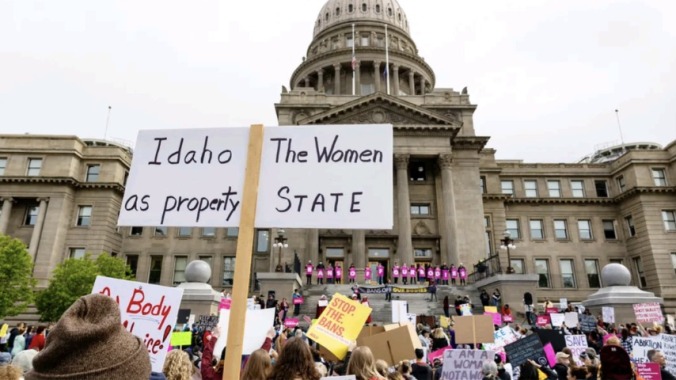
Since August 2022, Idaho’s been home to one of the country’s most evil abortion bans—a ban that’s so draconian that it’s chased dozens of OBGYNs out of the state; was once hauled before the Supreme Court; and called out by women for rendering them “medical refugees,” per their own court testimonies. Come November, voters will have a chance to overturn it.
Idaho’s secretary of state on Monday certified that Idahoans will have a say in a proposed ballot measure that enshrines a right to abortion in the midterms, after Idahoans United for Women & Families (IUWF) submitted more than 110,000 signatures—thousands more than the required 70,725—in its petition campaign. If the measure is approved, it will create and enact a law for “reproductive freedom”—thus allowing people to make their own decisions for abortion, contraception and fertility treatment.
IUWF was founded shortly after Idaho’s trigger ban went into effect in 2022, and has since focused on getting the ballot measure before voters. “We came together informally and eventually the idea that, ‘Hey, we need to draft a ballot measure, we need to raise money for some attorneys, we need to get our act together,’” Melanie Folwell, the executive director of the organization, told Truthout last month. “Access to reproductive health care has been so relentlessly politicized for power and influence and gain for decades now in this state, and unfortunately, women in Idaho, and people looking to grow a family, plan a family, [or] just be a person in Idaho are finding that the impacts of all that political football are very personal.”
Currently, Idaho bans abortion after just six weeks, with limited exceptions to save the life of the mother, or in pregnancies caused by rape or incest. The law had been even more ambiguous before 2025, until it was challenged in a state court by the aforementioned women, after which a Fourth Judicial District Court judge ruled to uphold the ban—albeit with more clarified medical exceptions.
A few months before that case, the state’s ban also made it to the Supreme Court after the Biden administration sued Idaho, claiming its abortion laws were at odds with EMTALA. SCOTUS didn’t actually rule on anything, however, instead punting the case back to a lower court, and further delaying any semblance of victory or protections for pregnant people in Idaho.
The ballot measure, however, could put things back to where they were before Roe was overturned—allowing for abortion until fetal viability, generally considered to be 21 weeks’ gestation. And given most voters do—surprise!—prefer having more reproductive rights than none, even the deep-red state is giving positive signals. Which makes sense, given, ballot measures protecting the right to abortion tend to be more popular than… not. As of 2022, more than a dozen states have voted on such measures—a majority of which ultimately chose to protect access to abortion, even in states that lean conservative.
 Keep scrolling for more great stories.