

It’s So Over for Crypto
Bitcoin is the only thing holding up crypto right now.
Photo by TradingView Splinter Crypto
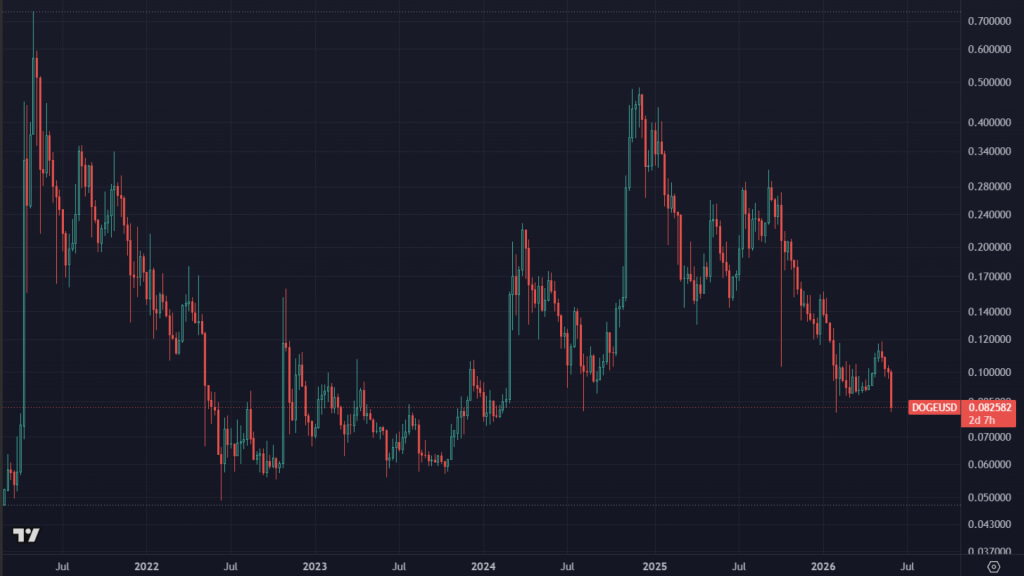
This is a headline that has been penned before, as many an outlet has tried to dance on Bitcoin and crypto’s grave over the last seventeen years, and scammy Bitcoin moon accounts have every one of these wrong calls screenshotted to use as engagement bait. I acknowledge the fact that my headline could join that broader constellation, and I will add a Bitcoin caveat to this blog because it’s the only coin of significance that actually had a bull market in 2025, but I feel very confident that this time truly is different for crypto. Its detractors typically make the mistake of pointing to the extreme lows crypto always experiences in bear markets as proof that it’s over, but the highs are what convinced me. Just look at the titular photo of the Dogecoin chart since 2021 and you can see a fundamental shift away from new crypto all-time highs guaranteed every four years. The network revenue of blockchains has been on a very clear downward trend since 2021, per Blockworks’ analytics dashboard.
It’s so over for crypto
— Jacob Weindling (@jakeweindling.bsky.social) June 5, 2026 at 10:35 AM
This multi-year trend is very bad extremely not good
— Jacob Weindling (@jakeweindling.bsky.social) June 5, 2026 at 10:37 AM
Network revenue is the closest proxy that crypto has to equity markets and cash flows and such, as the way that blockchains work is kind of like an arcade machine. You have to put money in for it to work, and that cash goes to the node operators on the network doing the advanced sudoku to confirm transactions. This is the most important part of crypto, because it is how the chain works and it also doubles as its security. A huge vulnerability was just found in the so-called privacy chain ZCash by Claude, and its price crashed nearly 50% yesterday as the market is being forced to wonder whether the coin can actually do what its boosters say it does. Bitcoin’s largesse is a protective bubble, because it raises the financial bar needed to attack it. The smaller the coin, the easier it is to attack it using methods like the 51% attack and other known vulnerabilities in this technology that hasn’t created many real-world use cases past stablecoins and scamming people. This is why bear markets are so dangerous for so much of the space, as the networks cease to work the way their builders envisioned once everyone packs up and goes home.
Plummeting network revenue since 2021 and 2022 is a proxy for general interest in crypto, and you can measure how many people are actually using this stuff. I was one of those people using it in 2021 and 2022 to play all sorts of irresponsible financial games, and I haven’t really touched it since. If you zoom in on that first network revenue chart above, you will see the color change from the 2021 bull run to the 2025 one. Ethereum in blue and its attempt to create a new decentralized financial architecture that the Federal Reserve of St. Louis found interesting was replaced with Solana’s memecoin casino in green. You can literally see crypto transition from an actual experiment testing its (bad) theories to a capitulation that it’s all just shameless gambling right around the time that crypto chose Donald Trump as its political standard bearer.
Speaking of shameless gambling, remember NFTs? No one really trades them anymore, and this is where crypto is actually pretty neat. The on-chain data being publicly available gives us evidence to show how no one is actually doing anything on-chain anymore. Here’s all NFT trade volume in history, and you can watch it drop off a cliff the minute the Fed raised interest rates in March 2022.
Hey remember NFTs
— Jacob Weindling (@jakeweindling.bsky.social) June 5, 2026 at 11:05 AM
And this is where we get into why I truly do think it’s over for crypto: we’re in a new interest rate world that changes the math around investing and risk-taking. Bitcoin was birthed in 2009 alongside Zero Interest Rate Policy (ZIRP), which made borrowing free. This was an emergency procedure implemented in the wake of the Great Recession, and we held it in place for far too long. This is at the heart of the ascendancy of Venture Capital since 2008 and their ability to take low-risk gambles on an ever-expanding market where eventually, everyone agreed that There Is No Alternative (TINA), and many of these big VC firms jammed billions into crypto when ZIRP returned in the wake of the COVID crash.
“With near zero cost of funds and asset appreciation occurring in every category, how could an investment not pay off?” wrote credit union expert Chip Filson about ZIRP and TINA in 2023. “Holding cash or buying short term bonds was for fools when higher returns were possible from virtually any other investment.”
The era that crypto grew up in took it as an article of faith that investing in an ugly monkey jpeg you don’t actually own is a far savvier investment than buying a 10-year U.S. Treasury Bond, and they were right! ZIRP created the gambling culture that envelops us now, because it truly did teach us that you could buy any old shitcoin with magic ZIRP money and watch it 100x in a few months. It will forever remain deeply disturbing to me how much my present financial wellbeing is dependent on buying Shiba Inu coin in 2021.
In March 2022, the Fed began the fastest rate-hike regime since the Volcker Shock of the early 1980s. That same month, the Bitcoin bear market began in earnest alongside collapsing NFT volumes. The LUNA ponzi that briefly sponsored the Washington Nationals blew up after shocker, supposedly “free” 20% interest on “dollars” wasn’t free nor dollars. Watching “dollars” evaporate into cents through a death spiral programmed into an obvious Ponzi eventually took out a litany of big players in crypto, leading to the gargantuan FTX blowup that marked the bottom of the 2022 bear market in October.
From that bottom, Bitcoin rose about 670% to a new all-time high in October 2025, just before Donald Trump killed the crypto bull market with a Friday post he TACO’d on by Sunday, creating by far the largest leverage wipeout in crypto’s history. That’s a healthy recovery and bull run for crypto’s only mainstream asset, but once you peer past the Bitcoin curtain, it’s clear that something fundamentally changed.
Ethereum, the second largest coin, only rose about 350% from its 2022 low to its pre-Trump 2025 post high, barely breaching the all-time high it made in 2021. Solana, despite recovering better than most big shitcoins thanks to becoming the main non-BTC coin of the 2025 run (up a little less than 2,500% from its FTX low), also barely breached all-time highs it established in 2021 when the Fed Funds Rate was more than 3% lower than it is right now. I wonder what changed!
A few things. TINA disappeared along with ZIRP. It’s not free to borrow anymore, which fundamentally changes the risk models on all sorts of financial chicanery (why Japan losing the last free lunch in finance is such a big development to keep an eye on now). All of a sudden, some shitcoin on Solana created off a Twitter joke that’s already left the zeitgeist isn’t so attractive anymore, and a 10-year risk-free return of 4.5% looks pretty solid. Crypto is a big hot ball of money flowing from meme to meme, and the way to make money is to try to follow it as best you can, but the end of ZIRP simply sucked a lot of money out of this big hot ball.
As did AI. Why would you bother with some shitcoin you know is a scam you’re just hoping you can sell before it crashes when you can buy the largest stock in the world at that same October 2022 bottom and watch it go up over 1,700%? You could have even bought a boomer stock in Oracle and out-performed Ethereum. Equities have seen a huge run over the same time period as they have recovered from the Fed’s interest rate shock, and when you compare equity risk models versus crypto risk-models when the equity returns are as good or better than crypto, why the fuck would any serious person ever buy crypto?
And unserious people, the lifeblood of crypto, also know that AI is the better trade. The degenerates who started buying crypto on Robinhood and have fueled NFT volumes and other crypto get-rich-quick schemes over the years have been lured away by the upside of AI stocks and options trading and pure gambling like zero-day expiry options. Or prediction markets. Or sports betting. Or those scammy slot machine AI ads that proliferated throughout all of March Madness. Crypto is not the only get-rich-quick scheme in town anymore, and it’s not a ZIRP town either. The ground shifted under cypto’s feet, and when that happened, almost everything but Bitcoin traded sideways in the range it established between the regime change from 2021 to 2022. I think it’s crystal clear that without Bitcoin’s wealth effect dragging everything up, crypto would not have experienced a bull market over late 2024 and 2025.
And the only reason that Bitcoin experienced a true bull market is because of its acceptance into ETFs. Institutional investors could never buy it on Coinbase or on chain due to the litany of financial regulations around it, and 401ks could not touch it either. Allowing vetted vehicles like IBIT to purchase Bitcoin for their clients created a gargantuan source of demand that pretty much no other coin in crypto got a serious share of. Bitcoin dominance (in orange below), what percentage of crypto’s total market cap is just Bitcoin (in blue), completely reversed the trend it established in the ZIRP universe where it was around 40% in bull markets. I’ve marked the last three Bitcoin all-time highs with white vertical lines so you can see where it matches to Bitcoin dominance, demonstrating how 2025 was truly a regime change for crypto. In past bull runs, people bought shitcoins. In this one, they bought Bitcoin and kept it around 60% dominance at the highs.
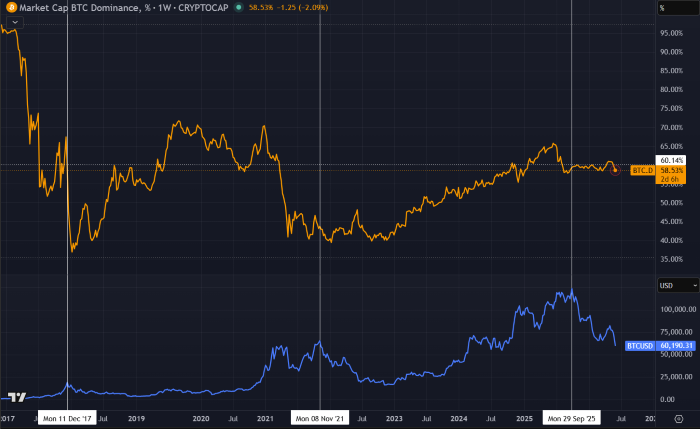
Chart by TradingView
According to CoinGecko, 53% of cryptocurrencies have failed, but that figure is optimistic compared to recent trends. They found that 11.6 million tokens died in 2025 alone, representing 86% of the 13.4 million coins that have left this world since 2021. I know that whatever remaining crypto bros on crypto Twitter are chomping at the bit to screenshot this title and wait to own me with it at new all-time highs, but everywhere you look, there is a mountain of evidence to suggest that other than with Bitcoin, they may be waiting for a while. Without the Bitcoin ETFs holding up the entire market, things could be really dark for the space right now.
Investing post-2021 in crypto is just more expensive because market caps across the board are higher, making it much harder to get those 100x returns that fuel the speculation which creates frothy bull markets. The risk calculus changed for many large trading firms who now are stuck with a large volume of shitcoins drifting sideways that they cannot sell into thin markets without crashing them. But don’t take it from me, a crypto hater, that this feels different. Take it from one of the best and most reasonable traders left on crypto Twitter.
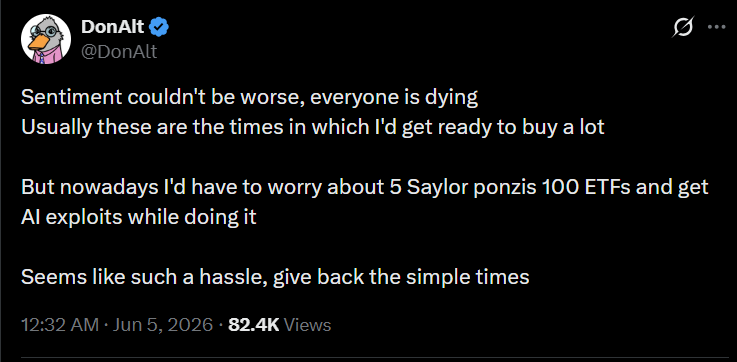
I agree. I still do trade crypto simply because I am forever cursed with the knowledge of how to do it and I am not going to walk by free money when I think I see it on the ground, but I just increasingly see less free money on the ground in crypto. I don’t see any reason to buy anything but Bitcoin because no one else is buying anything but Bitcoin. When I say it’s over for crypto, what I mean is that this iteration of it—the scammy bullshit that doesn’t work the way its religious adherents say it does and only survives on the power of memes and VC cash—is dead. Blockchains as a force for financial innovation do not work, and AI is exposing them in myriad ways.
To my eye, the charts in crypto look like everything but Bitcoin is circling the drain. The free lunch powering the land of vaporware and scams is over, and the market is now solely populated by Trump-adjacent sharks looking to steal your money the moment you press the buy button. If crypto is going to survive a crypto winter that looks to be the most brutal since the Mt. Gox meltdown, it is going to have to build something fundamentally different from the ZIRP government handout it survived on before.
 Keep scrolling for more great stories.