

Jennette McCurdy’s New Novel, ‘Half His Age,’ Follows a Familiar Script
It's not bad, per se, but it has none of the care and consideration that was evident in McCurdy’s memoir, I’m Glad My Mom Died.
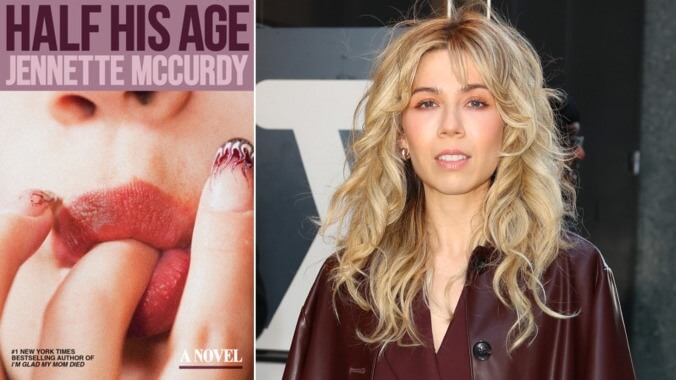
Photo: Ballantine, Getty Images (Jason Howard/Bauer-Griffin/GC Images) BooksEntertainment
In her bestselling memoir, I’m Glad My Mom Died, Jennette McCurdy writes about her first sexual relationship with a much older co-worker on the set of the Nickelodeon show iCarly. At the time, she was Mormon, extremely sheltered, and being sexually abused by her mother, who also encouraged her disordered eating in order to keep her body childlike. McCurdy had no idea about sex, she writes. “What have I done?!” her older paramour laments about breaking up with his age-appropriate girlfriend for McCurdy after she gives him a blowjob for the first time.
There’s no doubt that this experience inspired McCurdy’s latest book, Half His Age, which is her first novel. Here, though, her protagonist, Waldo, is sexually experienced and is the one to initiate the relationship. She’s in the driver’s seat—at least that’s what Mr. Korgy, Waldo’s high school English teacher, tells her. “We can’t stop any time you want,” he says at several points throughout their intense, whirlwind relationship, which spans most of Waldo’s senior year. “You’re in control here.”
Half His Age is McCurdy’s attempt to wrest back agency through Waldo. Waldo is not particularly special: She’s “seventeen with bad grades,” insecure about her looks, and her idea of fun is shopping on Shein with whatever is leftover from her Victoria’s Secret paycheck after she’s paid her mother’s electricity bill. Her mother, who had Waldo when she was younger than Waldo is now, neglects Waldo for days at a time in favor of her deadbeat boyfriend, who doesn’t even know Waldo’s name (“Hi Wanda,” he repeatedly calls her on the few occasions Waldo’s mom convinces him to spend time at their apartment). This behavior has some strong parallels to the way Waldo herself drops her other interests in order to make her entire personality about Korgy, but curiously McCurdy does not explore that angle very much.
Waldo, who has had several lackluster sexual relationships with boys in her senior year class, pursues Korgy, who is older than her mom. At some points, as a reader, you almost believe his assertion that Waldo is the one with the power, and their first sexual encounter is murky: He is the authority figure but he says no several times and Waldo doesn’t stop.
But as their affair progresses, Waldo and Korgy shift back to the traditional tropes of an inappropriate relationship: She contorts herself into “a doll, a marionette with lifeless eyes, porcelain skin, and no needs of my own, a doll who indulges his fantasies” (we’ll come back to that repetition in a second) while he schools her outside of the classroom with high-brow culture from his era, like “Bent” by Matchbox 20. (Cue the scene from Barbie in which all the Kens serenade the Barbies with “Push.”)
As we get to know Korgy, we—and Waldo—come to realize he’s a bit of a dolt. (Surprise, surprise.) Like in McCurdy’s real-life experience, Korgy ends up leaving his wife. Instead of expressing regret, though, he seems to double down on the mess he’s made of his life: He becomes the embodiment of the stereotypical tortured writer who couldn’t do, so he taught, hauling out his “half-finished dystopian-future novel, tucked in the back of a drawer, dusty and dog-eared and paperclipped with notes he never got around to.”
As Korgy trades his scholarly cardigans that caught Waldo’s eye in the classroom for days-old sweats worn around his sad bachelor pad, Waldo develops the ick. Suddenly she no longer wants to “shovel his cock into my mouth, praying in between gags that I’ll get it far enough back in my throat that he’ll have to love me,” as she puts it earlier, and instead reverts to the dissociation she experiences with all of her other romantic partners.
Though Half His Age concludes satisfyingly, with Waldo recognizing some semblance of her worth outside of her sexuality, McCurdy’s prose leaves you wanting. “I like writing that’s simple. Plainly stated observations, no fluff,” Waldo contends, yet Half His Age is sometimes too simple. It’s repetitive in parts that don’t feel intentional; it just feels like it could have benefited from another copyedit.
Half His Age isn’t bad, but it feels rushed in comparison to the consideration that was evident—and widely praised—in McCurdy’s previous book, which seemed honed over years. I’m Glad My Mom Died thoughtfully placed the reader in the mind of a child navigating abuse and trauma, so the apparent lack of care in this novel surprised me. Plus, there’s nothing to differentiate it from any other sexually destructive sad girl novel (McCurdy listed My Year of Rest & Relaxation as an inspiration to Elle) and I don’t think it will be dominating the conversation for years in the way I’m Glad My Mom Died has.
Scarlett Harris is a culture critic and author of A Diva Was a Female Version of a Wrestler: An Abbreviated Herstory of World Wrestling Entertainment.
 Keep scrolling for more great stories.