

Jezebel’s February Book Pick: A Story Collection About Living in the Shadow of the Troubles
Liadan Ní Chuinn's Every One Still Here is about a universal theme—complicated family relationships—in a singular setting: Northern Ireland after the Good Friday Agreement.
Photo: Charles McQuillan/Getty Images, FSG BooksEntertainment
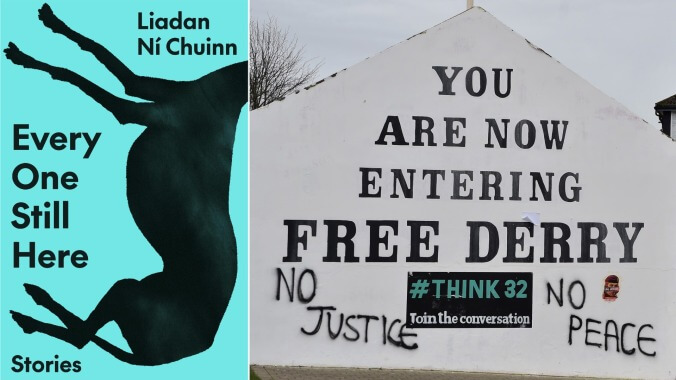
Liadan Ní Chuinn was born in Northern Ireland in 1998, the year the Good Friday Agreement ended the Troubles, the decades of violence stemming from England’s occupation of Ireland.
Other recent fiction about the Troubles—the novels Milkman and Trespasses, the TV show Derry Girls (all excellent)—is set firmly in the last century, relegating the violence to history. Ní Chuinn’s work does the opposite: Their new book of short stories, Every One Still Here, is set in contemporary Northern Ireland and is riddled with the effects of imperialism.
But these stories are not only about the after-effects of English violence on the Irish. A Basque family in “Amalur” discusses oppression in Franco’s Spain: “The language was banned, it was illegal to give your child a Basque name… they fined us for speaking it, our own language, in our own land, the government removed the language even from graves.” The protagonist of “Russia” works at a museum that displays preserved bodies from ancient civilizations, which become the target of anonymous protest, including signs taped to display cases saying things like “I AM SOMEBODY’S CHILD.” The structural violence of unequal economic structures also weighs heavily on these stories: adult children living at home not by choice but due to necessity; gig work’s lack of agency; multiple siblings who emigrated “to America and never came back.”
Every one of these stories is ultimately about a family relationship—some vaguely complex, but others painfully straightforward, if only anyone would address them. There are a couple of happily married Gen X couples who seem deeply unaware about how the choices they made as young parents impacted up their now-adult children. There are young adults whose parents died when they were kids; the causes are never made explicit but the trauma of growing up under the boot of the British Army is always at least an indirect reason. There’s infertility treated with IVF and adoption—or left to fester and harm relationships. There’s loneliness, there’s introspection; there are characters trying to process what’s happened to them and their families, and their relatives who want to avoid anything complicated and just get on with their lives.
Complicated family relationships are everywhere, but the specific history of England’s centuries of occupying Ireland is not, and the dichotomy of universal and specific is one of the book’s strengths. The two are woven together throughout Ní Chuinn’s collection, explicitly so at the end of the final story, as sentences toggle back and forth between Rowan’s memory of his family, and his anger at the U.K.’s ongoing refusal to punish soldiers who murdered Irish civilians:
“British politicians call British soldiers the ‘victims of persecution’.Rowan hears a man, stood round his dad’s coffin, saying: and sure, isn’t Dónal always taking things to heart, never forgave himself that, at their mother’s funeral, the priest forgot her name.
The British Army, Rowan reads, maintains that it was always, and remains, a neutral force.
There’s [his uncle], leaning forward where he sits, hands clasped together between his knees…
Our taxes pay for their guns, their boots, their salaries, their pensions, fifty million files sealed until all of us are dead.”
Ní Chuinn, who is nonbinary, is “protecting their privacy throughout the publication process” and published the book under a pseudonym. This highly risky, deeply respectable move in the era of personal branding makes this story collection stand even more strongly on its own two feet.
 Keep scrolling for more great stories.