

You’ll Never Be Half as Tough as the Sherpa Guide Who Spent a Week Crawling Down Everest
Before a miraculous rescue, he may have spent more time above Base Camp on Everest than any human in history.
Photo via Unsplash, Sebastian Pena Lambarri Splinter Everest
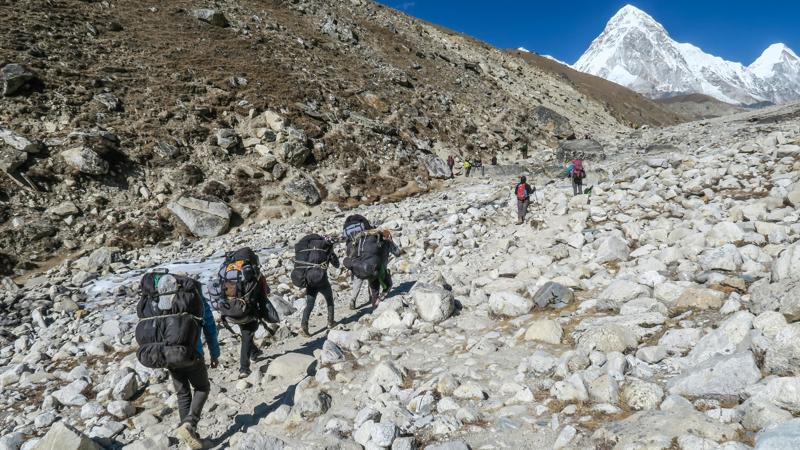
When it comes to levels of legitimate toughness and grit we assign to those who every year ascend to the roof of the world to take a selfie on the summit of Mount Everest, there’s a delicate gradient. At the bottom of the scale, you have the posh climbing enthusiast tourist, sucking down canisters of supplemental oxygen and hoping that their body lasts long enough in the Death Zone for their paid guides to drag them to the top before the zone follows through on its namesake. Higher up on the scale, we have the aforementioned guides, many of them of the Tibetan/Nepali Sherpa people, some of whom have summited Everest on numerous occasions. Still further up, you have unsung heroes like the “icefall doctors,” the specialized group of intensely hardy men who spend weeks preparing the way for all the other climbers every year, placing markers and finding ways around impassable ice. And on the tippy-top of the Everest Badass Scale, you have the guide who was just found alive on the mountain and rescued, six days after anyone had last laid eyes on him, who had subsequently crawled down the highest peak on Earth without food, water, oxygen or additional supplies. This guy, suffice to say, stands alone.
That man is the well known Dawa Sherpa, 52 years of age, also referred to as “Hillary” in reference to famed mountaineer Edmund Hillary, who alongside legendary Sherpa Tenzing Norgay became the first person to provably reach the summit in 1953. He had last been seen alive well above Camp 3 on Everest’s south face (the most common route), at a height of more than 24,600 feet, six days before he was found. To say that expectations he had survived were slim is a massive understatement: The man’s family was already reportedly on the second day of funeral rites for him when they heard that he had been rescued while crawling through the exceedingly treacherous Khumbu Icefall just above base camp. His teenage daughter, Mendo Lhamu Sherpa, undersells what an incredible moment of revelation this must have been: “When we first heard about it [the rescue], we could not be sure if that person was indeed our father. So to be certain we asked for photos to be sent and then only we were sure and very happy.”
www.outsideonline.com/outdoor-adve…
Hillary Dawa Sherpa went missing nearly a week ago on Everest. at nearly 8,000m. With no food, water or oxygen everyone assumed he was dead. And six days later he’s found having apparently crawled down the mountain. Absolutely astonishing.
— Hugo Gordon (@hugogordon.bsky.social) 2:58 AM · Jun 4, 2026
Incredibly, other than frostbite on his hands, Dawa Sherpa even seemed to be in relatively good health. As put by Pemba Sherpa, the executive director of the group overseeing search efforts for him: “Dawa managed to survive against all odds for days. It’s nothing short of a miracle. This is a true self-rescue. As far as I know, no one has survived alone at that altitude on Everest so far.”
In doing so, it is entirely possible that Dawa Sherpa may have just become the human being who can definitively say that they survived for the longest period on the mountain above Everest base camp in a single stretch, at least while alone. Reporting on this story around the wider media has largely focused on the time frame of six days, the period that Dawa Sherpa was missing before he turned up alive, but that unintentionally overlooks the fact that he was in fact above base camp for much longer, guiding a client to the summit before becoming separated during the descent. That client, former British Royal Marine Chris Thrall, successfully made the summit with Dawa Sherpa days earlier, but said that he forged ahead while the guide sat down with his backpack for a rest while they were descending from Camp 4, still near the Death Zone.
As Thrall described it: “And I turned and I said ‘Hillary, are you okay, brother?’ He said, ‘Yes, yes, fine Chris, please go, go!’ This is nothing new, you know, I’d go ahead, he’d go ahead.” Thrall continued on, reportedly helping another struggling Polish climber who was part of the group, but Dawa Sherpa never reappeared. The group had already been especially physically taxed, and it ultimately took Thrall 11 days in between leaving Base Camp and returning to it, much longer than usual for climbers. Dawa Sherpa spent even more time above base camp on top of that, the last six days of it all on his own, possibly suffering from injury, illness or plain exhaustion. But where you or I would surely have just accepted icy oblivion, this man just kept crawling from camp to camp, and ultimately onto the Khumbu Icefall, the specific location where more Everest climbers have died than any other, where he was finally and mercifully spotted by rescuers. This is a display of determination on a level that is impossible to quantify.
As I had written about previously for Splinter, this has already been a strange and fraught Mount Everest climbing season, one that highlighted the selfless work of people such as the icefall doctors in trying to find an accord with the mountain itself to allow anyone to ascend to the top. The narrow window of relatively workable conditions for the ascent started weeks later than usual thanks to massive chunks of ice (seracs) blocking paths in the Khumbu Icefall, even as hundreds of anxious climbers waited at base camp–which has the potential to create catastrophic scenarios higher up where progress is slowed in the Death Zone by too many people trying to make the summit at once, a scenario that caused mass death incidents in 2019 and 2023, sparking attempts at reform. Despite this, a reported more than 1,000 people managed to reach the Everest summit this year during the few weeks that constitute the heart of the climbing season, making it yet again the busiest on record, although there was thankfully no mass casualty event this time around.
Photo of the week: Line of climbers slowly trek to the summit of Mt. Everest | Everest, Nepal www.reuters.com/pictures/pho…
#photography #mountaineering #everest📷 Purnima Shrestha/Reuters
— Janet G 😎 (@thecuriousg.bsky.social) 1:25 PM · May 23, 2026
That said, people definitely died, as they do in every year on the mountain. There have been five confirmed deaths in 2026–three Sherpas and two other climbers–including multiple deaths from illness after making the summit, and the tragic death of a 20-year-old who fell down an embankment while ascending the Lhotse Face. Dawa Sherpa was presumed to be the sixth of those deaths, until he made a miraculous annotation to the grim tally of souls claimed by Everest.
As I observed back in April, as the icefall doctors attempted to work their magic in securing routes to the successively higher and more deadly camps that dot the mountain’s face, “Mount Everest remains the ultimate prestige symbol of the unprepared outdoorsman’s bloated ego.” It continues to draw those who overestimate their fortitude, even as the governments of Nepal and Tibet attempt to dissuade them, and only through the grace of their local guides–people such as Dawa Sherpa–do many of these people survive the ordeal. Sometimes, it falls upon those guides to pay the ultimate price for this kind of folly, but not even the famously deadly mountain could take down Hillary Dawa Sherpa, left on his own to crawl down its face for a week. There’s “indomitable,” and then there’s him.
 Keep scrolling for more great stories.