

Munetaka Murakami Is MLB’s Oddest (and Most Extreme) New Slugger
New White Sox star Munetaka Murakami might be MLB's most extremely specialized slugger, the ultimate "three true outcomes" guy.
Screenshot, YouTube SplinterSports baseball
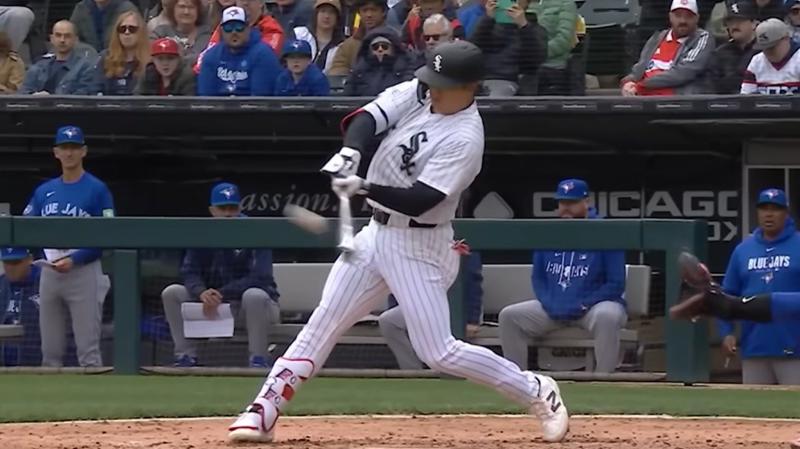
Coming into the 2026 Major League Baseball season, one of the biggest free agent narratives was which team would sign young Japanese superstar power hitter Munetaka Murakami. As a prodigious, youthful slugger and two-time MVP who posted gaudy home run totals overseas, including a scintillating 56 home run season in 2022, it was speculated that Murakami would draw near universal interest across baseball, commanding one of the biggest international contracts ever handed out. Numerous offseason projections predicted Murakami would achieve a contract of $150-180 million or more … and then he shockingly signed a two year deal for a mere $34 million. And who signed him? Well, the Chicago White Sox, of course! A team that had just finished the 2025 season with 102 losses, and the third lowest payroll in baseball, one year removed from a 2024 season in which they set a new modern record of 121 losses. To say this was an unexpected outcome is a massive understatement—no one was predicting that an international hitter with such impressive power numbers would end up where he did, on such an inherently affordable deal.
That the White Sox were able to sign Munetaka Murakami in this way speaks to how player scouting in MLB now works, how much analytics are valued, and how an exceptional player can sometimes slip through the cracks because people simply don’t believe it will be possible to translate their game to American baseball. No one offered Murakami the kind of contract that was expected because there were deep, deep doubts in every single MLB front office about his ability to translate his high-power, high-whiff skillset effectively to the highest echelons of professional baseball. Every team feared that he might be a total, complete bust. And watching the man perform today, you can understand where at least some of those doubts were coming from, because his skillset is one of the most extreme, and inherently fascinating hitting profiles in MLB today. We’ve had hitters branded as “three true outcome” (HR, strikeout, or walk) players before, but none of them in the game right now are doing it in such an extreme (and effective) way as Murakami is doing. He is simultaneously hitting home runs, striking out and walking at rates that are nearly unprecedented. And at least one facet of that game will be on display tonight as he comes back from the IL just in time to be a late addition to the annual T-Mobile Home Run Derby, becoming only the second Japanese player to do so after generational superstar Shohei Ohtani in 2021. It may well turn out to be a coming-out party for the league’s most dynamically extreme young hitter.
Lord of the Three Outcomes
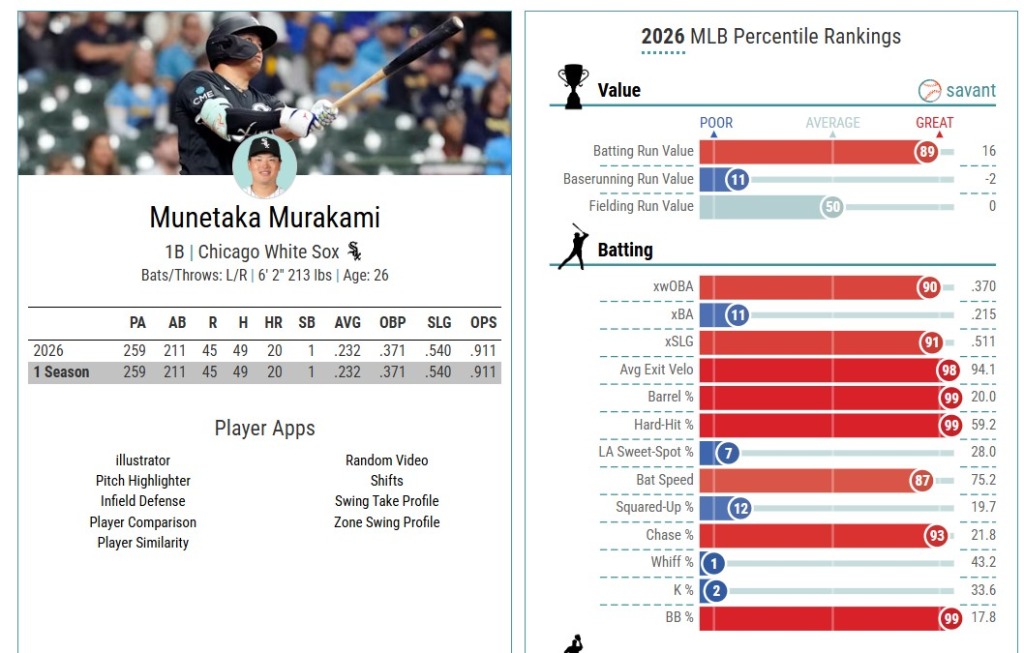
The single most fascinating thing about Munetaka Murakami, in my opinion, might actually be just how much he struggles to hit baseballs that are in the strike zone. He is legitimately terrible at making contact! His zone contact rate, a measurement of how often a player makes contact with the baseball when they swing at a pitch that is inside the strike zone, is only about 67%, which is among the very lowest in baseball–so low that it guarantees a very high rate of strikeouts simply because the hitter is missing pitches in the zone (not to mention outside the zone) so very often. And indeed, as you would expect, Murakami’s strikeout rate of 33.6% going into the All-Star break is in the top 2% in baseball.
There is, essentially, only ONE WAY that you can be effective and valuable as a major league hitter while striking out that much. You have to:
A. Hit a shit ton of home runs, and
B. Be willing to take a shit ton of walks.
And wouldn’t you know it? Munetaka Murakami also happens to be preternaturally good at both of those things.
Half a season into his MLB career, the absolute raw power is now beyond dispute. He hit home runs in his first three games as a member of the White Sox. He was on the warpath all through April and May in this regard, becoming the third White Sox player to ever hit 20 home runs before the beginning of June. The only other two to do that are both Hall of Famers: Jim Thome (2006) and Frank Thomas (1994). That total, by the way, was also the most home runs ever hit before June by a rookie, eclipsing the outstanding rookie performers like Aaron Judge, Pete Alonso and Mark McGwire. None of this should perhaps have been a huge shock considering that we are talking about a player who once hit home runs in five consecutive at-bats in Japan, but remember: The league was so afraid he would be a bust that no one but the lowly Chicago White Sox were willing to roll the dice on him.
MUNETAKA MURAKAMI GRAND SLAM OVER THE BATTER’S EYE
— Talkin’ Baseball (@talkinbaseballbot.bsky.social) 11:46 PM · Apr 17, 2026
Murakami’s home runs likewise easily pass any kind of eye-test that is preferred by the more stats-phobic old school viewer. He has hit tape measure shots, such as lofting a massive grand slam entirely over the huge center field batters’ eye in Sacramento. He’s hit home runs on pitches that were well outside of the strike zone, and pitches where he very clearly made relatively poor contact. Look, for instance, at this particular home run against the Nationals that Murakami catches out of the strike zone, on the end of the bat, and it still somehow manages to carry into the stands, defying all logic. These are things you can only do with certifiably outrageous strength.
But the most IMPORTANT part of Murakami’s game, and the only thing that makes his hitting profile viable at all, is the fact that he possesses an ELITE eye as a batter, refusing to swing at pitches outside of the strike zone. This is absolutely crucial for him in particular because, remember, he’s not good at making contact in a general sense. If pitchers ever figure out a way to consistently get Murakami out by throwing pitches outside of the zone and getting him to chase them, then his career will be instantly over, because his strikeout rate will balloon to historic levels that are not sustainable. But because his eye for determining balls and strikes is so good, Murakami is running a walk rate in 2026 of 17.8%, which is in the 99th percentile in baseball. And because he’s willing to take those walks, it forces pitchers to bring their pitches into the strike zone … where he can (occasionally) make contact and hit home runs. The refusal to chase, and the ability to walk, become his saving grace as a player. They’re completely necessary to paper over his contact issues.
All of these facets of his game are encapsulated in one of the most extremely skewed Baseball Savant pages any player has ever possessed. Look at the incredible gulfs between the areas in which he excels (chase, walks (BB), exit velocity), and the areas in which he’s one of the worst in the game (whiffs, strikeouts, expected batting average). This is the ultimate MLB two-face.
There are other extreme players in baseball, and other “three true outcomes” guys. Baseball history is full of them, and they have a tendency to be big-time run producers who are still polarizing to fans because of their obviously flawed nature. Some, like Adam Dunn, go on to long careers as potent offensive producers but still find themselves underappreciated years later. Others like Joey Gallo have a few big years before the contact/chase problems eventually become too much to overcome, and no amount of home runs can make up for the omnipresent strikeouts. In the modern game, the closest comparison to Munetaka Murakami is probably the Phillies’ home run king Kyle Schwarber, whose Baseball Savant page looks at least comparable … until you start to look more closely. Murakami, you’ll see, ends up being a more extreme version in almost every way that is measured. His contact skills are a run below Schwarber’s, meaning he whiffs that much more. But on the other hand, he chases pitches outside the zone even less frequently than Schwarber does, and he walks even more than Schwarber does, and Schwarber’s expected batting average is notably higher. Which is all to say, Kyle Schwarber is a bit more of a genuine MLB hitter, albeit still a three true outcomes guy. But Murakami? He is the OUTCOMES INCARNATE.
Consider, for a moment, one weird little Murakami factoid that demonstrates just how tailored and optimized his approach is for home runs above all else. Munetaka Murakami didn’t hit his first double in Major League Baseball until May 4, more than a month into the season. By that point, he had already hit 14 home runs. This set a new record for the most home runs ever hit to begin a major league career before hitting a double or triple. That is how odd an outlier Murakami truly is. Baseball fans are seeing the beginning of a truly noteworthy and unusual career this season, one that could ultimately be as fragile as it is exciting–a guy like Murakami has little room for error when his approach is as extreme as it is. Here’s hoping that when he strides to the plate to launch some dingers at the Home Run Derby tonight, he puts on a show … provided he can make contact, of course.
 Keep scrolling for more great stories.