

Trump Is Panicking Over the Threat of $5 Gasoline and Rampant Inflation
To quote the President: "ONLY FOOLS WOULD THINK DIFFERENTLY!" Now that is a calm individual.
Photo via Unsplash, engin akyurt Splinter Iran War
Less than two weeks ago, the price of a barrel of oil was roughly $65. Today, just over a week into President Donald Trump’s utterly pointless, fully voluntary war with Iran, a conflict we kicked off by almost certainly being the nation responsible for bombing more than 165 schoolchildren, the price of a barrel of oil briefly touched almost $120, before settling above the symbolic $100 threshold for the first time since the spike following Russia’s invasion of Ukraine in 2022. The President of the United States, certainly not mashing his sweaty palms into into his phone screen at the thought of $5 or $6 gasoline in the immediate future, only months before midterm elections, immediately went into EVERYTHING IS FINE, NOTHING TO SEE HERE mode on his own Truth Social, pumping out the following screed. I already invoked the term “sweaty” here, but I don’t believe there’s a better one to encapsulate this particular sentiment.
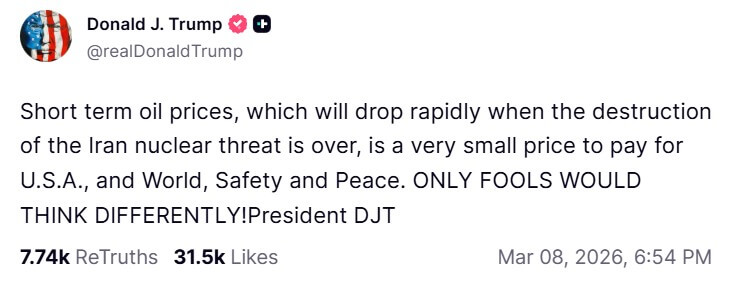
Ah yeah, things are definitely going great when you’re ending your online pronouncements with “ONLY FOOLS WOULD THINK DIFFERENTLY!” The world’s most persuasive individuals famously end all of their writings that way, regardless of subject.
In just over a week, Trump has managed to plunge the world into widespread financial and economic chaos, something that seems to only now be dawning on him, despite the fact that surely people on every side of the man would have attempted to explain the snowball effect that attacking Iran would have on the economy, and even more importantly, American perception of the economy. Perhaps Trump was simply delusional enough to believe hype men like Pete Hegseth promising that the war would begin and then end instantaneously, with all U.S. goals achieved and no ripple effects on the world’s oil-dependent arteries. Who the hell can say what the thought process was here, besides one Trump has stated clearly himself: Personal vengeance against Iran for past threats made against his own life. And now it seems we’re all going to collectively shoulder the price of Trump’s grudge, in a war whose projected duration has already swelled from days, to weeks, to months.
In case you need a refresher: Oil prices are currently skyrocketing due to both the threat Iran presents against Gulf area oil producers (because we dragged them into war), and the fact that the conflict has effectively closed the Strait of Hormuz, the vital shipping lane through which 20% of the world’s oil production usually passes. Iran has vowed to attack any oil tanker passing through the strait, and has in fact already done so. The U.S. has made noise about various solutions, including supplying insurance to tankers passing through the strait after other maritime insurers refused to do so, or providing naval escorts for tankers, but no actually operational plan appears to be in place. And meanwhile, the price of oil has a rocket strapped to it, with the price of a gallon of gasoline following close behind. Iran, meanwhile, has signaled no intent to deescalate the conflict, naming Mojtaba Khamenei, the son of slain supreme leader Ali Khamenei, as its new leader–a direct rebuke to Trump and the U.S.A.
“It’s a sign of continuation of Iran’s hardline approach and indicates that the war will be more prolonged than financial markets had assumed last week,” said Neil Wilson, a trading strategist for Saxo Markets, to CNN. “Complacency has been replaced by a degree of panic because the market is now pricing in a more sustained hit to energy and trade flows.”
And with the elevation of Mojtaba Khamenei, so ends just about any remaining hope for the war to resolve in rapid fashion, which is what has sent the financial world into more of an overt panic. The DOW Jones is in freefall as I write this, currently down more than 3,200 points in the course of the last month. Analysts are predicting that the price of a barrel of oil will continue to rise for roughly as long as the Strait of Hormuz remains closed, and that oil could hit $150 per barrel by the end of the month. Gasoline in America, meanwhile, has already shot up close to 20% in the last week, now hovering near $3.50. With oil continuing its trajectory, we could be sitting at $5 or $6 gallons of gasoline within a few more weeks as well, which even Trump knows is political suicide. Thus his very worried Truth Social assurances.
Oil up by $12 a barrel in less than 12 hours.
Gas prices skyrocketing.
Almost 100,000 jobs lost last month.
Another war in the Middle East.
Are we great again yet?
It’s not just gasoline, though–the price of gas is merely one of those highly visible, symbolic measures of our precarious economic position as consumers. The price of oil affects so much more than just gasoline, being fundamentally tied to inflation, the very thing that Trump’s administration has wanted to be publicly seen curbing. It is deeply ironic that Trump himself has spent so long haranguing the Fed about dropping interest rates, only to unilaterally plunge the United States into a conflict seemingly designed to send inflation through the roof, which is likely to be associated with rising interest rates in an effort to curb it. Because oil is a necessity in the fuel involved in transporting all products around the globe, higher oil prices make literally everything incrementally more expensive, fueling fears of stagflation. But again, it goes so much deeper than even oil–the Persian Gulf, for instance, is also the world’s leading source of common fertilizers, meaning that those prices are now spiking as well. Higher fertilizer costs and lower utilization means lower crop yields, which means more expensive food for everyone. Yet another fringe benefit for the consumer of a Trump war with Iran that has no obvious goal or ending in mind.
How bad it all ultimately gets comes down to how long the conflict lasts, whether the Strait of Hormuz remains closed, and whether combatants in the conflict choose to go after each others’ oil industry. The U.S. attempted to shield fears on that final front by saying that we had “no plans” to directly attack Iran’s oil industry … only for Israel to simply attack Iran’s oil industry instead this weekend, filling the skies above Tehran with chemical rain.
To date, the war with Iran has cost the lives of seven American service members, in exchange for higher prices, frayed relationships throughout the region, and a gloomy economic forecast. Sadly, even if Trump finally pays for the chaos with a blue wave midterm election in November, the damage has already been done.
 Keep scrolling for more great stories.