

My Week With a Nextdoor Catphish Scammer
How I spent days chatting with an AI-wielding scammer as they attempted to build an emotional connection.
Photo via Unsplash, Lindsey LaMont, Operation Shamrock, In Depthsocial mediaSplinter Scams

Of all the online locales where I could have met the scammer I recently spent more than a week chatting with, Nextdoor probably would have been near the bottom of my suspect list. It is, after all, a social media service focused on hyperlocal networks meant to be limited to just your own neighborhood or the surrounding areas, with profiles tied to legal names and concrete addresses. It’s the place where I lurk to watch absurd neighborhood gossip unfold: Retirees bitching about teenagers coming too close to their property; local birders posting their best backyard cardinal photos; obsessive conspiracy theorists ranting about how local ordinances are clearly meant to specifically target them or their families. I rarely comment on Nextdoor, and since joining in March of 2022 I’ve made a grand total of one post to my personal profile. And yet, even while barely using the service, a scammer still found it worthwhile to specifically target me there.
Recognizing immediately what was likely happening, I decided on the spot to go along with the deception, to see how far down the rabbit hole it would lead. What follows is my experience with what is referred to as a “pig butchering” scam, which millions of Americans are now being targeted by every year via phony social media profiles and advertising. According to the FTC and FBI, an estimated $12.5 to $16.6 billion American dollars were lost to these scams in 2024, a more than 30% increase from the year before. It’s a booming international criminal enterprise.
Her name, supposedly, was Sofia. We had never interacted in any way before she sent me a friendly message out of the blue. Immediately, I was suspicious: In years of browsing Nextdoor, I’d never gotten a random, unsolicited message, much less one from a profile with a woman’s name attached to it. Her profile, likewise, was effectively blank–just some pleasant stock imagery and no actual posts. This is what I saw, when I first clicked on it.
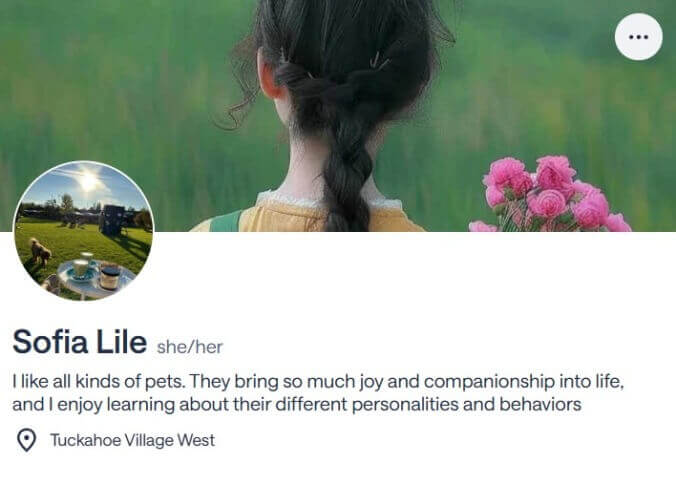
Sofia’s profile said she lived in a neighborhood just down the road from mine, near a park where I often walk with my wife. Curious how she would respond to questions about the local area, I gently probed her for opinions about our neighborhood on the outskirts of Richmond, Virginia. What did she think about the schools, parks, restaurants? Did she have a single detail about suburban Richmond to share?
Perhaps unsurprisingly, she did not. Sofia quickly admitted she did not actually live in Richmond at all–she instead claimed to live in Los Angeles, having merely lived in Richmond previously, and said she was originally born in Italy. This was the moment when any doubt about whether I was speaking with a scammer more or less vanished: What reason would an Italian-born resident of L.A. have to strike up conversations with random people in Virginia she’d never met or interacted with before, in a city where she no longer lives, on the opposite seaboard of the United States from where she claims to now reside? It’s a bait-and-switch technique that would be a necessity for launching such a scam on Nextdoor, which is only open by definition to people who live in your neighborhood. A scammer, however, can’t very well claim to live right around the corner from their mark, lest the target pull an immediate habeus corpus demand on their ass. Thus, the switch to Los Angeles. Even the choice of Italy as an origin point for Sofia seemed perfectly calculated: It’s exotic enough to be intriguing, while also serving to excuse any occasional lapses of English, given that the actual person I was speaking with was most likely based somewhere in Southeast Asia, the global center for pig butchering scams.
My curiosity was now well and truly piqued. If I played along with Sofia, how far would it all go? What would our conversations be like, and how convincing would they be? How long would it take for the scammer to transition to some kind of monetary talk? What kind of fake cryptocurrency or investment scheme would they attempt to get me to participate in? Would there be a romantic element, some kind of honeypot operation involving blackmail? Or would they somehow sense that I was screwing with them and cease contact? I had no idea what to genuinely expect, but I committed myself: I would play along for as long as it took to find out.
My Friendship with Sofia the Scammer
I set some ground rules for myself, as our Nextdoor chats continued. First of all, I would play things more or less as “neutrally” as I could, allowing Sofia to make all the first moves whenever possible. I wouldn’t bring up money, or investing. I wouldn’t attempt to push for more intimacy or emotionality. I wouldn’t overshare–I used stock photos to represent myself, my pets, etc. I would just be pleasant and attentive in my answers, and see how Sofia would attempt to steer the conversation in those types of directions. I wanted to see: As the scammers assessed a seemingly very average 39-year-old man, how and when would they try to make their move?
On the second day of chatting, Sofia made one of the moves I was anticipating would have to happen sooner rather than later: She asked to move our conversation away from Nextdoor. This is a necessity for scammers who are attempting something as intricate as a pig butchering scam, so named because they involve building up a sustained, trusting, emotional relationship with the mark–“fattening them up,” as it were, like a pig before the “butchering” phase in which money is extracted from them via the built-up trust of the relationship. A scammer doesn’t want to spend weeks chatting with a mark on a platform like Nextdoor, only to have their account there shut down–they have to get the conversation somewhere with less risk for them. For Sofia, and for millions of other scammers, that was WhatsApp, the popular global messaging app featuring end-to-end encryption. This feature, meant to offer user privacy, also offers more safety to hide behind for scammers. Sofia told me that she was “rarely” on Nextdoor, and that we should continue our frequent conversations on WhatsApp. Soon after, our original Nextdoor conversation was seemingly deleted by the site, with each message now just reading “this message was removed by Nextdoor.”

I followed Sofia to Whatsapp like the good little mark I was pretending to be. She responded by sending me the only purported photos of herself she would ever end up sending. This woman was supposedly my new digital bestie. For copyright reasons, after discovering their eventual source, I can’t embed them here.
Oh yeah, that’s absolutely the physical incarnation of a cultured Italian woman whose hobby is talking to random men online on the opposite seaboard. Hilariously, Sofia claimed after sending these photos to be 40 years old, rather than the pictured woman who looks more like someone in her mid-20s. Presumably, she chose “40” because it was closer to my own age; an aspect that would perhaps make the emotional connection she was seeking seem more organic and less improbable. Though it does make me wonder: If she thought I was 50, would she have claimed that these photos depicted a 50-year-old woman as well?
Chatting with Sofia often felt like talking to someone who was putting in daily “shifts,” as it were, of building a relationship. I would hear nothing from the account for 12 or 16 hours, and then it would suddenly reply to the previous day’s closing message with a flurry of new communication, and remain extremely active for the next hour or two, replying within moments to each message, before falling silent again. In these spurts, Sofia probed for information about every aspect of my life. She asked about my specific job duties (I vaguely said I was in marketing), and seemed to be gauging how satisfied I was with work. She asked about my partner, forcing me to decide if I should pretend to be single for the sake of the experiment (I told the truth, that I’m married). She asked in surprising detail about my cats. To be clear, there was a lot of icebreaking cat talk. When I mentioned having lost a cat, Sofia grew capital R romantic about the subject of animal souls and companionship.
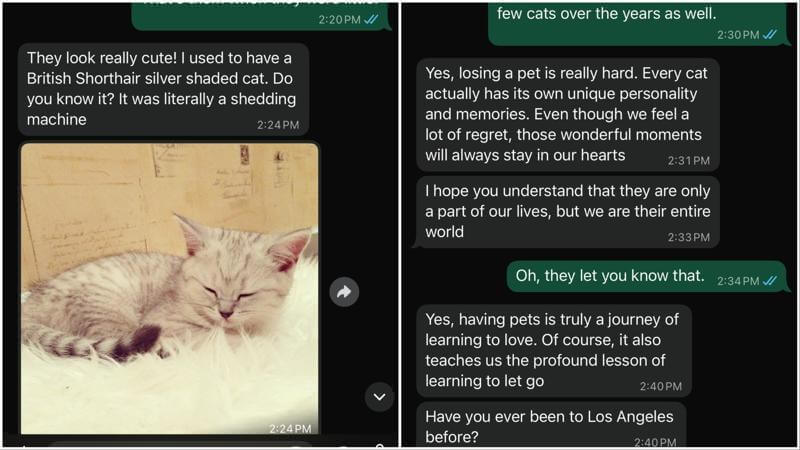
As you can see at the end of that exchange, Sofia often steered the conversation in the direction of Los Angeles, where she supposedly resided, repeatedly suggesting that maybe I could visit her there one day. Oddly, these exchanges never quite turned overtly romantic or sexual in the way that I assumed they might: The character of Sofia seemed to walk a delicate line, where she attempted to entice without outright encouraging me, the mark, to declare myself enamored with her. Outright seduction didn’t quite seem to be in the cards–perhaps this is because a married mark/pig who becomes too attached might be more likely to be discovered by a spouse before they can be “butchered.” Instead, Sofia spoke often of the “deep friendship” we might cultivate … when she wasn’t suddenly and inexplicably turning into a Los Angeles Wikipedia entry, as in the strange segment below.
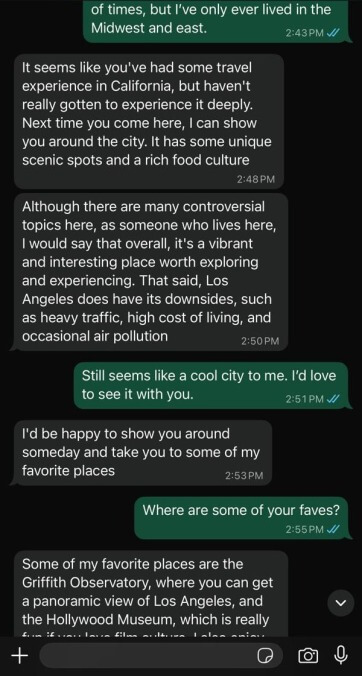
If it’s not yet clear from the snippet of conversation above, it became obvious before long that our good friend Sofia was getting a little help in crafting these conversations from generative AI–I love its little aside on L.A.’s downsides, like “occasional air pollution.” This topic was something I had been quite curious about–just how would the latest AI tools be employed by those running phishing or pig butchering schemes? Think about how useful it would be for scammers to be able to generate realistic-looking photos, or even voices, to leave a message for a mark or craft the little details that would make their performance more compelling. I had to wonder, was there any chance that the photos of the woman Sofia had sent me were purely AI generated? They didn’t have the look or telltale signs to me, but who can say with absolute certainty? I know better than to assume I’m infallible in recognizing AI “slop,” and within a few more years, will any of us be able to tell real from fake in this regard? For scammers, it must feel like the holy grail.
…although with that said, there were some times that Sofia’s use of AI to generate text was not only obvious, but undeniably comical. My personal favorite: When I mentioned that it was snowing in Richmond, and she launched into an entire paragraph on the beauty and wonder of fresh snowfall, as real humans so often do when chatting with each other via text message. You’ll have to forgive my deeply sarcastic reply; I simply couldn’t help myself in the moment.

Talking with Sofia on a daily basis quickly grew to feel both routine and distinctly circuitous. She would ask roughly the same questions on a regular basis, inquiring about the minutia of work tasks in particular. There were times when she would seemingly forget that she’d already asked me more specific questions before–I suspect this is because the scammer wouldn’t necessarily remember everything we’d talked about while in the course of cultivating dozens of potential “pigs” to be butchered. She’d say odd, inhuman-sounding things here and there: After sending a stock photo of a middle-aged man to represent myself, I told her that “I’m just a normal guy,” and she replied with “We’re just ordinary people. The photos look great, and the smiles are friendly.” In no way did this sound like some kind of alien appraising our exchange of pleasantries.
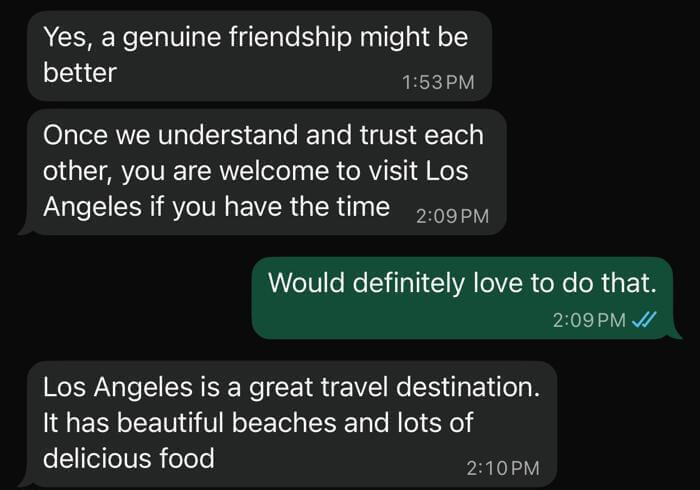
And then, as suddenly as the conversation had begun, it was over. I can’t say for sure why Sofia suddenly stopped responding, right when she was seemingly steering the conversation into more overtly intimate waters. Maybe my occasional jokes and attitude seemed to suggest that I was too aloof to be a good target to deploy the rest of the pig butchering playbook. Perhaps I said something that made the scammer outright assume that I was screwing around with them. Maybe they just put in the necessary effort to look me up in more detail, and found that I was a writer, someone who had spent some time writing about online delusions in the past. Whatever the reason was, Sofia suddenly went silent, ignoring all future attempts to reach out. One of her final messages had promised once again that “once we understand and trust each other,” we would meet in Los Angeles. I guess I failed on the whole “trust” thing, as far as this scammer was concerned.
The Truth Behind the Digital Mask
It didn’t take very long, after ceasing communication with Sofia, for me to answer one of my lingering questions: What was the original source of those photos? Granted, it was more difficult than it should really have been, owing to the fact that Google, like so many other pillars of the internet, has seemingly gone out of its way to enshittify the ability of users to perform a simple reverse image search, in order to sell them functionality that was once free. I found nothing via any of Google’s tools when attempting to track Sofia’s photos back to their source, forcing me to employ a wide variety of independent and third party image searches. After running through a handful of them with no luck, I finally stumbled on one that provided me with what looked like a familiar face. It looked a lot like “Sofia.”
The photos I had been sent of Sofia were apparently harvested from the Instagram account of a “beauty, fashion & lifestyle” influencer based in Frankfurt, Germany, username chariklia. The biggest initial tell, beyond physical resemblance, was that pretty much every single photo on the chariklia account featured the young woman (who is indeed in her 20s) wearing the same conspicuous, gold cross necklace that was in the photos I was sent–she’s seemingly never without it. Curious if I would eventually find the exact photos that were sent to me by my Nextdoor confidant, I scrolled through her entire post history until I finally landed on one. It was the exact same photo, originally posted by chariklia in the spring of 2023. I would presume that the modestly successful (160,000 followers) model/influencer, who is apparently represented by a Berlin-based talent agency called ENKIME, likely has no idea that her images are being used by scammers in pig butchering schemes targeting people in the U.S.A. … or perhaps every single woman in her scenario is already simply aware of the fact that their images will be stolen and used for this sort of nefarious purpose. Call it a universal truth of being an attractive person on the internet. At the very least, it put to bed the question of whether AI had been used to dream up the bait for my scam.
In an odd way, finding the photo almost gave me a certain esteem for my scammer, given that they were smart enough to use the more demure, casual, believable photos they stole from chariklia’s profile, rather than sending me a bunch of lingerie or bikini shots. It speaks to a certain sophistication on the part of the scammers, their willingness to invest in the long and slow process of building up familiarity and rapport with the mark before advancing the relationship to the eventual pivot to topics like cryptocurrency investments. Curious to speak with someone with greater expertise on the subject, I reached out to Erin West, a former government cybercrimes prosecutor who is now the founder of Operation Shamrock, a global nonprofit that connects scam victims to law enforcement and corporate programs intended to help them in seeking justice or restitution when possible. West seemed fascinated to hear about the particulars of my case with “Sofia,” especially given that she typically deals with those who have been successfully scammed and doesn’t get many firsthand accounts of pig butchering attempts that were abandoned partway by the scammers.
“I don’t quite know how it is they’re able to sort out people like you and me who are onto them, but it does happen,” West said in an interview with Jezebel. “I’m not surprised at all that there was no communication about money or crypto in that time period you were talking to them, because it’s a long con.”
And it’s a con that most of the perpetrators have no choice but to carry out. Many phishing scams and pig butchering operations are based out of large compounds in countries such as Cambodia and Myanmar, along with the likes of Laos, Sri Lanka and the Philippines, with the backing of Chinese organized crime syndicates. The actual people doing all the grunt work of texting and WhatsApp messaging? They’re effectively prisoners in many cases, often having been trafficked or lured to these countries from thousands of miles away (particularly from poor African nations such as Uganda) with the promise of higher-paying jobs. Instead, they’re taken to a compound by their new captor-employers and forced to meet regular quotas of how much money they should be scamming per week from American marks. The only way out of such a compound is for a family to scrape together an impossibly high ransom.
“Each person working in one of these compounds is probably trying to cultivate 20 or more relationships at once,” said West. “They have multiple phones that they’re using at all times, building trust. I’ve seen pictures with 10 or 12 phones in front of a person. I know from reading their internal chats that they’re often supposed to be making 20 new contacts per day, with a ‘contact’ being at least one response from that person.”
In the U.S., meanwhile, omnipresent exposure to scams has more or less become baked into daily existence for Americans. A recent Reuters piece that uncovered internal projections from Meta indicated that the Facebook/Instagram operator determined that a full 10% of its entire overall annual revenue (roughly $16 billion) was being generated by ads that forwarded users to scams or banned goods. For three years or more, Meta reportedly declined to identify and act on this torrent of scam advertising for the likes of fraud investment schemes or illegal online casinos, falling back on policy that it would only ban advertisers if its automated fraud detection systems determined there was a “95% or more” probability that the advertiser was committing fraud. In all other cases, Meta simply charged the advertisers more as a “penalty,” but it stands to reason that these advertisers were happy to pay the higher rate to have a chance to deploy their scams on some of the country’s biggest social media networks. According to West, this omnipresence is one of the things that makes her work difficult–people know that scams are all around them, but simultaneously believe that it can’t or won’t happen to them. Everyone thinks that they’re the exception.
“There’s a level of apathy about these scams because they’re so frequent, but people don’t actually understand too much of the reality behind them,” she said. “That’s the tragedy of what’s happening, there’s not enough information. People think that this is something that happens to stupid people, something that happens to elderly people, when I’m confident that you probably know someone in your own life who has been scammed in some way.”
To those like West who have dedicated years of their lives to fighting such scams, it no doubt feels like going up against the hydra–shut down one operation, and two more pop up to take its place. Nevertheless, some progress actually is being made these days, both in the U.S. and abroad, although some of it is on the grim side: Singapore, for instance, recently announced that it will begin punishing scammers within its own borders with public caning, up to 24 strokes. In a rather more organized judicial capacity, the U.S. recently issued an indictment for Chinese national Chen Zhi, the founder/chairman of multinational business conglomerate Prince Group in Cambodia, alleging that he masterminded the “operation of forced-labor scam compounds” across the country, where pig butchering scams were executed. The Justice Department went on to say that it had seized almost $15 billion in Bitcoin from accounts associated with Zhi, the largest forfeiture action in the history of the department. The now-disgraced businessman, who apparently has multiple aliases, was arrested and extradited to China, where he faces a complex process of indictment. Still, this is the kind of big fish that has rarely been reeled in by countries attempting to fight these sorts of scams. A significant number of scam compounds in Cambodia have reportedly shut down and released their captive workers.
“The U.S. needs to recognize these organized scam networks as a national security problem, in addition to the immense volume of U.S. dollars leaving the country,” West said. “They should be engaged in negotiation at the highest level of government with the countries that are allowing this to happen within their borders. The U.S. has barely been engaged in this conversation at all and has barely done any of the on-the-ground investigatory work. Only now is the U.S. starting to wake up to the fact that this is a major deal.”
It seems safe to say that I’ll never know precisely who I was talking to, for the week that I was conversing with Sofia, the raven-haired Italian romantic who loved cats and waxing poetic about a guy in Virginia telling her that it was snowing outside. Chances are, the scammer behind the facade simply determined that I wasn’t worth their time, that talking with me was never going to result in the kind of payoff they needed to make their quota. I’d like to think, though, that just as Sofia was about to tell me about an enticing new cryptocurrency investing opportunity, perhaps a non-corrupt Cambodian police squad burst in and put a stop to that particular operation. Maybe they even managed to free the poor soul who had to put up with talking to me, when they weren’t using ChatGPT to do it. That would be the best possible outcome, unlikely as it may be. It could have happened, right?
As for the rest of us, we should recognize just how easily we can become the target of a sophisticated psychological pressure campaign designed to separate us from our savings. It can happen literally anywhere: Even on a social media network as innocuous and mundane as Nextdoor, where the average post involves a missing cat or wild accusations between neighbors over property lines. Don’t think that it can’t happen to you. Your Sofia could be (figuratively) right around the corner.
 Keep scrolling for more great stories.