

What Does Donald Trump Think ‘Regime Change’ in Iran Actually Means?
Traditionally, you don't have the same people and government in power after "regime change" has happened.
Photo by The White House Splinter Iran War

Does Donald Trump know what the words “regime change” mean, or imply? The empirical evidence would suggest that at least a decade ago, he did. Back in his campaigning days, and especially in the 2016 Presidential campaign, when he was a significantly more lucid and less clearly dementing man in retrospect, opposition of foreign entanglement by the U.S. was Donald John Trump’s signature foreign policy stance. He raged against what he referred to as decades of “failed policy of nation building and regime change” underwent by the likes of George W. Bush and Barack Obama, and vowed that his administration would “stop racing to topple foreign regimes.” Even in the buildup to the still ongoing Iran War, both Trump and key figures of his administration were notably leery about using those words. Trump claimed that regime change “takes chaos, and ideally, we don’t want to see so much chaos.” JD Vance on Meet the Press insisted that “we don’t want a regime change.” Secretary of State Marco Rubio said “We’re not into the regime change business here.” And even a bloodthirsty Pete Hegseth said that “Operation Epic Fury” was “not a so-called regime change war” after it started.
But now, roughly seven weeks into the war, Trump is increasingly claiming that the conflict is in fact about regime change. And not only that, would you believe that we’ve already been super successful at it? Possibly multiple times? Yes sir, it’s the world’s first successful regime change in which the regime … is the exact same one as was there before the war, with the son of the former leader (at least nominally) in charge, only now everyone is “very reasonable.” What a change! My head is spinning, it’s such an all-encompassing change. I’ve got to sit down.
“We’ve had regime change,” trumpeted the President recently to reporters aboard Air Force One. “If you look already because the one regime was decimated, destroyed. They’re all dead. The next regime is mostly dead. And the third regime, we’re dealing with different people than anybody’s dealt with before. It’s a whole different group of people. So I would consider that regime change.” This has also become one of his favorite random things to drop into unrelated Truth Social posts, just throwing in the phrase “regime change” now and then and claiming it’s a box that has already been checked.
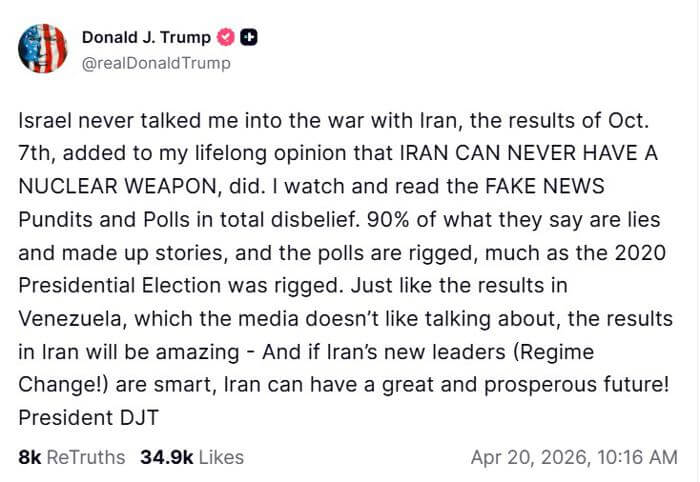
Well first of all: No. Sorry, but no. I realize that one of Donald Trump’s very favorite tactics in these types of scenarios is to strip mine the English language for specious, semantic nonsense he can weaponize, but “regime change” does in fact have a definition, and it does not involve putting the son of the guy you blew up, who is just as much of a cleric and religious radical as his father, in charge. By the textbook definition, it involves a total replacement of a system of government and control with a new system, not just a few people in power or figureheads at the top. This is also why “regime change” did not happen in Venezuela following the U.S. capture of Nicolás Maduro: The exact same government was left in place, and the U.S. simply trusted “interim” President Delcy Rodríguez to fall into line as an agreeable patsy, which she has indeed done. More or less the same thing has happened during the war in Iran on a wider scale–although U.S. strikes killed many high-ranking officials, their successors were simply appointed in efficient fashion through the official government channels. Iran’s president, Masoud Pezeshkian, has simply kept its government humming along, still able to control its state media, repress its citizenry and project absolute control within its borders. It’s an unbroken regime that has been in power since the 1979 Islamic Revolution.
As Arash Azizi, a scholar of Iranian history put it to The Atlantic: “The war and decapitations have affected the internal factional balance, but they haven’t changed the regime. There is arguably even more regime cohesion now than there was before the war.”
So, what led to such a dramatic change in Trump’s approach to those words? Would you believe we can probably thank Bibi Netanyahu for it? The Israeli Prime Minister is increasingly seen as the driving force behind the launch of the war in the first place, following a detailed presentation he made to Trump, military generals and cabinet members in the White House Situation Room in early February. In said presentation, as reported by The New York Times, Netanyahu described pie in the sky victories that could be won by a combined United States/Israel attack on Iran, including the assassination of the ayatollah, destruction of the Iranian missile program and nuclear capabilities, a popular rebellion/revolution, and ultimately regime change. As they assessed the vivid claims that Netanyahu was claiming could be achieved, Trump’s cabinet, intelligence officers and military advisors more or less unanimously tried to burst the bubble: Although the U.S. military could certainly crush the majority of Iranian military sites quickly enough, they told Trump in no uncertain terms that the idea of true regime change happening there via bombing alone was deeply unpractical and unrealistic, especially without a full-on invasion of a country of 93 million people. Or as CIA director John Ratcliffe reportedly described the idea of installing a secular ruler for Iran, in a single word: “Farcical.” Numerous figures likewise warned Trump that Iran might still be able to choke off the vital Strait of Hormuz during the war, leading to ballooning oil and gas prices, but Trump was seemingly convinced that victory would be simple and swift. As he’s so fond of doing, he ignored an entire room full of experts telling him one thing and decided to believe the opposite, which just so happened to coincide with what he already wanted to believe.
Does President Trump think that every time a country gets new leaders it’s a regime change?
— Missing The Point (@missingthept.bsky.social) Apr 20, 2026 at 10:27 AM
Seven weeks later, the global economy is in shambles, Trump’s approval is at record lows, and merely 25% of Americans believe that the U.S. has achieved any of its strategic goals in the Iran War. The Strait of Hormuz is still closed, despite multiple false starts (and then attacks) and attempts to reopen it during the so-called ceasefire that may or may not end within the next 24 hours. The country’s supreme leader is now technically Mojtaba Khamenei, the son of assassinated former supreme leader Ali Khamenei, although it’s not entirely clear that Mojtaba Khamenei is wielding practical power following some kind of wounding he also reportedly received in the war’s opening salvos. It’s yet another thing that Trump has had to walk back, given that he called the ascension of Mojtaba Khamenei completely “unacceptable” when it happened, but within a few weeks was calling the same regime “reasonable.” At the same time, though, it has been widely speculated that the Islamic Revolutionary Guard Corps (IRGC) has largely seized control of political and governmental power in Iran, and are the ones wielding day-to-day power.
Suffice to say, that also wouldn’t be “regime change”–if anything, it would be a more intense version of the theocratic power structure that previously existed. Islamic military hardliners are widely expected to not just continue the same policies of the governmental cleric structure, but wield power even more brutally in repressing the citizenry.
“When President Trump says he has changed the regime in Iran, he’s right in one sense—he’s changed it to a much more radicalized regime,” said Ali Vaez, Iran Project Director at the International Crisis Group, to CNN. “All of these individuals who are now in place—the new national security advisor, the new head of the IRGC, the speaker of the parliament, who himself was a former commander of Revolutionary Guards—they all have been involved in domestic repression extensively in their past lives. Given the degree of regime paranoia, I do believe that the repression is going to be much harsher than was the case in the past.”
This would all seemingly make the promised “popular uprising” that Netanyahu tried to sell Trump and his cabinet on even more of a fantasy. Despite decades of brutal repression, there does not appear to be any well-organized resistance waiting under the surface of Iran, ready to leap into action with a little CIA assistance. The United States certainly doesn’t seem to have organized such a coup, any more than they even got their media talking points in order before the war began at the end of February. Lest we forget, Trump offered up no fewer than 10 different rationales for why the Iran War was happening within its first six days, with “regime change” as one of them, and the President encouraged Iranian freedom fighters to throw off their oppressive masters (so we could install new oppressive masters for them).
Regime change, Trump style. At what cost?
#Iran
— Citizen Paul Templeman (@paultempleman.bsky.social) Apr 17, 2026 at 10:02 AM
Given the abject failure of both the U.S. and Israel to engineer those circumstances, perhaps it was inevitable that Trump would need to pivot to a stance rooted entirely in delusion, claiming that because he was sold on the idea of regime change in Iran—against all of his campaign trail promises and beliefs—he has no choice but to now believe that it has already been successfully achieved. Or pretend to believe, anyway. Increasingly, his focus has shifted to other concrete goals like opening the Strait of Hormuz, the closure of which is something that only happened in the first place because our President decided to take the United States to war. Whenever it finally happens for real, it will be a crowning moment of “Trump takes credit for fixing something his own actions broke” diplomacy.
Next up on the docket: Cuba, where the U.S. might just put a Castro back into power. Regime change! What a fun, easily achieved thing it truly is.
 Keep scrolling for more great stories.