

Newly Discovered Spider Uses a Web Catapult to Launch Ants Into the Air
The ants launched by this spider catapult apparently experience 15 times the G-force felt by fighter jet pilots.
Photo via Unsplash, Adrian Infernus Splinter Nature
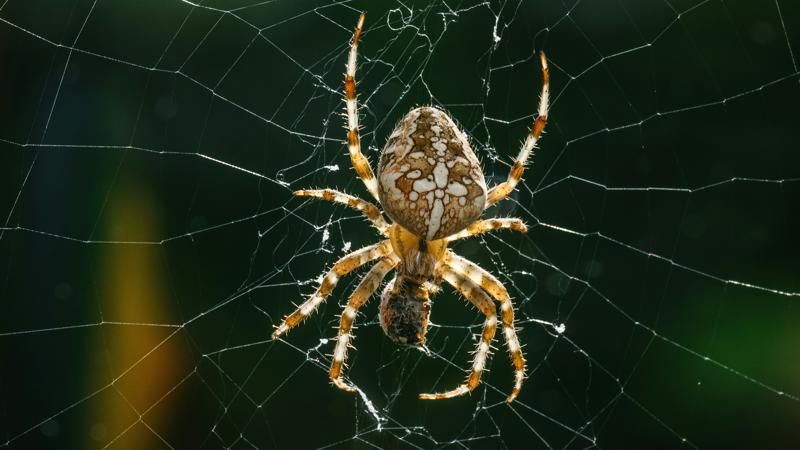
Chalk up another entry into the canon of animals that definitively use tools in order to find a meal–in addition to the likes of primates, dolphins, octopuses and certain birds, you can now add spiders to the list as well. Or a very special and newly discovered Australian (of course) spider, anyway, which researchers have observed building a catapult of webbing specifically to target the sole species of ant it preys on in the tropical rainforests of the Cape York Peninsula in Queensland. The “catapult” is so powerful, in fact, that it’s shattered all known records for the amount of energy that can be expended by a biological catapult per “firing” when adjusted for its size–it’s so strong that the researchers who discovered and filmed the new species have calculated that the unlucky ant is hauled off the ground at an acceleration of up to 1,367 meters per second squared, which is equal to roughly 140 times the force of gravity, or 15 times more than the strongest g-forces typically experienced by a jet fighter pilot. This is one seriously yeeted ant.
The spider is of the genus Propostira, and it seems to prey exclusively on the dangerous, highly aggressive green tree ant (Oecophylla smaragdina). In a paper published this week in the journal Current Biology where the research team announced its findings, they theorized that the ingenuity of the spider’s trap is an evolution specifically to deal with the otherwise dangerous ants, which could swarm and overwhelm it quickly if the trap worked more slowly. In honor of its ability to launch its prey with such power, the researchers are informally calling it the “ballista spider” after the ancient Roman bolt thrower.
By day, the spider retreats to the underside of leaves to wait for the cover of nightfall. In the evening, however, it leaves its lair from its central “core web” and constructs an extremely taut series of “tension lines” of web, anchored to the ground by a small cone of webbing. The researchers theorize that when the trap is ready, the spider deploys a pheromone of some kind that then quickly calls the ants, attracting one into biting the cone. That releases the tension in the web, slinging the ant a foot or so into the air with great speed, where it lands in the core web and becomes entangled. The spider is then free to wrap up and make a meal of the ant at its leisure, while the other ants below have no idea what became of their suddenly disappeared comrade. Imagine, for a moment, how horrifying this would be on a human-sized scale.
Scientists have discovered a tiny “ballista spider” that launches prey into its web with up to 140 times the force of gravity
Researchers say the trap subjects ants to around 15 times more G-force than fighter pilots experience
— Dexerto (@dexerto.bsky.social) 1:15 PM · Jun 23, 2026
The ballista spider is not the first arachnid that has been discovered using a catapult sort of web–previous spider species have been observed making web catapults that they trigger themselves, usually to launch themselves/launch the web directly onto prey. The ballista spider, on the other hand, is the first species ever discovered to create a fully functional trap in which the prey triggers the reaction, while it simply sits back and waits for dinner to come sailing into its web. It could scarcely be a more brutally efficient system.
To that end, the researchers observed that these particular webs store more energy and are able to exert more force than any other known biological catapult of this kind. Scaled up to a larger size, the researchers calculated that “a kilogram of the web would store 78.17 kilojoules of kinetic energy and very briefly exert 11.73 megawatts of power. The ballista spider demonstrates how extreme prey specialization can drive the evolution of exceptional biomechanical performance.”
You can see the deadly silken bug-launcher in action below. Marvel at the beautiful, deadly efficiency of a highly evolved and specialized predator, and be thankful that you’re not a hapless ant about to pull 140 G’s shortly before you get digested.
 Keep scrolling for more great stories.