

The Entire Trump Tariff Scheme Just Suffered a Supreme Collapse. Refunds, Anybody?
Photo via Unsplash, Ian Hutchinson PoliticsSplinter Tariffs
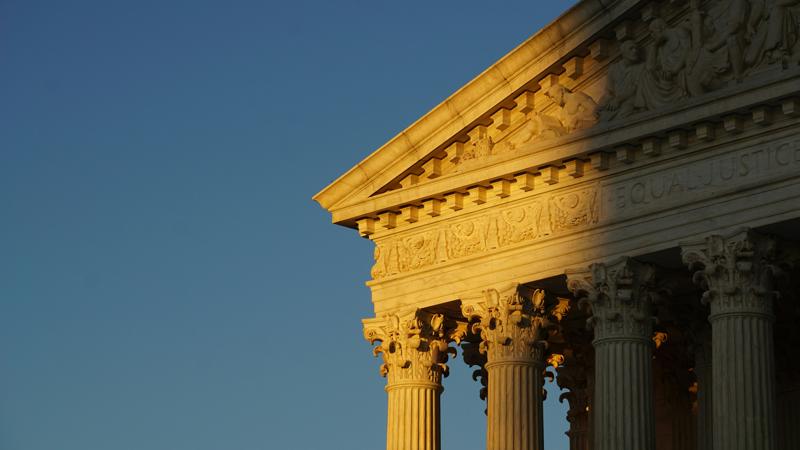
In a momentous decision that is no doubt going to inspire a Donald Trump Truth Social meltdown beyond the scope of anything we’ve ever seen, the U.S. Supreme Court today announced its ruling against the President’s ability to unilaterally declare tariffs against other nations, under the guise of the International Emergency Economic Powers Act. Trump’s administration had leaned entirely on this piece of legislation from the 1970s—never before employed to justify tariffs—as precedent for why he could issue or threaten to issue sweeping tariffs for vindictive reasons against longtime U.S. allies, thanks to the powers it confers the President to “regulate” commerce during times of national emergency. The Supreme Court Justices effectively declared that Trump has been abusing these “emergency” powers, a massively influential decision that will shake the foundations of Trump’s entire economic plan for his second term and potentially invalidate trade deals, especially with major U.S. corporations already queuing up and demanding refunds on tariffs they have paid. It’s a stunning rebuke from a Supreme Court that has up to this point repeatedly kowtowed to Trump, with a 6-3 decision in which Chief Justice John Roberts, Justice Amy Coney Barrett and Justice Neil Gorsuch joined the liberal justices in striking down the tariffs.
“The president asserts the extraordinary power to unilaterally impose tariffs of unlimited amount, duration, and scope,” wrote Roberts in the decision. “In light of the breadth, history, and constitutional context of that asserted authority, he must identify clear congressional authorization to exercise it. When Congress grants the power to impose tariffs, it does so clearly and with careful constraints. It did neither here.”
Trump’s immediate reaction was calling the decision a “disgrace,” but his eventual online response in particular is guaranteed to be volcanic. Underlings of the administration have long clashed with anyone who sought to accurately portray his tariffs as a tax on the American people, something that this Supreme Court decision validates in the eyes of the law. A recent study from the New York Federal Reserve calculated that almost 90% of the final economic costs of Trump’s tariffs have been shouldered by U.S. businesses and U.S. customers, which caused Trump economic advisor Kevin Hassett to call the findings the “worst paper I’ve ever seen in the history of the Federal Reserve system.”
Speaking to the media this afternoon, Trump went on the expected tirade against the Supreme Court justices, calling the people he himself appointed “very unpatriotic and disloyal to our Constitution” for not blindly following orders, and saying they were “swayed by foreign interests” without explaining in any way what that was supposed to mean. As for the future of the tariffs, Trump vowed that “now I am going to go in a different direction,” employing other legal means to repeat some of the tariffs, although “it’s a little bit longer process.” In particular, he said he would impose sweeping tariffs under Section 122, but by law that application would expire after only 150 days without Congressional approval. Predictably, Trump made no mention at all of the potential for the government to have to issue refunds.
So.
A globally disruptive, economically unsound, and whim-driven tariff policy turns out to be unconstitutional.
Huh.
— Kai Ryssdal (@kairyssdal.bsky.social) Feb 20, 2026 at 10:08 AM
Both members of the Democratic party and many conservative economists and business leaders have already hailed the Supreme Court decision, even though the Trump administration has vowed to replace as many of the tariffs as possible through other, more complex and inherently limited means. Senate minority leader Chuck Schumer seized on the ruling as an economic boon for consumers, calling it “a win for the wallets of every American consumer,” and stressing that “a president cannot ignore Congress and unilaterally slap tariffs on Americans. Now Trump should end this reckless trade war for good and finally give families and small businesses the relief they deserve.”
Even Mitch McConnell, longtime Republican Senate leader, hailed the decision as a reaffirmation of the powers vested in Congress to determine taxation through legislation, saying “As a matter of Constitutional authority, there is now no room for doubt: the use of IEEPA to circumvent Congress in the imposition of tariffs — already without precedent — is also illegal. Congress’ role in trade policy, as I have warned repeatedly, is not an inconvenience to avoid.”
Scott Lincicome, the vice president of the conservative-leaning Cato Institute’s Center for Trade Policy Studies, which has repeatedly criticized the emergency tariffs, also displayed cautious optimism: “The court’s decision is welcome news for American importers, the United States economy, and the rule of law, but there’s much more work to be done. Most immediately, the federal government must refund the tens of billions of dollars in customs duties that it illegally collected from American companies pursuant to an ‘IEEPA tariff authority’ it never actually had.”
And that topic is the immediate elephant in the room following this decision: Tariff refunds for American businesses that import goods. Numerous large corporations such as Costco have already filed lawsuits or submitted official claims for refunds in anticipation of this possible Supreme Court outcome; understandable given that there are billions of dollars on the line here. The U.S. Treasury is estimated to have collected roughly $240 billion in tariff revenue since April of 2025, and the research firm Capital Economics has estimate that the cost of potential refunds would exceed $120 billion. That is a massive chunk of revenue for the federal government to suddenly lose—and almost none of it would likely end up passed on to consumers, as if that needs to be said. But that won’t stop corporate America from trying to claw back as much of the tariff money they paid as possible.
“Legal victory is meaningless without actual relief for the businesses that paid these tariffs,” said Dan Anthony, the executive director of small business coalition We Pay the Tariffs. “The administration’s only responsible course of action now is to establish a fast, efficient, and automatic refund process that returns tariff money to the businesses that paid it. Small businesses cannot afford to wait months or years while bureaucratic delays play out, nor can they afford expensive litigation just to recover money that was unlawfully collected from them in the first place.”
This answer – from one of the president’s key economic advisors – is disgraceful.
And, fwiw, the number for tariff pass through is closer to 94-96 percent
— Kai Ryssdal (@kairyssdal.bsky.social) Feb 18, 2026 at 9:22 AM
The Supreme Court’s decision does not specifically mandate or enforce refunds, leaving the legality presently unsettled. The only justice to directly mention them, in fact, was Justice Brett Kavanaugh in his dissent, in which he invoked arguments made by the government that insisted that refunds would be a costly and painful mess. As Kavanaugh wrote: “In the meantime, however, the interim effects of the Court’s decision could be substantial. The United States may be required to refund billions of dollars to importers who paid the IEEPA tariffs, even though some importers may have already passed on costs to consumers or others. As was acknowledged at oral argument, the refund process is likely to be a ‘mess.'”
Symbolically, this is a truly deep rebuke of President Donald Trump by a conservative-dominated Supreme Court that has in most cases been happy to act as a rubber stamp for the President’s agenda. Trump’s use of tariffs in this way extended well beyond the stated reason of trying to close the U.S. trading gap—they were a cudgel that he has used to perform instantaneous threats against any nation that failed to immediately do what he wanted. We’re only a month removed from when he was arbitrarily placing tariffs on European nations when they didn’t agree with him that the United States could simply take the territory of Greenland by force. Trump has likewise used tariffs to attempt to force extensive parts of his domestic economic agenda, such as increasing U.S. manufacturing. The revenue generated by those tariffs was likewise crucial as a way to partially offset the lost revenue from Trump’s tax cuts and reduced IRS revenue collection abilities. Losing that tariff income will mean that the country’s spending deficit will only grow more dire.
Of course, this chaos all could have been avoided if Trump and his economic cronies hadn’t decided to apply entirely novel legal reasoning to allow Trump to raise and lower taxes depending on his mood fluctuations. But we should know better than to expect any common sense from this administration, and should clearly buckle up for economic turmoil instead. I’m starting to think American citizens might not get Trump’s promised “tariff rebate checks” after all.
 Keep scrolling for more great stories.