

Georgia Asks Residents, Would You Mind Helping Us to Kill Some 4-Foot Invasive Lizards?
"If you're not in a position to use a firearm or something like that, try to document it with a photo and let us know."
Photo via Unsplash, John Hanusek Photography Splinter Nature
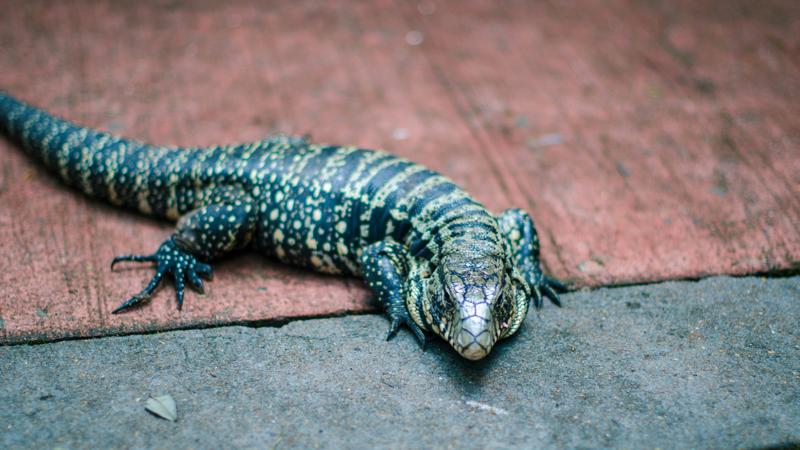
When your state asks you to get involved in a bit of conservation for the sake of the greater good, who are you to say no? Granted, they may be asking if you would mind directly assisting in the destruction of some exotic, invasive lizards the size of a small dog, but that’s no reason to suddenly get all squeamish. If you’re a resident of a few South Georgia counties in particular, this scenario may be more than merely hypothetical, as the state has recently imported a particularly hungry expat from the invasive species paradise that is neighboring Florida, in the form of Argentinean black-and-white tegu lizards. The Georgia Department of Natural Resources (DNR) has asked the state’s residents for help in not only tracking the spread of the creatures, but in stopping the lizards in their tracks via lethal means.
All jokes aside, that does seem like a pretty heavy ask: Just how many people who encounter one of these things are going to be in the headspace where they’re legitimately considering how to kill what looks like a miniaturized Komodo Dragon? Speaking with Georgia Public Broadcast, a DNR biologist described the lizards as particularly fast, wily and difficult to catch, which means residents should “act immediately” when spotting one, up to and including pulling out a gun and starting to blast away at the thing. No seriously, you’re allowed to shoot them.
“If you’re not in a position to use a firearm or something like that, try to document it with a photo and let us know,” said senior wildlife biologist Daniel Sollenberger to the radio station. “We can perhaps give some guidance or maybe help try to put a trap out or something like that.”
Well I should fucking hope that the organization is going to offer some “guidance” as to how one might dispatch or trap a 4-foot long adult lizard that is pushing 20 pounds. It does seem like one of those scenarios where I would be very much seeking guidance, like lots of guidance. However much guidance as you can give me. Then again, this is rural South Georgia we’re talking about; maybe the people of Toombs and Tattnall Counties, where the tegus have most often been sighted, are of a significantly hardier stock and are ready to leap into unprompted lizard combat at a moment’s notice.
Georgia Argentine Tegu Invasive Threat Grows as Wildlife Officials Intensify Eradication Efforts in 2026
The georgia argentine tegu invasive issue remains a major concern in 2026 as state wildlife officials continue efforts to control and eliminate populations of Argentine black and white tegus…
— unitedlegal.bsky.social (@unitedlegal.bsky.social) 11:49 AM · Jun 4, 2026
Why is the black-and-white tegu considered such a concern? Well, they’re pretty voracious for one, and pose an imminent threat to the eggs of ground-nesting bird species such as quail and turkey, as well as protected Georgia species such as hatchling American alligators or gopher tortoises. But the tegus aren’t particularly picky; they’ll reportedly eat everything from chicken eggs or chicks, to carrion, to crops and vegetables, to whatever other tiny creatures they can get down their gullets. Bonus: They’ve even been known to carry salmonella, leading researchers to fear that a proliferation of tegu could spread bacterial contamination to vegetable crops and harm humans in the process. Nor does the threat of winter cold naturally pen in the tegu, which can enter the hibernation-like state known as brumation to simply go dormant through the winter months, before returning to breed once again in the spring.
As the naturalist in the embedded DNR video amusingly concludes, “…so they can live almost anywhere, and eat almost anything.” Yeah, I can see why that might be considered a problem, conservation-wise?
The tegus seen in Toombs and Tattnall Counties are theoretically the only breeding populations of the lizards known to be in the state, but more tegu have been seen sporadically in other locations since they first began to arrive in 2018. A complete map of sightings provided by the DNR suggests exotic pet escapes and abandonment could be responsible for other tegu sightings on Georgia’s northern and western edges, although one wonders if this means the creatures–already considered a permanent, invasive menace at this point in Florida–could be ready to jump to the likes of Alabama as well. Sightings have been reported in 30 Georgia counties, statewide. This is not an insignificant number of giant lizards!
Despite their size, it should be noted that DNR does not consider tegus to be a direct threat to common domestic pets such as dogs or cats, although the ravenous lizards can apparently be attracted by unsecured sources of pet food. If, somehow, you do happen to be a Georgia resident who manages to stumble across such an odd sighting–and you’re not comfortable whipping out the gun you’re definitely carrying and opening fire–then you can use the following form to report your tegu sighting. I suppose the squeamish can always leave the state-sanctioned lizard homicide to the professionals.
 Keep scrolling for more great stories.