


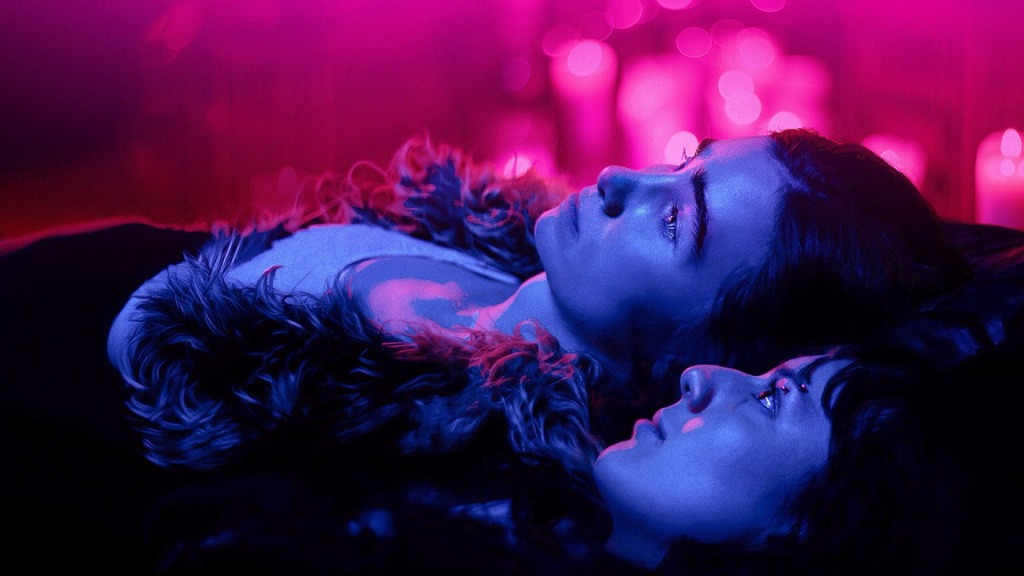
In a country that’s increasingly hostile to women and our autonomy—piling on the loss of reproductive rights, the rise of violence against women, the backlash against the #MeToo movement, and the disinvestment in women in the entertainment industry just as a start—its films are highlighting those seeking safety in numbers. The more evocative of these cliques take on a witchy edge, forming their makeshift girl worlds into covens where ritual takes precedence over reason. These covens can offer what the world will not: strength and community. But not all covens are created equal. While some can be nurturing spaces, a place for belonging in a world full of rejection for misfit women unwilling to conform to the norm, this need for camaraderie and support can also be used against our heroines. Even the spaces made for and by women can be corrupted into competitions for control.
Perhaps no other movie this year channeled that Mean-Girls-meets-The-Craft energy as much as Meredith Alloway’s Forbidden Fruits. Set among the retail workers of a large mall, Forbidden Fruits follows a fiercely closed-off group of fashionable it-girls named after fruit: Apple (Lili Reinhart), Cherry (Victoria Pedretti), and Fig (Alexandra Shipp). A would-be coven candidate named Pumpkin (Lola Tung) emerges from the food court’s pretzel store, looking to fit in, but the more she becomes a part of the Fruits, the more the group starts to lose its focus and the group’s dynamic sours.
Before things go downhill in a spectacularly bloody way, the coven in Forbidden Fruits is used like a fortress, bonding a limited membership with each other at the expense of other friendships and dates outside the miniature universe they’ve set up for themselves in their store’s dressing room. Imperfect as it is, this coven is a safe space for them to discuss their problems or distract them from their traumas, maintaining the illusion of being the mall’s aloof cool girls by requiring that the members deal with their big feelings in a dressing room as a kind of forced mystical confessional. While they have some fun matriculating their new member with their own spells and practices, the rules Apple sets for the group become too constricting, alienating her believers and revealing that Pumpkin has her own agenda. A sisterhood that’s built to keep their members isolated, exploitable, and on a pedestal above others is no sisterhood at all.
These complicated group dynamics also crop up in Avalon Fast’s Camp, a dreamlike horror movie about surviving tragedy when it always seems to follow you. Emily (Zola Grimmer) is convinced the losses she’s endured are her fault, and her dad sends her to a religious camp for troubled kids to help distract her from the loss of her closest friend. For the first time, Emily feels accepted by a group of fellow misfit counselors who don’t walk away from her sad stories. The experience causes Emily to open up and join in their witchy business. Like the way the Fruits created a colorful lair out dressing rooms, the counselors sneak up into a cabin’s attic to make their own space—a cluttered world of lamps, candles, books, and old pictureframes that’s surrounded by the warmth of the wooden walls and newfound friends. It’s like a summer camp update of Charmed, where magic brings young women together. But instead of facing off against a monster of the week, Camp‘s coven becomes a healing place for its wounded character.
Fast embraces the supernatural side of her story with a dreamy vision of candles in soft focus, glowing angels, and otherworldly imagery. More explicitly, the woods where the camp is set is home to an unseen voice that calls Emily (and sometimes other characters as well). It’s a mysterious place where a phone booth can appear in the middle of nowhere, and this enchantment can haunt Emily as much as it dazzles her, as it forces her to confront old pent-up grief and make the choice to hang out with her new friends over returning home to her dad at the end of the summer. The coven here is not trying to dominate one another but hold onto one another, listen and embrace each other, even group cry with one another—almost Midsommar-style, but silent—as Emily gets closer and closer to letting go of her guilt. She finds a connection with the coven that she couldn’t find after the death of her best friend in the normal world, where indifferent classmates only saw her as “weird.”
Much in the same way the coven in Camp helps its protagonist heal, there is a sense of protection in the witchy community of The Serpent’s Skin. Alice Maio Mackay’s movie follows the psychically gifted Anna (Alexandra McVicker) as she leaves her homophobic hometown in the rearview mirror to start a new life. She meets Gen (Camp‘s Fast), a goth tattoo artist with similar but different supernatural abilities and a vision of a mysterious snake pattern. They become a powerful couple, both against an intolerant world and the soul-sucking demon currently possessing Anna’s hottie-next-door, Danny (Jordan Dulieu).
Of the three films, The Serpent’s Skin leans furthest into the supernatural, full of telekinetic powers and a villainous demon. As Gen helps Anna unlock her potential, the pair grow closer, teaming up to improve the world around them and protect their friends. The Serpent’s Skin is also the most overtly political film of the bunch, taking the recent rise of transphobia and intolerance head-on. The evil that displaced Anna from her hometown follows her to her new city in the form of hateful posters and men. When Gen remarks that Anna acts like the “witch hunters are still on to us,” Anna answers, “They are, they just changed their names.” Before the demonic presence emerges, the film’s first villain is an ordinary man who attacks women, Anna included.
Witches have always been a stand-in for women on the fringes of society. After a brutal year of backlashes against women, gathering together feels radical and celebrating our potential takes courage when we’re not supposed to talk about the increasing oppression. The range of covens wooing young women in this year’s movies shows that this need for connection can be taken advantage of, sometimes from within, but it can also become a place of healing and strength. If there’s a male loneliness epidemic, there stands to reason there’s a female one as well. But instead of violently raging against the opposite sex, the women in Camp, The Serpent’s Skin, and even those channeling the witchy energy of Mother Mary are rooted in the search for community and solidarity in a world where they don’t feel at home. Even the upcoming Practical Magic sequel centers on the power of sisterhood. While Forbidden Fruits works like a cautionary tale of what happens when that sisterhood is poisoned by jealousy and lies, there’s still far more good than evil to be seen in the 2026 season of the witch. Through magic, these witches are reclaiming some semblance of autonomy at a time when social conservatism is intent on stifling it, shoring their power against the forces of hatred and isolation.
 Keep scrolling for more great stories.