

Happy July Fourth! U.S.-Born Pope Excommunicates Right-Wing Weirdos
Like any kind father, Pope Leo warned the Society of Saint Pius X against tearing “the garment of Christ,” which he called a “sin of extreme gravity." And like any willful offspring, the sect thoroughly ignored him.
Photo: Harold Cunningham/Getty Images Latest Catholic Church
It’s not often in the 21st century that we get a good old fashioned religious schism. But this week, the lord above (I’ll leave the specifics of that lord up to you—Jezebel is strictly nondenominational) granted us a long-brewing showdown between the Vatican and the Catholic sect known as the Society of Saint Pius X (SSPX), ending with Pope Leo XIV’s excommunication of up to 200,000 people, depending on how you count it.
SSPX has been an occasional thorn in the side of the Catholic Church since it formed in 1970, in response to the reforms introduced during Vatican II, a series of meetings of Catholic leaders in the mid-1960s called with the express purpose of addressing the church’s position in the modern world. Besides affirming a commitment to peace and a belief that (basically) non-Catholic Christians are not heretics, the major development to come out of Vatican II was that mass should now be said in local languages, rather than Latin. All of this makes perfect sense, if you want to have a religion whose adherents know at least generally what’s going on when they attend services. But if you know even a little bit about the history of the Catholic Church, you probably know that the guys in charge have often loved their power over the faithful a bit too much, and for some bishops, these attempts to ever-so-slightly liberalize were beyond the pale. Thus the conservative, traditionalist “priestly fraternity” was born.
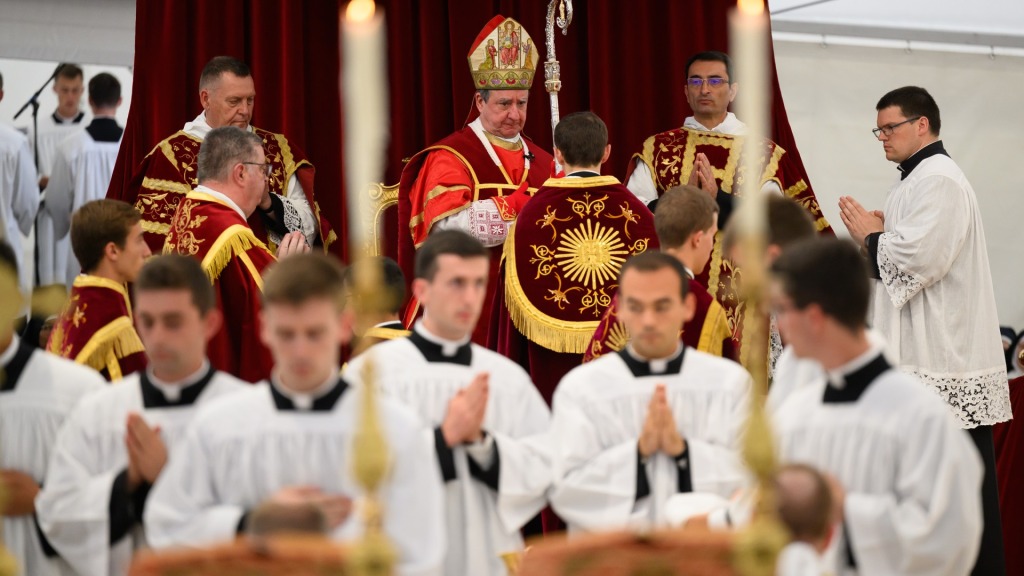
Fast forward to this week, when SSPX consecrated four new bishops in a (honestly quite beautiful) mountain town in Switzerland, where its headquarters are based. According to the Guardian, the service was live streamed across the world, “carried out in French” and “translated into English, German, Italian and Polish”—ironic, given that, as you may have read above, the reason the group was founded was because it loved doing mass in Latin.
It was this consecration that led to the excommunication, because none of these four bishops had been approved by the pope; inducting them into holy leadership positions was deemed “an act of schismatic nature.” Previous acts of schismatic nature include historical hits like the Protestant Reformation, and the multiple times during the first half of the second millennium where two popes claimed legitimacy. (I cannot recommend going down these Wikipedia rabbit holes enough; if there’s one type of guy who lives for drama, it’s Catholic bishops over the millennia. See also: Conclave (2024).)
Like any kind father, Pope Leo warned SSPX earlier this week against tearing “the garment of Christ,” which he called a “sin of extreme gravity,” according to the Financial Times. And like any willful offspring, SSPX thoroughly ignored him.
The whole episode hearkens back to another time; a schism in the Catholic Church very much falls into the category of “thing I learned about in history that I thought would never come up again.” (There have been other recent schisms, including the ongoing Moscow-Constantinople Schism in the Russian and Ukrainian Orthodox Churches, but with its 1.4 billion believers, the Catholic Church outranks pretty much any other Christian denomination.)
After SSPX consecrated the bishops, Cardinal Víctor Manuel Fernández, whose Vatican title is “prefect of the dicastery for the doctrine of the faith,” declared that the men involved “have incurred ‘ipso facto’ [and] ‘latae sententiae’ excommunication” for the “episcopal consecration of four presbyters, without pontifical mandate and against the will of the Supreme Pontiff.” Beyond being both theologically and politically dramatic, that means any sacraments they carry out (including confessions and marriages) are considered invalid in the eyes of the Catholic Church. (Though Fernández wrote the memo, the ultimate responsibility for the move rests with the pope himself.)
The excommunication extends not just to the newly (fake? illegitimately?) consecrated bishops and those who (fake? illegitimately?) consecrated them, but also to “the lay faithful … who formally adhere to the Fraternity are to be considered excommunicated.” There are some 200,000 SSPX members across the world, particularly in the United States, France, and Argentina; now they have to decide whether to stay in their schismatic sect, or leave the Catholic Church. One such worshipper told the BBC that being excommunicated “actually makes me feel quite strong.” And to a degree, fair enough; much of religion and faith are deeply personal matters. On the other hand, it is funny that lay people who actively choose SSPX are implying that they understand Catholicism better than the literal pope.
Beyond the novelty of having such major church drama in 2026, the excommunications are exciting for another reason: It indicates that Pope Leo may also be willing to break with Opus Dei, arguably the best known Catholic sect (at least if you’ve read The Da Vinci Code). It has far fewer members, but is linked to some extremely influential D.C. Republicans, including Leonard Leo (who basically orchestrated and funded the right-wing Supreme Court takeover) and Kevin Roberts, the head of the Heritage Foundation. Any move against Opus Dei would thus be seen by, for example, adult convert JD Vance as a personal affront.
With all that in mind, something about the timing of this feels especially auspicious: The first American pope gets to excommunicate some far-right weirdos the week of the 250th birthday of the United States. It’s enough to make me embrace patriotism and Catholicism, when, under normal circumstances, I would rarely be in favor of either.
 Keep scrolling for more great stories.