

Trump Administration Spent More than $1 Million Per Person to Deport Immigrants to Rwanda
In some of the "third country" deportations, the U.S. then paid a second time to return that person to their home country only weeks later.
Photo via Unsplash, Daniel Eledut, chart: Senate Foreign Relations Committee Splinter Deportation

Quick query: How do you feel, generally speaking, about the United States government spending the equivalent of 24 years of the median income of a U.S. worker in order to deport a single undocumented immigrant to the nation of Rwanda? Because that’s apparently exactly what the country did in 2025 with seven individuals, paying the Central African nation a total of $7.5 million to accept a grand total of only seven deportees—a cost that doesn’t even reflect additional money spent on items such as transportation. Rather, the federal government made a direct, $7.5 million payment to Rwanda simply in exchange for the nation taking these immigrants through what is called third country deportation, a cost per person that is equal to more than 24 years of total income at the current U.S. median individual income of roughly $44,000. This new data comes to us via a startling new report from the Senate Foreign Relations Committee, which in great detail explains how the United States has spent vast sums to ship migrants to third countries, only for many of those same migrants to be returned to their home countries weeks later … often at further U.S. expense. We’re talking about an epic tale of governmental waste, here.
“Through a growing web of bilateral arrangements, the United States is convincing foreign governments to take in people with no connection to their country, largely through financial payments or pressure,” reads one of the report’s conclusions. “In some cases, the Administration is sending migrants thousands of miles only for them to later be returned to their home country at additional taxpayer expense. The Administration justifies these deals as necessary because home countries refuse to accept their nationals, but evidence contradicts these claims. In practice, third country removals have produced little measurable benefit while imposing significant financial and diplomatic costs on the United States.”
As of January 2026, in fact, more than 80% of the migrants who have been sent to “third countries” as part of this plan had already been returned to their original country of origin, often being paid for once again with U.S. tax dollars.
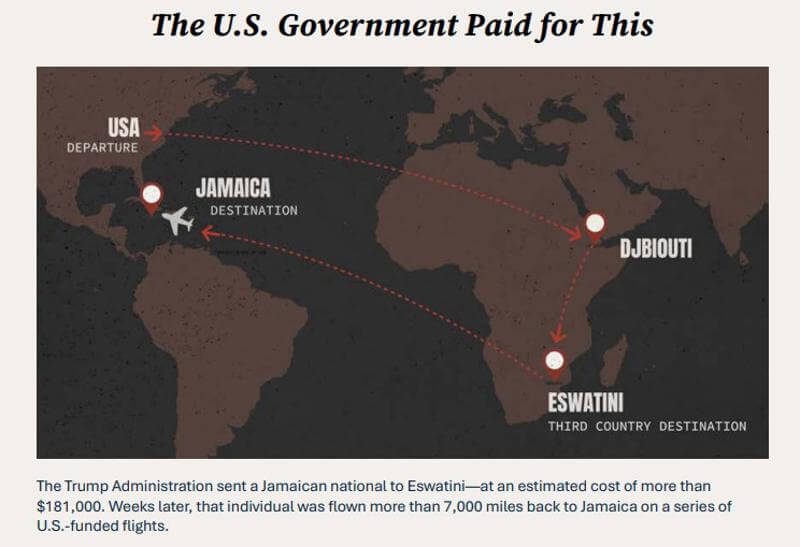
To give one specific example of how pointless these deportations and transports can be: A Jamaican national placed in a cell in ICE custody with other Jamaican nationals, and received a deportation order to be sent back to Jamaica. Instead, the U.S. government separated the man from the others and inexplicably sent him to the small Southern African nation of Eswatini—a nation we have reportedly paid $5.1 million to accept only 15 deportees. The Jamaican man remained in Eswatini only a few weeks before the Trump administration then flew him back more than 7,000 miles on a series of taxpayer-funded flights to Jamaica. Government officials of Jamaica don’t understand why any of this happened, saying that they would have accepted his initial return with all the others: “The government has not refused the return of any of our nationals.” The Trump administration simply flew this man around the world, at massive taxpayer expense, for absolutely no reason and with nothing to gain by doing so. The Senate Foreign Relations Committee even includes a nifty little graphic, charting this one man’s pointless journey, courtesy of DHS and the State Department.
At least 10 different countries have accepted third country deportations from the United States, but the majority of payments have been sent to five, which have collectively received more than $32 million directly: Equatorial Guinea ($7.5 million), Rwanda ($7.5 million), El Salvador ($4.76 million), Eswatini ($5.1 million) and Palau ($7.5 million). In addition to this, the Trump Administration has spent at least $7.2 million on expensive military flights to transport these migrants, according to the Senate report’s estimate. All told, it puts the cost of sending roughly 300 migrants to these countries at an average of about $133,000 per person. Where’s DOGE when you need them?
But wait, it gets even more specifically absurd! You may have squinted a bit there at the name of “Palau.” Turns out, that is a small island nation located 1,500 kilometers east of the Philippines, buried in the Pacific Ocean. Palau has a total population of only 17,663, and is only 180 square miles. And yet, according to this report, the United States government paid Palau $7.5 million last year for the nation to accept third country deportees … and to date we haven’t sent them a single, solitary person. What was that $7.5 million for, exactly? Your guess is as good as mine. I imagine the Palau government was probably grateful for the windfall, though. There is apparently an “agreement” in place to send third country migrants at some vague point in the future.
What if we spent the $100,000 per person in America setting them up with housing assistance, healthcare, education, etc? www.nytimes.com/live/2025/12…
— southpaw (@nycsouthpaw.bsky.social) Dec 24, 2025 at 7:19 PM
Shockingly, the Senate report also claims that despite the U.S. government sending more than $32 million to these five foreign governments for third country deportation deals, the U.S. State Department has not doing any follow-up oversight on how those taxpayer funds are to be employed. As written in the document:
In an unusual move, the Trump Administration has provided these funds directly to foreign governments, rather than through trusted third-party implementing partners who conduct regular monitoring and oversight, making it more challenging for the State Department to track the use of funds. The State Department is also not using a third-party auditor to track the use of money; instead, the State Department appears to be relying on the foreign governments themselves (some with a clear history of corruption or mismanagement) to report on the use of U.S. Government funding.
The true purpose of these third country deportations, in many cases, would appear to be psychological more than anything else: They’re the U.S. government’s veiled threat to all migrants, that instead of simply being returned to your country of origin, you could be sent to some hellhole prison on the other side of the Earth and left to rot. The report quotes a few unnamed individuals, such as “a current U.S. official familiar with third country deportation operations,” who privately described them as a “scare tactic” and “hugely expensive deterrent.” That person referred to the insanity of paying a country like Palau $7.5 million to take deportees and then not deporting anyone there as money that has essentially been paid just so the government can more effectively threaten the migrants it has in detention: “With countries like Palau or Eswatini, the point is that the Administration can threaten people that they will literally be dropped in the middle of nowhere. The point is to scare people.”
It should likely go without saying that for the migrants being sent to these places, these are worst-case outcomes. But the United States is also in many cases effectively skirting the law here, using third country deportations as a way to indirectly deport migrants back to their home countries in defiance of court-ordered protections that say those migrants cannot be returned to their home countries due to the likelihood that they would be persecuted or tortured in those places. Despite the migrants have those court-ordered protections, after being deported to third countries such as Ghana and Equatorial Guinea, they were then sent back to their home countries to face potential reprisals. Of note: This appears to be precisely what the U.S. government intended to do with Chinese national Heng Guan, who made an epic journey to the U.S. in 2021 in order to publish video evidence he had collected of the genocide of the Uyghur people in China. The U.S. government planned to deport Heng Guan to Uganda, which is known to send prisoners back to their trade partner China, where Guan would likely have ended up imprisoned or dead. At the last minute, thankfully, a federal immigration judge stepped in and granted Guan U.S. asylum status.
Other migrants send to third countries have not been so lucky. As the Senate report puts it, in frightening detail:
In Equatorial Guinea, Committee Minority staff understands from advocates that all 29 third country nationals removed from the United States to Equatorial Guinea had U.S. court-ordered protections from being sent back to their home countries due to the likelihood they would be tortured or killed. However, upon arrival, deportees say they were discouraged by Equatorial Guinean officials from applying for asylum in the country and later were told they could not apply and would instead be sent to their home countries. As of January 2026, at least eight individuals have been sent to their country of origin and virtually all have been told they will be sent back despite fear of return. It appears the Trump Administration may have paid a highly corrupt foreign government $7.5 million to do what the United States could not legally do itself.”
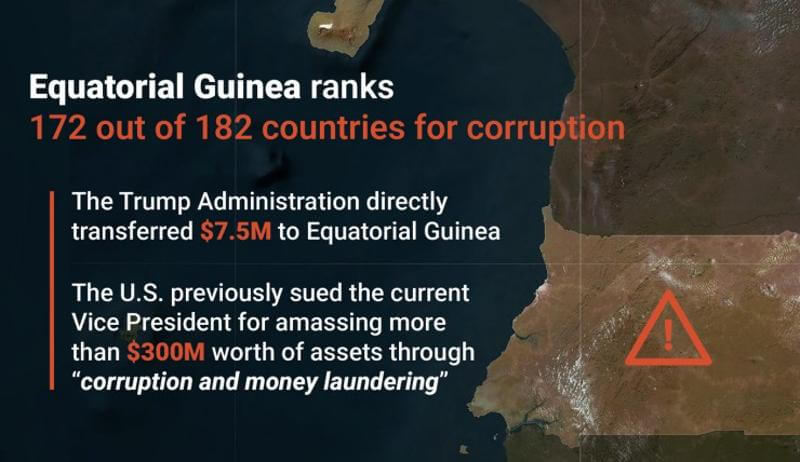
That’s where we now are, in 2026: Paying small, corrupt nations vast sums of taxpayer money to accept third country deportations, only for some of those people to be sent back to their home countries to face further persecution. Of all the things our government could spend 24 years’ worth of median U.S. income on, doing that to a human being is surely one of the most evil choices one could make.
 Keep scrolling for more great stories.