

Looks Like $5 Gas Is Back on the Menu
The midterms are less than four months away. Seems like a great time for gas prices to go through the roof.
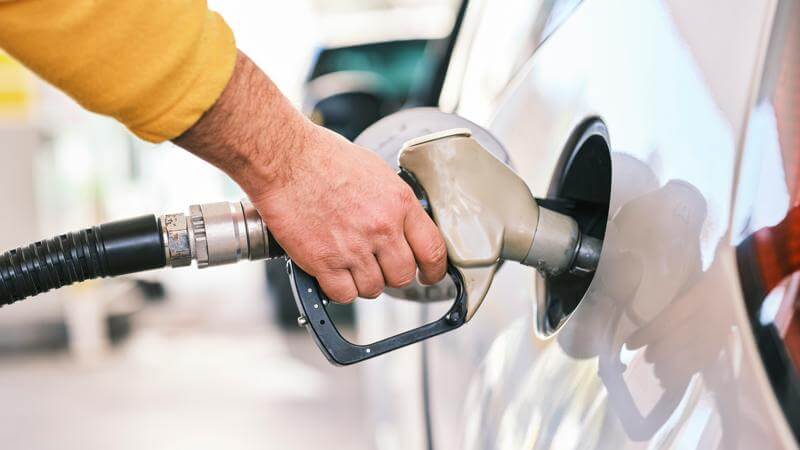
Photo via Unsplash, engin akyurt Splinter gas prices
It was only a couple weeks ago where, even to the cynics, the Iran War seemed to genuinely be coasting to a supremely wasteful (more than $38 billion torched!) but final conclusion. After all, the United States and the Iranian leadership led by the son of the ayatollah we blew up—because we absolutely did not succeed in “regime change,” regardless of what Donald Trump might say—had signed a “memorandum of understanding” to negotiate the end of the war! Sure, they were publicly disagreeing about literally everything contained within that document, calling into question whether anyone on either side actually possessed the slightest bit of “understanding,” but the world economy was bullishly reacting as if the conflict was about to be over. Oil prices were falling, with gasoline prices trailing them. Republicans were acting victorious, despite the war having gained the United States precisely bupkis. Now fast-forward a few weeks, and we find ourselves … right back at square one, with fully renewed hostilities, American troops being killed by the “obliterated” Iranian military, a new blocked oil-shipping strait in the Middle East, and the promise of $5 gas at the pump looming on the horizon. The midterm elections, by the way, are 102 days away.
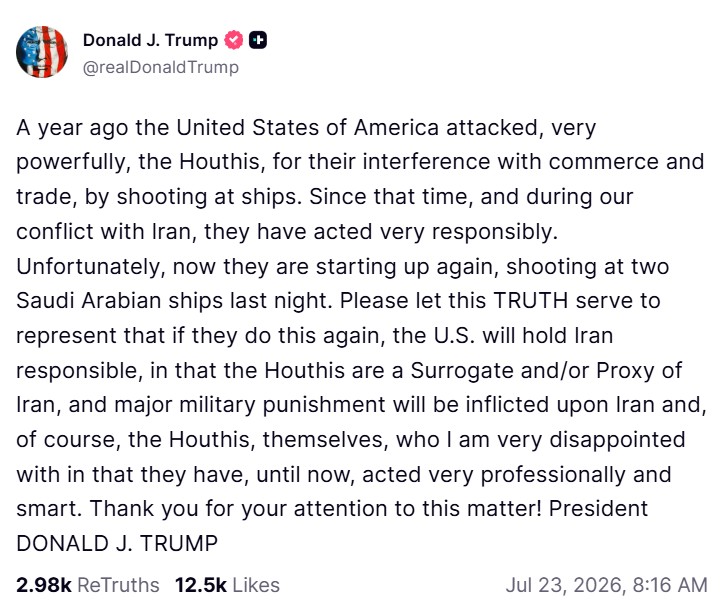
The big news of the last 24 hours? That would be the sudden, new threat posed by the Iran-backed Houthi militants who control the western side of Yemen, bordering the Red Sea. Earlier this week, the Houthis announced that they would be blockading the narrow Bab al-Mandab strait where the Red Sea enters the Arabian Sea, and would be forcibly stopping or attacking tanker and transport ships attempting to pass through the strait. This is the passage that pretty much the entire supply of oil from Saudi Arabia has been taking ever since the beginning of the Iran War, given that the Strait of Hormuz on Saudi Arabia’s eastern side is now too hazardous to venture. Closure of Bab al-Mandab would restrict the roughly 3.6 million barrels of oil Saudi Arabia exports per day, forcing that oil through slower, more expensive channels such as the Suez Canal, taking the fuel in the wrong direction from intended markets in Asia, sending prices soaring. The Houthis, meanwhile, have already made good on their threats, claiming credit for attacks on two Saudi ships in the last 24 hours, while other ships have turned around rather than risk passage of Bab al-Mandab. So yeah, naturally Donald Trump expressed the expected stance in response: He is “disappointed,” and he will kill every man, woman and child in the region as necessary. You know, the usual Trump stuff.
This news has immediately hit the oil markets like a bomb, taking what had been a relatively slow creep upward since the disintegration of the Memorandum of Understanding and turning it into a full-fledged rally in oil prices. The price of a barrel of Brent Crude surpassed $100 on Thursday for the first time since May, and has risen nearly 7% today alone. Corresponding nationwide averages in gas prices are now $4.09, but that’s a trailing price that will continue rising to catch up with the price of oil. Analysts from RBC Capital Markets were quoted by the New York Times saying the full conflict had new “entered a decidedly more dangerous phase,” and that oil prices are still a “lagging indicator of the extreme pressure building in the region” that will continue to climb as high as $150 per barrel. By the way: The estimated price of a gallon of gasoline when oil is at $150 per barrel is roughly $5.50 to $6.50 at the pump.
The United States is of course no stranger to conflict with the Houthis in Yemen, having most recently engaged in a 52-day long campaign of airstrikes and naval strikes against them in March through May of 2025 after they had threatened shipping in the region. With the U.S. military now busy with Iran and its stocks of conventional weaponry potentially depleted, how long will it take to deal with the Houthis this time? Twice as long? That would last all the way until the midterm elections, FYI.
LATEST: Iran-backed Houthi militants say they have struck two tankers in the Red Sea, risking another bottleneck that could further disrupt global energy supplies.
— NBC News (@nbcnews.com) 8:50 AM · Jul 23, 2026
It’s difficult to see how the situation is supposed to develop in any way except to get worse. Trump, the master negotiator, is once again threatening to attack Iranian civilian infrastructure, posting in the last 24 hours that the U.S. military would destroy a bridge or power plant “any time the Islamic republic of Iran shoots at a ship in the Strait of Hormuz,” strikes that would have the capacity to indirectly kill tens of thousands of Iranians. This is of course also an admission that the U.S. is incapable of defeating Iran through purely military means, or fully halting its ballistic missile or drone-launching sites, which continue to result in U.S. casualties in the region. Trump has been drawn (by Israel, largely) into exactly the sort of quagmire in the Middle East he spent literally years lambasting Democrats for and promising to avoid, without even a potential boon to be gained at the end. We’re literally just bargaining for a scenario where the grand prize is a return to the status quo of how things were before the war, and meanwhile the U.S. government has already spent $38 billion in taxpayer dollars achieving absolutely nothing. The U.S. House of Representatives, seemingly in celebration, signed off on not only a $1.15 trillion defense bill yesterday, but also an additional $95 billion budget bill that would also sneak Trump’s voter-disenfranchising SAVE America Act into law.
BREAKING: International benchmark oil prices cross the $100 a barrel again as violence escalates in the Middle East.
— The Associated Press (@apnews.com) 9:34 AM · Jul 23, 2026
The true war, meanwhile, continues to rage within Trump himself, between his sensitivity to negative economic news–particularly in the form of gas prices–and his raging narcissism and ego in needing to be seen as the victor in the out-of-control regional conflict he threw the United States into. For all the effort that goes into portraying Trump as someone who doesn’t give a shit about any kitchen table economic issue, he has proven to be sensitive to gas prices in particular, often promising that they would rapidly normalize just as soon as the world recognizes his greatness in a region-spanning peace deal (except for that one time he tried to convince us high gas prices were good for America). He’s also trumpeted stunts like the small network of “Freedom Fuel”-selling gas stations that made headlines for selling gas at 50 cents below national averages, while being run by Trump-boosting grifters. The last thing that Donald Trump wants to see is national gas prices surging toward $5 and beyond, because it’s one of the markers most closely tied to his historically low approval rating, which had actually begun to recover a bit in the span since the Memorandum of Understanding was signed. These latest developments may well put it into abject freefall again, and Trump has little space left to fall on that front: He’s already polling among the most unpopular Presidents ever for this point in his term.
What looked like it might have been a merciful end to the period of soaring fuel prices turned out to be a mirage, brought on by the utter inability of the Trump administration to forge a diplomatic end to their own conflict of choice. When gas is $5 per gallon at the pump in the United States, how many will wear their MAGA hats to pump it?
 Keep scrolling for more great stories.