

Trump Bombed Iran Over Uranium, but His Saudi Besties Get to Make Their Own
The Trump Organization is partnering with a Saudi developer on $10 billion worth of Trump-branded projects in Riyadh and Jeddah, but that's surely unrelated.
Photo by Win McNamee/Getty Politics Saudi Arabia
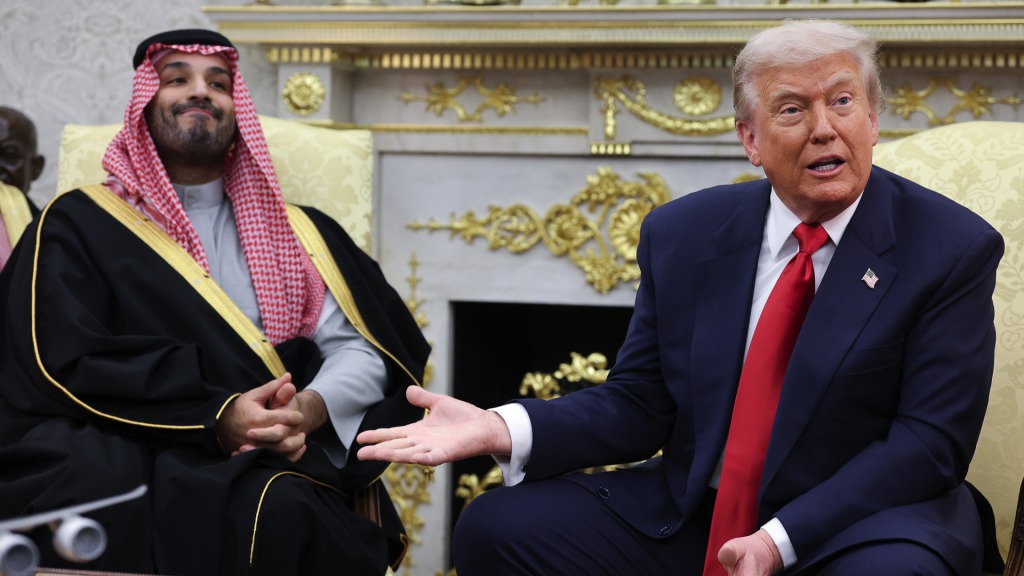
President Trump has spent months warning the world that Iran can not be trusted with the ability to build a nuclear weapon. The United States is currently in this ridiculous war with Iran because of a confrontation over the country’s nuclear ambitions. Trump is even threatening to bomb Iran’s nuclear sites again… while simultaneously opening the door for his BFF Saudi Arabia to develop the exact capability he’s treating as an existential threat in Iran.
The Trump administration just approved a landmark nuclear cooperation agreement with Saudi Arabia that could eventually allow the kingdom to enrich uranium on its own soil, according to new reporting from the Associated Press, Reuters, and The Wall Street Journal. This 30-year agreement would allow American companies to help Saudi Arabia build out a civilian nuclear energy program and, after a joint U.S.-Saudi study, could pave the way for an enrichment facility inside the kingdom.
But the irony here is hard to miss: uranium enrichment is one of the major issues driving America’s war with Iran.
And the thing is, enriched uranium can be used for non-weapons purposes like power generation, which is what Iran claims it needs the uranium for. Having enrichment capabilities doesn’t automatically mean a country is building a bomb. But the same technology can produce uranium enriched to the higher levels needed for nuclear weapons—which is exactly why who gets to enrich uranium, and under what safeguards, is so critical.
And the scary part is that Saudi Arabia has been pretty explicit about where it stands. Saudi Crown Prince Mohammed bin Salman said in 2023 that if Iran ever obtained a nuclear weapon, Saudi Arabia would need one too: “If they get one, we have to get one.”
And the part to note that is so unbelievably Trumpian is that Saudi Arabia isn’t a random beneficiary of this newfound flexibility. Trump and the kingdom have gotten extraordinarily cozy: Saudi Arabia has pledged hundreds of billions in U.S. investment and the Trump family’s own financial ties to the kingdom run deep. The Saudi sovereign wealth fund poured $2 billion into Jared Kushner’s investment firm after Trump left office, while the Trump Organization is now partnering with a Saudi developer on $10 billion worth of Trump-branded projects in Riyadh and Jeddah.
Saudi Arabia insists that its nuclear ambitions are peaceful, but MBS’s statement has understandably made nuclear proliferation experts somewhat interested in the fine print here.
And, well… the fine print is interesting.
According to Reuters, this new agreement does not contain the so-called nuclear “Gold Standard,” under which a country agrees not to enrich uranium or reprocess spent nuclear fuel. It also reportedly does not require Saudi Arabia to adopt the International Atomic Energy Agency’s Additional Protocol, which gives international inspectors broader access and tools to verify that nuclear material isn’t being secretly diverted toward weapons.
If we want to take Secretary of State Marco Rubio’s word for anything, he insisted on Wednesday that the administration would never enter into an agreement that leads to nuclear proliferation. The administration’s argument is essentially that keeping Saudi Arabia’s nuclear program closely tied to American companies and oversight is safer than allowing Riyadh to turn to countries like China or Russia instead. Creating a pretty big Iran-shaped elephant in the room.
The deal isn’t a done deal quite yet. It is expected to go before Congress under the rules governing U.S. civilian nuclear cooperation agreements, giving lawmakers roughly 90 days to review it. Congress can try to block the agreement, although the president could veto their disapproval, and overcoming that would require a two-thirds majority—so expect some extremely calm and normal conversations about nuclear proliferation in Washington.
Still, the timing is extraordinary. The United States is engaged in an escalating conflict with one Middle Eastern country over fears surrounding its nuclear capabilities while potentially helping another Middle Eastern country develop one of the most sensitive pieces of nuclear infrastructure.
Apparently uranium enrichment is less terrifying when your business partners are doing it!
 Keep scrolling for more great stories.