

Everyone’s Getting a Bag of Dry Pasta for Christmas
Italian pasta producers warn that the Trump administration's combined 107% tariffs and duties could force them to pull their products from U.S. shelves early next year.
Photo: iStockphoto Politics
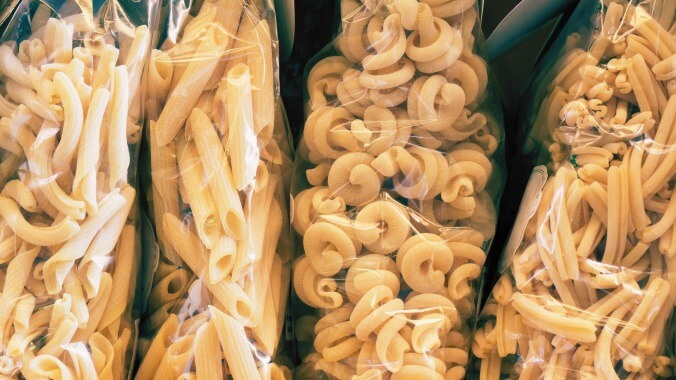
In a first-of-its-kind event, the Venn Diagram of “Trump administration catastrophes” and “Christmas gift ideas for family members you really only see two or three times a year” has become a circle. Thanks to Trump’s beloved tariffs, pasta from Italy might be hard to come by come 2026—so, if you consider yourself a saucy little pasta freak, it’s time to stock up.
On Monday, the U.S. Commerce Department announced a 92% antidumping duty on Italian-made dry pasta, according to the Wall Street Journal. This is on top of Trump’s existing 15% tariff on imports from the European Union, and would affect at least 13 companies, including recognizable brands like Pasta Garofalo, Rummo, and even Barilla (though the U.S.-produced Barilla will be the least affected).
“It’s an incredibly important market for us,” Giuseppe Ferro, the chief executive of La Molisana, a family-run pasta factory in southern Italy, told WSJ. “But no one has those kinds of margins.”
Rummo’s chief commercial officer in the U.S. said they wouldn’t pull the product or put the full burden on consumers, but warned prices could still jump from $3.99 to $7.99.
The decision follows an antidumping probe by the department launched in August 2024, after two U.S. manufacturers alleged unfair pricing by Italian exporters. Officials say they proposed the tariff after two of the accused Italian companies, La Molisana and Pasta Garofalo, were uncooperative. But both say the process was mishandled and have denied any wrongdoing.
The WSJ further writes:
American pasta makers have regularly filed antidumping complaints against Italian imports since [the mid-1990s.] Reviews by the Commerce Department have often found one or more Italian companies guilty of underpricing their pasta.
But the penalties were usually small. Italian makers shrugged and saw it as part of the cost of doing business in the U.S. “All pasta makers, big and small, know that to export pasta to the U.S. you have to pay a tariff,” said Enrica Massarelli, a Naples-based accountant specialized in fighting U.S. antidumping cases on behalf of Italian pasta companies. Italian companies were convinced that products made in Italy, the birthplace of pasta, would retain their appeal with consumers.
The outlet notes this is the first time so many Italian companies have faced “trade-killing” tariffs. Rummo’s CEO said this isn’t about cheaper pasta, but rather “an excuse to block imports.”
The department will make its final decision in late December or early January, but if it goes through, it would be the highest-ever tariff on a food import from Italy. The biggest producers say they’ll stop selling to the U.S. as soon as January—which would plunge our country into a pasta shortage by the spring, maybe even earlier.
We probably deserve it, but also, please, my gorgeous, merciful, female God—anything but the carbs.
Like what you just read? You’ve got great taste. Subscribe to Jezebel, and for $5 a month or $50 a year, you’ll get access to a bunch of subscriber benefits, including getting to read the next article (and all the ones after that) ad-free. Plus, you’ll be supporting independent journalism—which, can you even imagine not supporting independent journalism in times like these? Yikes.
 Keep scrolling for more great stories.