

ICE Wants to Cram 5,000 Detainees In Your Local Empty Warehouse. That’s Fine, Right?
In some places, it's the NIMBYs of all people standing between ICE and their next concentration camp.
Photo via Unsplash, Bryan Landry Splinter ICE
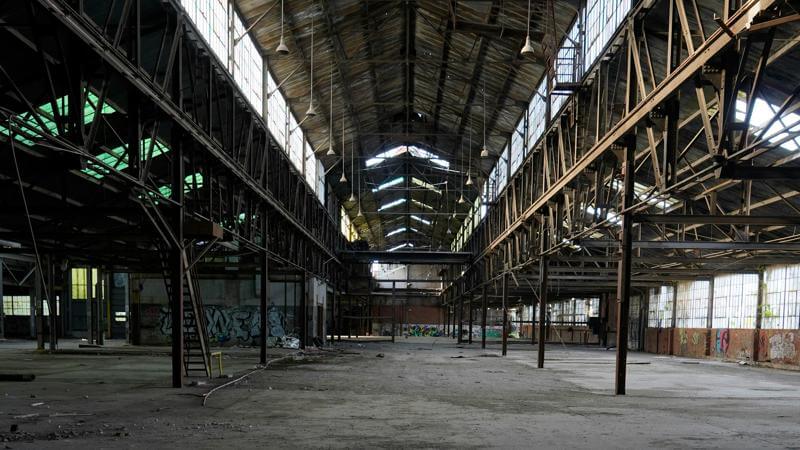
Last week, the number of detainees in the custody of U.S. Immigration and Customs Enforcement (ICE) reached an all-time high, surpassing 70,000 for the first time in the 23 years that ICE has existed as an agency. Despite the stated goal of processing deportations in an effort to cleanse the country of those the Trump administration deems undesirable, under the guise of enforcing the law, an ever-increasing number of people are ending up stuck in detention for ever longer periods. As the total population of detainees grows, overwhelmed immigration courts can’t keep up, and the standard of care can only reasonably be expected to go in one direction. This is presumably how we end up with ICE recently ceasing its legally required reports on detainee deaths, which are also at all-time highs. So with that said: How would you feel about your town handling a few thousand cruelly treated detainees in the nearest available empty warehouse? Because ICE has billions to spend, and it needs some spiffy new concentration camps as soon as possible to carry out its Trump-sanctified mission.
There are currently about 73,000 individual detainees facing deportation in ICE custody around the U.S. according to DHS data. By way of comparison, at the start of 2025 there were less than 40,000. The Trump administration, meanwhile, wants far more total detainees even though the nation’s immigration courts are already critically understaffed and overwhelmed. As part of the “One Big Beautiful Bill,” which allocated an insane $45 billion alone to expand detention space, it has created makeshift detention facilities all over, which have unsurprisingly been the subject of countless abuse complaints. Some, like Florida’s “Alligator Alcatraz,” where Amnesty International reports detainees are placed in 2×2 metal boxes in the sun, are state operated, which means it exists outside of ICE databases and direct federal overview. Others, like El Paso’s Camp East Montana at Fort Bliss, where a medical examiner recently ruled a detainee was choked to death, have become particularly infamous for the deaths associated with them. But for the newest generation of these facilities, DHS seems to be targeting preexisting buildings in towns/cities with unused warehouse space, which could be quickly converted to detention sites with capacities in the hundreds or thousands. DHS spokesperson and liar extraordinaire Tricia McLaughlin recently said the goal was “80,000 new ICE beds,” and daily average population of detainees at more than 100,000.
BIG news from @bloomberg.com, which confirms that ICE has gone ahead and *purchased* multiple commercial warehouses with the aim of converting them into mass detention camps.
This is likely to be the big detention story of 2026 — literal warehousing of people.
www.bloomberg.com/news/feature…— Aaron Reichlin-Melnick (@reichlinmelnick.bsky.social) Jan 30, 2026 at 11:47 AM
This has created an environment in which individual cities and states, particularly blue cities and states, are attempting to explore avenues to stop DHS from opening new, local detention facilities. Cities like Kansas City, Oklahoma City and Salt Lake City have either attempted to pass local ordinances to make this more difficult, or publicly announced that local property owners would refuse to sell or lease their facilities to the federal government for use as ICE detention facilities. States such as New Mexico and California, meanwhile, have attempted to find state-level loopholes to dissuade construction, such as a California proposal that “seeks to nudge companies running ICE facilities out of the state by imposing a 50% tax on their proceeds,” according to NBC News. In many cases, though, neither states nor cities have much direct control over whether private companies choose to sell or rent large facilities such as unused warehouses to the federal government. Just this month, ICE has reportedly paid $102 million for a warehouse in Washington County, Maryland, $84 million for one in Berks County, Pennsylvania, and $70 million for another in Surprise, Arizona. It likewise remains to be seen if state-level attempts to impede ICE efforts to open more detention facilities can survive the inevitable court challenges.
“We’re currently in a moment where it is being tested,” said Danielle Jefferis, an associate law professor at the University of Nebraska to NBC. “So there is no clear answer as to how the courts are going to come down.”
Perhaps unexpectedly, though, one of the stronger deterrents to ICE and DHS successfully being able to open new detention facilities seems to be good old-fashioned NIMBYism. As it turns out, even those who might otherwise support the Trump administration’s immigration doctrine don’t want to have to physically confront it on a daily basis, or are distinctly unnerved by the thought of thousands of detainees crying themselves to sleep only miles from their doorsteps.
I’ve been able to watch something close to this scenario play out in my own admittedly bluer backyard of Richmond, Virginia, in the northern suburban area of Ashland. In late January, the Hanover County Board of Supervisors announced that it had received a letter from DHS, informing them that DHS would be turning a local warehouse into an ICE “processing center,” presumably for human beings. The 550,000-square foot warehouse is owned by Jim Pattison Developments, a Canadian-based property management and development company, which had seemingly been in negotiations with DHS about the sale of the facility without the county’s knowledge. The county’s statement denies knowledge of the sale while more or less implying the powerlessness of the local government to directly do anything about it:
“The lack of early communication from the federal government has created understandable concern and misunderstandings,” the county said. “Hanover County did not request that DHS select this property, was not involved in the selection process and was not consulted by the federal government prior to being notified. Hanover also was not consulted regarding whether the purchase would be consistent with the County’s land use policies or Comprehensive Plan, or regarding its potential impact on residents and businesses. Additionally, the County has had no role in negotiations between the private property owner and the U.S Government and does not have authority to intervene in those discussions.”
It was the residents, meanwhile, who most loudly demanded that ICE stay away from their homes, as hundreds of protesters assembled outside government buildings leading up to the Hanover County Board of Supervisors, threatening that the scenes of chaos and violence seen in locales like Minnesota would inevitably follow wherever ICE had a more concentrated premise. “You want what’s happening in Minnesota to go down in our backyard?” asked a resident to county officials at the meeting. “Build that detention center here, and that’s exactly what will happen.” Another really hit on the note of person-concerned-specifically-because-it-will-affect-them, saying “This detention center threatens to disrupt the very fabric of what makes Hanover special. Such a facility brings with it heightened anxiety and fear, not only for immigrants but for all of the Hanover residents.”
Make a big enough noise, however, and you just might succeed in scaring off the ownership of such facilities from wanting to bring down waves of hate and negative publicity on their heads. In the case of Hanover County, Virginia, that seems to be what happened: Jim Pattison Developments, the owner of the half-a-million square foot warehouse, abruptly backed off from the planned sale after the local outcry and protests, noting in a statement on its website that “The transaction to sell our industrial building in Ashland, Virginia will not be proceeding.” Naturally, they don’t apologize for the fact that they wanted to provide DHS with a place to house detainees and contribute to a record surge in human rights abuses perpetrated by our government, but expecting that kind of contrition is obviously too much to ask. We’ll just have to settle for nondescript, tail-between-legs slinking away.
The Hanover County property that federal immigration officials wanted to buy and convert into an immigrant processing and detention center is no longer for sale, according to a statement released by the Canadian-based developer that owns it.
— VPM News (@vpm.org) Jan 30, 2026 at 2:47 PM
Not to be lost in this discussion is the fact that the makeup of those detained by ICE–including for long periods–is increasingly made up of people who haven’t been charged with any crime. From Jan. 2025 to Jan. 2026, the number of “non-criminal detainees” rose 2,500%, from merely 945 to 24,644. Before the second Trump administration, these are people who would have simply been working their way through the immigration court system until potential deportation, but at least doing it while living in their own communities. Now they increasingly get to do so while living for months in a makeshift tent encampment–ah, and by the way, inspections of ICE facilities plummeted throughout 2025 even as the number of people being held in those detention facilities skyrocketed.
Perhaps when we have more than 100,000 people in indefinite detention in former Amazon warehouses, though, DHS will finally get around to being able to inspect those facilities again, or report when the people in them die. But considering that they can’t even keep measles out of them, we wouldn’t count on it.
 Keep scrolling for more great stories.