

‘Move Fast and Break Things’ Broke Everything
Silicon Valley's broken ideology ultimately destroyed people's trust in them.
Photo by Julia Demaree Nikhinson - Pool/Getty Images SplinterTech Silicon Valley

“Move fast and break things” is a famous phrase coined by Mark Zuckerberg, and the fact that this alleged human who knows what friends are was the progenitor of a belief that Silicon Valley adopted as its business model is all the blog space necessary to prove the depravity of this era. But alas, the evidence continues to pile up rebutting this harmful ideology breaking the world for capitalists’ profit, and there is far more damage that must be assessed, like the now seemingly weekly stories of someone in the throes of A.I. psychosis.
“Roschelle hoped that Sapphire [an A.I. device] would get to know her so well, and the technology powering her so good, that, when Roschelle died, her daughters could ask Sapphire to tell them stories about her,” a disturbing New Yorker report titled “When A.I. Is a Member of the Family” shares. It details a story of a mother with A.I. devices spread around the house, and she is always talking to them. It expands to her daughter Cece’s life at school, as she is not interested in A.I. while “most of her friends did their homework with an app called Gauth.” Artificial Intelligence has proliferated both at her home and school, and the report tells a tale about a girl who feels alienated by an entire world around her talking to chatbots like Character.AI, as “Cece knew that these platforms had been accused of telling children to role-play violent sexual scenes or even to kill themselves.”
The litany of teen assisted suicides by chatbots is enough proof to show how depraved this modern A.I. era has become and how not ready for public use these products are, and when you add in how it is actively destroying education, it’s hard not to look at this technology as an all-out assault on adolescence itself. Kids are using chatbots to cheat in school to a truly stunning degree, as one Brown professor found after splitting the midterm and final between take home and in-person tests that basically his whole class was cheating with A.I.. It is not at all hyperbolic to say that the A.I. “learning” products out there right now are a conscious attempt to eradicate the way we humans been taught to learn for centuries.
A Brown professor gave his students a take-home midterm exam. After suspecting many cheated using AI, he made the final in-person. The orange dots are the midterm scores and the gray dots are the final scores.
I applaud S22 for honesty because I would’ve cheated.
— Sung Kim (@sungkim.bsky.social) July 8, 2026 at 11:57 PM
Technology is a tool the same way that a hammer is a tool so I don’t want to make this a simple case of all tech is bad, and to write this blog decrying Silicon Valley’s abject nihilism, I used Claude as my search engine to find examples. I have ditched the utterly useless Google search for the hallucination bot, because the hallucination bot has a pretty neat feature where if you include “You are never to tell me a statement of fact without a link for supporting evidence, I don’t believe a fucking thing you tell me” in its base instructions, it will go find links on the web for your queries, instead of producing some flattering and median half-truth from its training data like it’s designed to do by its creators trying to justify centi-billion-dollar valuations as they try to catch up to the world’s first trillionaire.
But we don’t live in a world where people are constantly walking around with hammers in their pockets and routinely taking them out to hit themselves in the head with it. If we did, and if we lived in a rational world, we might pass some kind of law to stop people from doing that. But we don’t live in a rational world; we live in one where a guy who stole Harvard students’ data to make a hot-or-not clone is seen as a global thought leader, because he moved fast and broke things in other people’s lives and got world historically rich because of it.
Such is the price of innovation say the hammer salespeople, and if people are going to hit themselves in the head with it, well that’s just the price we must pay for those of us who understand how to use it to build new things. That analogy works fine as a defense for tech just so long as you can’t come up with one for a hyper-addictive hammer specifically designed to exploit human emotions and instincts that we’re not even consciously aware of.
Instagram has moved fast to become many people’s primary source of information about the world, and the things they broke along the way, per Facebook’s own internal company studies that the Wall Street Journal reported on in 2021, were children’s lives. “Repeatedly, the company’s researchers found that Instagram is harmful for a sizable percentage of them, most notably teenage girls” WSJ reported. They also found one company slide from 2019 that said “We make body image issues worse for one in three teen girls.”
But it’s not just Instagram and Zuckerberg’s corrupt fiefdom building pedophile chatbots to point the finger at; all of algorithmic social media has changed the way we interact with the internet, and not for the better. They clearly are trained to prey on younger and more vulnerable users and get them addicted to their products. “Algorithms also reacted to accounts behaving like struggling adolescents, which received over 30% more problematic- and over 70% more distressing content than their non-struggling peers,” found one study published by University of California, Davis researchers in December 2025. What Facebook and big tech and other bad actors are doing these days is fundamentally no different from Joe Camel, knowing full well that the key to making money from their addictive product is hooking people early in their lives.
“After a period with no significant change in trends from 2001 through 2006–2007, suicide rates for people aged 10–24 increased through 2021,” wrote the CDC in 2023. “And homicide rates declined through 2014 and then increased through 2021.” This is a complex subject that this CNBC article does a good job of going through all the various contributors to this CDC data, but I don’t think you can argue that the proliferation of algorithmic social media feeds rising in tandem with suicides among kids aged 10-14 in the CDC chart below is an unrelated issue. This is part of what breaking things looks like in practice.
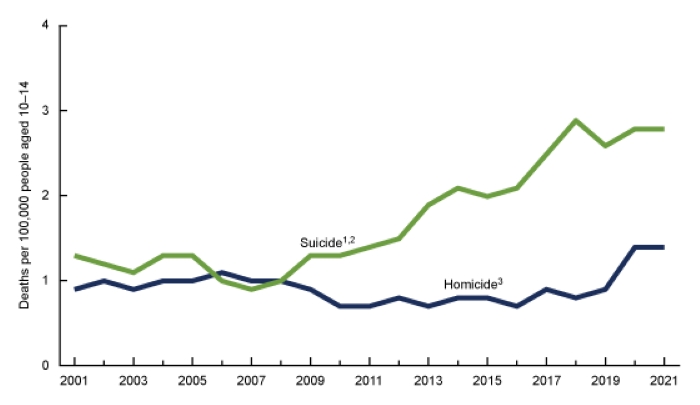
Chart by CDC
Carl Fleischer, co-director and medical director of the Boston Child Study Center-Los Angeles, told CNBC that among other things, social media is a key contributing factor to the rise in teen suicides. The manicured life projected on apps like Instagram and TikTok pressures kids to meet unrealistic standards, and the basic nature of online interaction makes cyberbullying more difficult to detect as well. Another thing you can plot on the chart above alongside the rise in teen suicides is access to guns, as that is where the hammer analogy is more apt, as simply making sure people don’t have access to them is the best way to stop them from harming themselves with it.
Even tech itself has not been well-served by this hyper-capitalist ideology whose entire theoretical concept is to privatize gains and socialize losses, as the security world’s hair has been on fire well before Claude’s new Mythos model supposedly found enough zero-day exploits to functionally destroy the internet as we know it. There’s always good reason to doubt any claims by A.I. companies all racing to justify the most expensive IPOs in history, but this is an area where the vulnerabilities of current software and what A.I. is quite good at match up well. There’s no reason to disbelieve that A.I. has brought something of a holy reckoning for the tech world who acted for a decade or more as if there were few major downsides to shipping broken code.
In fact, Zuckerberg recanted this phrase in 2014, saying that “What we realized over time is that it wasn’t helping us to move faster because we had to slow down to fix these bugs and it wasn’t improving our speed.” The base concept at the heart of this broken ideology is that fixing code is relatively straightforward and cheap, and so the idea is it’s more important to get a flawed product out that you can then update later than to ensure it works exactly as you’d hoped before you release it. That’s all fine and dandy, just so long as you, unlike companies like Equifax, actually patch that vulnerability later on.
But a lot of companies haven’t and it has led to major data breaches that have affected hundreds of millions of people. Equifax was notified by the Department of Homeland Security in 2017 that they had a hole in their defense systems, a patch was never applied, and 143 million Americans had their social security numbers, birthdates, and addresses leaked. Facebook had a similar breach in 2018, as 30 million accounts had their digital keys hijacked, leading to 14 million people having extensive profile data like location history stolen from them. In July of 2024, you may remember not doing any work for a whole day because Crowdstrike pushed a flawed update that lead to the largest IT outage in history. Now, as Cyberscoop noted earlier this year, “For 20 years, tech has moved fast and broken things. The result: a cybersecurity crisis built on rushed code and vulnerable software.”
A simple search of “move fast and break things” returns a range of articles and quotes from people in tech saying we shouldn’t do that anymore, even as tech’s golden fraudulent goose, Elon Musk, destroyed a good portion of the federal government last year, embracing “Silicon Valley’s most notorious instincts to ‘move fast and break things’ in a lightning battle to muscle into the computer systems and power structures of federal agencies,” as NBC reported. Meta’s dedication to making flawed products has lead to them being fined in December 2018, December 2022, and they have lost twice in court this year when jurors determined that Meta misled users about the safety of its apps. They also were sued over Facebook’s role in inflaming the Rohingya genocide in Myanmar.
People like Zuckerberg have built empires where you and I are the product, and he has become world historically rich by selling our data to advertising companies. Providing a free service in return for using your data is fine just so long as everyone understands what they are getting out of this, but Zuckerberg’s empire where roughly 10% of its annual revenue comes from fraudulent ads has proven that it is not interested in an honest relationship with its customers. Move fast and break things is an inherently exploitative business model where negative externalities are pushed onto the populace in order to create more private profit, and it extends beyond just software updates. Ultimately, the widespread and growing hatred of Silicon Valley and the fervent bipartisan opposition to data centers proves that perhaps the thing they fundamentally broke more than anything was society’s trust in them, and they’re learning the hard way that it’s not so easy to gain that back.
 Keep scrolling for more great stories.