

We Really Don’t Give Thanks Often Enough That Orcas Don’t See Us as Food
We're very lucky that orcas don't see us as a meal, given that they can hit a 4,000 pound sunfish hard enough to make it literally explode.
Photo via Unsplash, Mike Doherty ScienceSplinter Nature
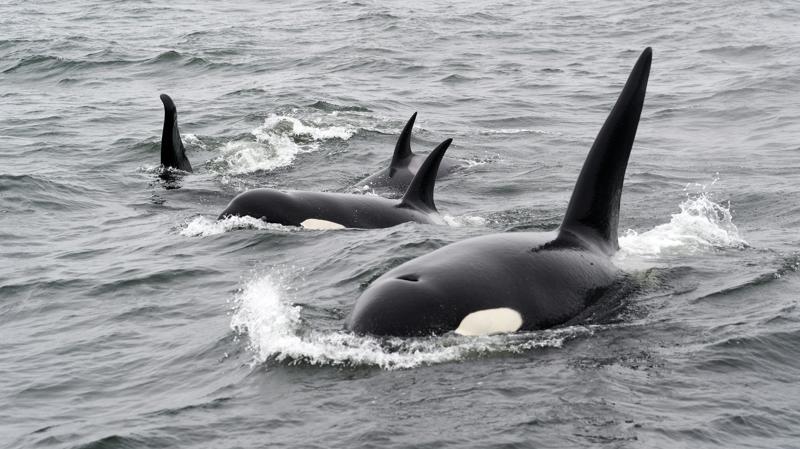
You know, every so often a news story about the natural world comes along that is not only fascinatingly violent, but also makes you realize that you should be counting your blessings. The footage currently going around of a pod of orca whales/killer whales ramming a 4,000-lb sunfish so hard that the fish literally explodes is one of those moments, because once you get past the jaw-dropping physical spectacle of watching these perfectly evolved killers go about their business, how can your next thought be anything but: Good lord, I’m glad these things don’t choose to do this sort of thing to human beings when they absolutely could, at their will. Truly, it’s the orca’s ocean; we merely swim in it.
Said behavior has actually apparently been witnessed on two separate occasions, and has naturally caused a stir in both the ecology world and the media, judging from CNN headlines like “Watch an orca ram a sunfish so hard that the fish explodes.” The behavior was witnessed in 2024 and 2025 in the Mexican Pacific Ocean and in the Gulf of California, and we’re now learning about it thanks to the researchers reporting their findings in the journal Frontiers in Ethology. But without further ado, the footage you came here to see:
1/4 Orcas making sunfish explode
One orca firmly holds the carcass of a sunfish (whose viscera have already been removed) while an adult male crashes into it at high speed, making it explode into countless pieces.
(paper) www.frontiersin.org/journals/eth…
— Tay (Antonio J. Osuna Mascaró) (@biotay.bsky.social) 5:04 AM · Jul 23, 2026
What you’re seeing is one adult orca holding the massive, disc-shaped sunfish (which are one of the ocean’s heaviest fish, and can be up to 10 feet wide) by its tail, when another killer whale comes flying in from out of frame and plows right through it, blasting the sunfish into a shower of slick, fishy chunks. You can literally hear the “thwack” of it exploding into bits, and the shocked researcher’s reaction. Thankfully for that poor creature, it was apparently already dead: The whales had killed it and eaten some choice bits before apparently deciding to employ this technique to blast it into pieces. The real question from an ecological perspective is why: To knock it into convenient bits for their young and adolescents to feed, perhaps? Or perhaps these whales are real assholes who revel in violence? The aforementioned CNN piece yields some genuinely hilarious quotes from the researchers involved, mulling over this very possibility, while calling the act of exploding a fish “prey fragmentation,” among other things.
“They had already consumed the sunfish’s internal organs, which are the most nutrient-rich parts of the prey,” said lead study author Kathryn Ayres of nonprofit Beneath the Waves, who shot the footage. “This suggests that causing the sunfish to explode may not have served an immediate feeding purpose and could have just been for fun.”
Which of course begs the question, just what else do these gleeful aquatic sadists do for “fun” that we don’t already know about? Because rest assured, orcas are some truly strange beings, fiercely intelligent and capable of great degrees of communication and imitation. When one of them picks up a particular habit or trick? They all figure it out. Look, for instance, at the time in 1987 when a group of orcas in Puget Sound near Seattle randomly picked up a strange fashion quirk: They started “wearing” dead salmon on their heads like hats, sometimes for literally weeks at a time. The behavior was never seen again until 2024, when it briefly reappeared. What evolutionary purpose would this have served? None, as far as any researcher has ever deduced. It’s just orcas, being the ocean’s most flamboyant murderers.
That kind of shared, learned behavior probably also has something to do with the last big news cycle that involved the killer whale: When they began regularly attacking, disabling or outright destroying small boats and yachts in the Mediterranean sea near the Strait of Gibraltar in 2022 and 2023. Those who witnessed these attacks have said that the whales worked in conjunction to specifically target boat rudders, and may have been taught the behavior by an elder or matriarch who had an adverse run-in with a fishing vessel, and so now sees boats as threats and has passed this behavior on. The “killer whale attacks” story eventually ran its course in the media, but the behavior itself has continued unabated: The years 2025 and 2026 are still seeing plenty more whale attacks and boat sinkings off the coast of Spain.
A captain filmed orcas targeting his ship’s rudders off Spain’s coast. These intelligent creatures are challenging our understanding of marine behavior.
— Digital Brain (@yourdigitalbrain.bsky.social) 5:10 AM · May 21, 2026
Thankfully, the most notable detail involved in the whole boat attacks story is that despite the whales having attacked, disabled and even sunk numerous boats, they’ve never once attacked a single human being. We are blessed—truly blessed—that evolutionarily speaking, the orcas all over the world’s many oceans have seemingly never seen human beings as a viable food source, or something to harass in the way they are perfectly happy to fuck with other creatures. There has never once been a verified, fatal wild orca attack on a person, and it’s not for a lack of opportunities. Conversely, the only actual attacks have been when people are killed by orcas in captivity (or in 1977 Jaws ripoff Orca), when depressed or deranged whales have taken out rather obvious frustration on their trainers, or played a bit too, er … enthusiastically. It all suggests that these animals have always been happy enough to leave us well alone, if we leave them alone.
And thank god for that, because a video like the above is a genuinely frightening reminder of what these animals are capable of. We’re talking about a 10,000 pound pack hunter that will prey on nearly anything, including blue whales, the largest animal on Earth, which they enjoy killing by holding under the water until they suffocate, and then eating their tongues. Trust me, if you hadn’t seen Free Willy as a kid, the orca is the animal you’d dread encountering every time you dipped a toe into the ocean. If they wanted to, they could absolutely hold us in place while a second whale barrels in to smash us to pieces. They could be cruising around Puget Sound wearing hats made out of children just as easily as salmon.
But thankfully, they don’t. Although you have to wonder: With the way we’re pushing the oceans to the point where they’ll be uninhabitable, how much longer can we genuinely expect to stay in the orca’s good graces?
 Keep scrolling for more great stories.