

Booze like a Founding Father with Two Different Versions of the Sazerac Cocktail
We celebrate an American milestone with one of the oldest of all American cocktails--with whiskey AND brandy.
Photo by Jim Vorel Splinter sunday cocktail corner
Sunday Cocktail Corner is a series dedicated to finding just the right libation for the situation.
This weekend, we celebrate the 250th anniversary of our nation by acknowledging that in the vast majority of places in that nation, it’s so hot outside that it causes instantaneous pain to the human nervous system just to step out of your door for a moment. No joke: I dared to walk out the door in order to snap a few photos for this article, and my face immediately began to melt like one of the Nazis in the final moments of Raiders of the Lost Ark. If I’d known a few weeks ago the dire straits we would now be in on the 4th of July, perhaps I would have saved the Corpse Reviver #2 for this week. Oh well, no matter–this week’s selection was always going to have a historical American boozing bent, for obvious reasons. And there aren’t many cocktails with deeper American roots than those of New Orleans’ iconic Sazerac.
As The Simpsons once observed, America’s history of substance dependance runs deep: “All of our Founding Fathers, astronauts and World Series heroes have been either drunk or on cocaine.” That’s really not much of an exaggeration, either–at least when it comes to the Founding Fathers, anyway. Curiously absent from the likes of Hamilton is the fact that almost every person depicted in the musical was a prodigious drinker, particularly the men who would go on to become America’s earliest Presidents. In the days after the Revolutionary War, George Washington operated what was literally the country’s largest commercial distilling operation out of Mount Vernon, selling his rye whiskey far and wide. Every political function doubled as a raucous kegger. Author Daniel Okrent, in his indispensable book Last Call: The Rise and Fall of Prohibition, detailed some of the personal drinking habits of the men who are today so often depicted as sober-minded philosophers:
Washington kept a still on his farm, John Adams began each day with a tankard of hard cider, and Thomas Jefferson’s fondness for drink extended beyond his renowned collection of wines to encompass rye whiskey made from his own crops. James Madison consumed a pint of whiskey daily. Soldiers in the U.S. Army had been receiving four ounces of whiskey as part of their daily ration since 1782; George Washington himself said “the benefits arising from moderate use of strong liquor have been experienced in all armies, and are not to be disputed.”
National drinking rates in America, meanwhile, would only soar far higher in the 1800s, peaking in the middle of the century at roughly three times the average yearly ethanol consumption of today. And wouldn’t you know it: This was also the time that the foundational ideas of what constitutes a “cocktail” were being codified. It’s somewhat pointless to try to say what the “first” cocktail really was, as drinks such as the Old Fashioned constitute a long series of evolutions with no clear starting point. But the Sazerac, famously associated with the city of New Orleans, was certainly one of the very first to be standardized. In fact, if you order a Sazerac today, what you receive is pretty close to what you would have gotten in the mid-1800s, with elements such as the absinthe rinse or the presence of creole bitters, most famously Peychaud’s Bitters. But one major thing has changed: The base spirit.
The Sazerac, you see, was not originally a whiskey-based cocktail at all–it was made with brandy, specifically French cognac. For half a century or so, that cognac-based version would have been the standard Sazerac–until the mid-1880s, when the Great French Wine Blight that imported American grape vines unwittingly unleashed upon Europe practically eradicated the European wine industry. French brandy subsequently became sparse, leading to a change in the Sazerac that has persisted to this day: The cognac turned into rye whiskey, one of America’s earliest native spirits.
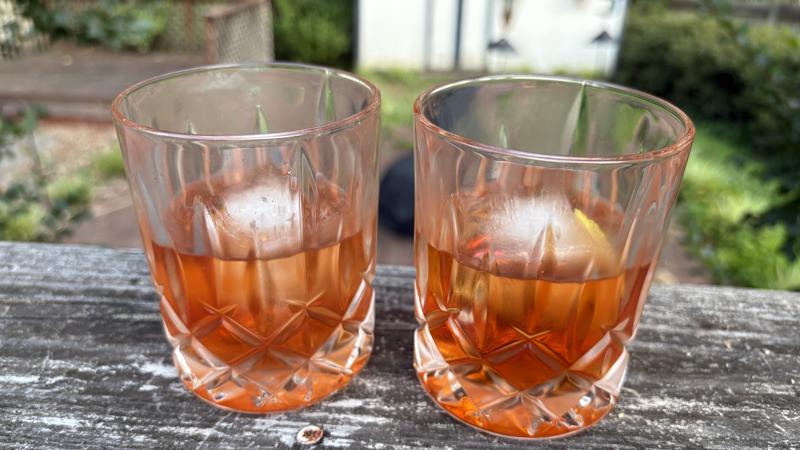
All these years later, though, I realized that I’ve never actually had a Sazerac made the original way. So I decided I might as well test it out and make both versions: How the drink might have been in the mid-1800s, and how it’s typically made today.
Sazerac Cocktail Recipe
— 2.5 oz cognac or rye whiskey
— 1 sugar cube (or tsp fine sugar)
— 4 dashes Peychaud’s bitters/creole bitters
— 1 teaspoon water
— Absinthe, to rinse
Rinse a glass with absinthe and discard. Put your sugar cube or crystal sugar at the bottom of a mixing glass, and saturate with Peychaud’s bitters. Add water and swirl it around to partially dissolve, and then add spirit of choice (the rye whiskey or cognac). Fill mixing glass with ice and stir well. Strain into your absinthe-rinsed glass, either neat or on ice. I like a single, large cube for this. Express a strip of lemon over the drink, and either use it as garnish or drop into the drink.
A note on Peychaud’s bitters: It’s sacrilege to say that you could probably get away without using the absinthe rinse in this drink, but as long as you have the Peychaud’s bitters you’ll still be making what is recognizable a Sazerac. What you can’t do is try to substitute some other form of non-creole bitters, such as Angostura, because what you make there will never evoke a Sazerac to anyone. Peychaud’s bitters are an interesting, subtle thing–fruitier and more cherry-like than Angostura, with floral undertones, anise notes and less pronounced bitterness. The only acceptable substitute will be other products listed as “creole bitters.” Go buy a tiny bottle of these if you intend to make Sazeracs.
As for the differences between the rye whiskey and cognac Sazerac variations, they somehow manage to be both subtle and pronounced at the same time. The brandy-based version of the drink is intriguingly soft, less angular and spicy than most any other version of a Sazerac I have had, with a fruitier sweetness that allows the anise rinse (and its telltale anise character) to play up. I think I rather like this? The rye whiskey version, on the other hand, is more unmistakable in its base spirit, a little less sweet and more intense in its peppery, oaky backbone. If I’m being honest, neither version I’ve made here is quite as good as some of the better Sazeracs I’ve consumed at bars and restaurants over the years, but I’m not terribly surprised–this isn’t a cocktail I’ve often made at home in the past. If anything, the results are indicative of a quintessentially American status of being a work-in-progress: We have a theory of what we want our country (or cocktail) to be, but we still have a lot of work to do to get there. Perhaps another 250 years from now, we’ll have perfected both.
 Keep scrolling for more great stories.