

The Complicated, Frustrating History of the First Spousal Rape Trial
Sarah Weinman's excellent new book, Without Consent, chronicles the relationship at the center of the sensationalized 1970s trial and its impact on the long—and alarmingly recent—fight to criminalize spousal rape.
Photo Credit: Getty/Bettman BooksIn Depth
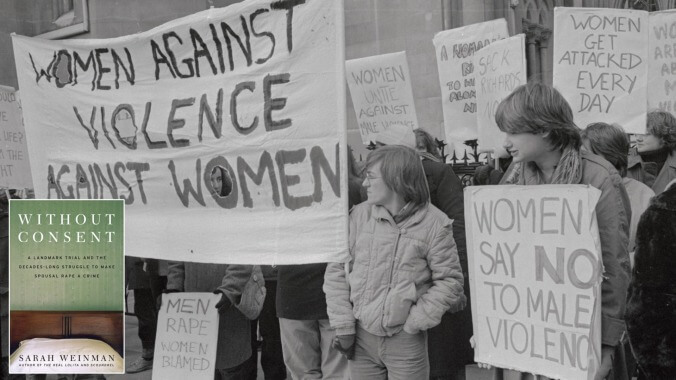
When 23-year-old Greta Rideout filed rape charges against her husband, John, in 1978, he became the first American man to be tried for the rape of his wife. The year before, their home state of Oregon had criminalized spousal rape, and the Rideout trial became a test case of the law. In her excellent new book, Without Consent: A Landmark Trial and the Decades-Long Struggle to Make Spousal Rape a Crime, Sarah Weinman excavates the story of the Rideouts, which has been almost entirely forgotten despite the sensational national news coverage it received at the time. By telling the story of both Greta and John Rideout, Weinman shines a light on the long and alarmingly recent fight to criminalize spousal rape. Since the 1970s, Weinman shows, laws concerning spousal rape and popular understanding of the crime have changed dramatically.
Oregon was only the fourth state to pass a marital rape law, and the laws were controversial. As John Rideout’s defense attorney, Charles Burt, told the press, “Rape is not with meaning when it’s a husband and wife. … Maybe this is the risk of being married, you know?” Burt was hardly alone: Many men at the time expressed bewilderment, and outrage, at the topic being raised at all. In 1979, for example, California State Sen. Bob Wilson went so far as to say, “If you can’t rape your wife, who can you rape?”
Greta’s perspective was different. She had long endured physical abuse from John, but after he allegedly assaulted her in front of their 2-year-old daughter and then violently raped her, Greta fled their home and took their child with her. After consulting with an advocate at a local women’s crisis center and a lawyer, Greta made the radical decision to charge her husband with rape. “If I had stayed,” Greta explained to a journalist, “I might have been brainwashed into thinking I had deserved it.” Her decision would have lasting consequences for her life and for women across America.
In English common law of the 17th and 18th centuries, which formed the basis of the U.S. legal system, wives were considered the property of their husbands. According to the principle of coverture, a woman was subsumed into her husband’s legal existence upon marriage, which made it impossible for her to sign contracts, own money separately from her husband, or stop him from accessing her sexually.
Though many believed that spousal rape simply could not exist, some public intellectuals over the years argued that it was not only possible but also a terrible crime. Philosopher John Stuart Mill, who enjoyed an unusually egalitarian marriage, forcefully condemned marital rape in 1869, calling it “the lowest degradation of a human being,” while women’s rights campaigner Elizabeth Clarke Wolstenholme-Elmy argued in 1880 “that it would be a gross immorality to enact…that [rape] by a husband, however base and cruel it may be, is justified by the matrimonial consent of the wife once given and never to be retracted.” Fiction writers like George Eliot and Arthur Galsworthy, meanwhile, alluded to or explicitly described marital rape in harsh terms. But, as Weinman points out, the dominant cultural image of spousal rape comes from the sensationally popular Gone with the Wind, in which Rhett Butler rapes his wife Scarlett O’Hara, and she wakes up the next morning relishing what transpired the night before.
This push and pull, between a minority who argued against spousal rape and a majority that dismissed or even romanticized the concept, would characterize the Rideout trial, which, unsurprisingly, hewed to stereotypes that remain familiar today. Though Greta and feminist advocates made a forceful case for married women’s right to bodily autonomy, mainstream media reacted with skepticism and hostility to their claims. Greta’s sexual history was ruled fair game for the prosecution, and she was painted as a sexually irresponsible woman who planned to get rich off of selling her sensational (and, it was implied, falsified) story to Hollywood. (As Greta later said in an interview, “When I’m being offered money, especially when I’m sitting here on welfare, I’d be dumb not to accept it.”)
Burt argued that John Rideout was the simple victim of a calculating, vindictive, deviant woman—despite the fact that the defense admitted that he had physically assaulted her, since the prosecution had only charged him with rape. It was OK for a man to beat his wife, the defense implied, and to rape her: As Burt told the press, “Our legal position is that the marital relationship is still a defense. There are enough problems with the marital relationship now without allowing one spouse to charge the other with a 20-year felony.” Yet Burt and John also maintained that John hadn’t raped Greta: “No force was involved” (which, of course, ignored that his defense was not contesting the physical assault accusation).
In other words, John hadn’t raped Greta, but if he had, it wouldn’t have been illegal. The argument was convoluted and contradictory but combined with the defense’s vilification of Greta, it was enough to persuade the jurors. When John was found not guilty, “The crowd burst into applause.”
Not long after the trial, Greta and John reconciled. Like many battered women, Greta struggled to extricate herself from her relationship, particularly because she relied on John’s (very limited) income to make ends meet. The press was unforgiving of this development: Women’s rights activists despaired, while male columnists crowed. One writer described the couple as “terminally stupid.” Another wrote, “I’ll never take sides in another husband-wife rape case again without thinking of Gone With the Wind.” Greta left John again a few months later, explaining her thought process to yet another journalist, after which she became more leery of the press. The couple finally got divorced, though John stalked and threatened Greta throughout the process, eventually winding up in jail.
The furore over the Rideout case, and the couple’s subsequent reconciliation and ultimate separation, shows how dramatically our popular understanding of domestic violence has changed since 1978. As I read Without Consent, I found myself thinking that the criminalization of spousal rape in the United States has been more important in how it changed ideas about marriage and consent than in how it changed the law, though the two things are inextricably intertwined.
Today, though spousal rape is a crime, it’s very rarely prosecuted. I looked for statistics, and could find none; the numbers are simply too small. Given that only a tiny fraction of rapes are prosecuted, this isn’t surprising. I asked Weinman if she’d found any more concrete information, but she described the number of spousal rape prosecutions as “a fraction of a fraction of a fraction of a fraction” of total rape cases. (Not all victims of spousal rape, or domestic violence, are women. Researchers have begun to explore domestic violence in same-sex marriages, but the paltry statistics for spousal rape make it hard to estimate how often this occurs.)
Women have many reasons not to charge their husbands with such a crime: fear of retaliation, economic dependence, concerns about family stability, and feelings of shame. In her book, Weinman cites compelling studies from the 1980s, in which researchers found that an alarmingly high percentage of women, between 8 and 10 percent, had endured spousal rape but didn’t describe those experiences as “rape.” As Weinman told me, spousal rape remains an under-discussed topic today (compared to, for instance, abortion) because of “the level of shame that people feel about rape and sexual assault within marriage.” If your husband rapes you, she said, “You can’t leave and they’re not leaving. You wake up the next morning with that person, you have children with that person.” While a victim of date rape or stranger rape may work up the courage to go to the police, a woman charging her husband (or long-term partner) with rape knows she will be blowing up her life by doing so. It’s hardly surprising that so few women choose this path.
Even so, Greta’s ordeal had an effect. Bill Bebelhout, a columnist for a local paper, was able to see that the trial had not been a waste of time and money despite the couple’s reconciliation: The trial, he wrote, “forced millions of people, from Salem, Oregon, to Bath, England to give serious thought to the complexity of the husband-wife relationship.” Thanks to Greta, activist Laura X and others led years of campaigning to pass spousal rape laws across the country.
And attitudes about rape and domestic violence have changed since then: Though victim-blaming is still rampant, the public has a much better understanding of how victims react to trauma, and of the cyclical nature of abusive relationships. Weinman highlights these changes in her book by returning to John Rideout decades after the initial trial. In 2017, John Rideout was tried for rape once again (though not for spousal rape), and the tenor of the trial was much different. This time, he was convicted of raping two women. Weinman was able to attend a retrial (held due to a change in Oregon’s trial system), and she told me that the prosecutor asked prospective jurors whether they thought marital rape was a crime. “Uniformly,” she said, “they said they believed that marital rape was a crime. Hearing that in the courtroom was pretty validating.” Even more validating was seeing John convicted for rape once again.
It’s gratifying to see Greta Rideout’s story told in Without Consent, given how poorly she was treated by the media at the time of the trial and in the subsequent chaotic months. Weinman, whose other books include The Real Lolita and Scandal, has made a specialty of turning a feminist lens on true crime, but Without Consent is distinct from her previous books in that it is motivated more by the desire to explore an idea than a person or incident. In addition to Greta, Weinman also tells grim stories of victims who spurred other states’ spousal rape laws—including Sarah Powers, who was murdered by her estranged husband after he was found innocent of raping his previous wife—and the stories of the John’s later victims, who testified against him in the 2017 trial. Repeatedly, Weinman shows that if the law took the claims of victims more seriously, other women would not be subject to similar or even worse acts of violence. Her rage on behalf of these women pulses through the book, without ever impeding her keen analytical approach.
Greta remains a shadow looming over the book even when she is not present, but, paradoxically, she did not consent to participating in this project. Despite Weinman’s repeated attempts to contact her, she didn’t reply before dying in 2023. Though she had given occasional interviews over the decades, Greta had mostly avoided the press after her bleak 15 minutes of fame. Weinman told me she would have changed Greta’s name had she lived until the publication of the book, but she also acknowledged the overall complexity of the subject. Due to a journalist who covered the initial trial, Greta’s name is in the public record, an initial violation that permanently transformed Greta’s life and cannot be undone. And without Greta’s story, there simply would be no book. Weinman had to write about Greta, but remained aware that doing so was fraught: “Reporting on other people’s lives is the biggest responsibility I will ever have, particularly those who were survivors of sexual assault,” she told Jezebel. “Constantly continuing to struggle with it is probably the only answer I have.”
The history of women’s rights is fraught in this way because so many women, like Greta, have found themselves in positions they would never have chosen. No doubt, Greta would have preferred to live out her life in happy obscurity. Instead, her husband abused her and she made a decision to act, thereby putting herself in on the legal record—and in books like this one—forever.
As attorney Taylor Kordsiemon told Weinman, using the Dobbs decision as a model, the Court could reverse spousal rape laws, or, more plausibly, “not recognize the right to self-defense against marital rape.” If these dire predictions come to pass, American women will not only need to organize and support each other at a grassroots level, but will also need people like Greta Rideout who are willing to face public scrutiny in order to stand up for their own rights and our collective, fundamental dignity.
Like what you just read? You’ve got great taste. Subscribe to Jezebel, and for $5 a month or $50 a year, you’ll get access to a bunch of subscriber benefits, including getting to read the next article (and all the ones after that) ad-free. Plus, you’ll be supporting independent journalism—which, can you even imagine not supporting independent journalism in times like these? Yikes.
 Keep scrolling for more great stories.