

The U.S. Randomly Deported Four Men to Africa. It’s Taken Them 9 Months of Fighting to Get a Local Lawyer.
Eswatini is Africa's last absolute monarchy. The Trump administration paid them $5.1 million to take random deportees.
Photo via Unsplash, Hédi Benyounes Splinter Deportation

The incredible cruelty and general pointlessness of so-called “third country” deportations remains an underreported and underknown element of the second Donald Trump administration’s broader immigration-related atrocities. One thing that no one who looks into the topic doubts: It’s an incredible money pit, and one that serves no seeming purpose besides waste and potential graft. Why, for instance, did the United States bother to pay the nation of Rwanda $7.5 million to accept a grand total of seven deportees in 2025, at more than $1 million per person? Why, after paying these incredible sums, do the deportees in question sometimes end up being sent back to their home nation anyway at additional U.S. expense a few weeks later? No one can really say how the capricious whims of the Department of Homeland Security and State Department are playing out here. What we can say is that these unfortunate immigrants have often been subjected to shockingly stupid, cruelly unfair circumstances in the place where they end up, when third country deportation occurs. Just ask the four men we deported to the small African nation of Eswatini, who apparently spent the last nine months fighting and jumping through hoops just to obtain the right to speak with a local lawyer. It ended up taking a ruling from the country’s Supreme Court in order to grant these men the most basic legal right imaginable.
The four men in question are immigrants originally from Cuba, Yemen, Laos and Vietnam–one will note that not one of them is actually from Africa, or has any connection to the little southern African nation of Eswatini. All four of the men were originally convicted of “serious crimes” in the U.S. and had deportation orders, but had served the entirety of their prison sentences in the U.S. before being deported. But rather than being returned to their home nations–which is ostensibly done in some cases because countries refuse to accept a person’s return, or because the person would face some danger there–they instead faced deportation to the middle of nowhere in Africa. The United States paid the government of Eswatini a reported $5.1 million to take on deportees, of which there have been 19 to date. Where did Eswatini stick these people? Well, how does a maximum security prison sound, despite the fact that they’ve committed no crime in the country, and already served their sentences in the U.S.? The men have reportedly been allowed contact by phone with their U.S.-based lawyers, but were denied any kind of local legal representation on their behalf. Pertinent to this discussion is the fact that Eswatini is ruled by a king as Africa’s last absolute monarchy, and has been accused of brutal repression of democracy advocates and dissenters. Sounds like a great place for the U.S. to be doing business.
‘We still deserve due process,’ says Cambodian man deported by US to Eswatini
— The Guardian (@theguardian.com) Apr 7, 2026 at 12:56 PM
This all begs the question: What is the rationale for why these men are even in prison at this point? Because the United States paid for them to be imprisoned and punished? And why did the government of Eswatini work so hard in its effort to deny the four men any legal representation?
Because rest assured, these guys got railroaded for the last nine months by the nakedly corrupt system that the U.S. has gotten into bed with. A lower court had already ruled previously that the men could meet with local Eswatini lawyer Sibusiso Nhlabatsi, which was arranged through their U.S.-based lawyers, only for the government to intervene and appeal the decision to the country’s Supreme Court. Arguing before that court, the government claimed that the deportees didn’t actually want to meet with Nhlabatsi, and also–and this is an incredible kicker–that they had no right to a lawyer “because they had not been arrested or charged with a crime in Eswatini.” You know, the place where they’ve been sitting in a maximum security prison for nine months. The gall on these guys, to admit to someone you’re imprisoning that they’ve committed no crime, but also that you’re going to continue imprisoning them for the hell of it.
As U.S. lawyer Alma David, who represents two of the deported men put it, the fact that it took nine months of legal wrangling to secure this most basic of resources “speaks volumes about how hard the government of Eswatini is fighting to deny these men the most basic of rights.”
Seven other African nations have also signed similar deals, taking millions of dollars from the U.S. State Department in exchange for handling relatively small numbers of seemingly randomly chosen deportations, and each treating those new arrivals in vastly different ways. South Sudan, Rwanda, Uganda, Ghana, Cameroon, Equatorial Guinea and the Democratic Republic of the Congo have all taken deportees, but Eswatini has been home to some of the strangest and most glaringly wasteful or nonsensical cases.
Case in point: A Jamaican national placed into ICE custody among other Jamaican nationals received a deportation order to be sent back to Jamaica. Instead, for reasons unknown according to a stunning Senate Foreign Relations Committee report on third country deportations, he was sent on his own to Eswatini. Only a few weeks later, the Trump administration then flew him halfway back across the globe … to Jamaica, where he was released. Even the Jamaican government officials were stumped as to why he wasn’t simply given to them in the first place, saying the following: “The government has not refused to return of any of our nationals.” The man was simply flown around the world by the Trump administration at massive taxpayer expense, for no reason and with nothing to gain from doing so. The committee report even includes a graphic that charts this one man’s pointless journey.
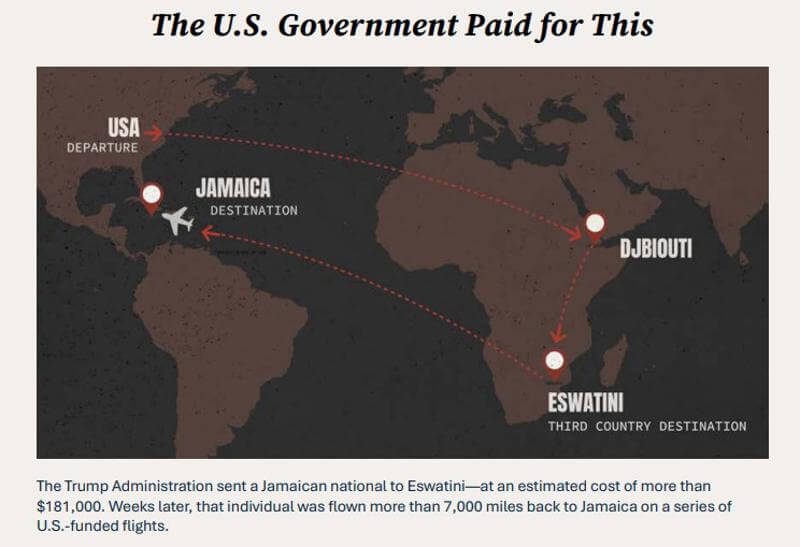
Still, he’s far better off than the people who simply got stuck in an Eswatini prison, unable to even speak with a flesh and blood lawyer in their presence. There they continue to languish, having apparently been selected as symbolic demonstrations of the United States’ willingness to expel immigrants in any direction that they might randomly blow, to anyone who is willing to take them, at price tags that often work out to 10 or 20 times the annual salary of the average U.S. worker. Surely you’ll agree that this is the very best possible use of $1 million per person.
That said, the window of legality for third country deportations may be closing. In late February, U.S. District Judge Brian Murphy in Massachusetts issued a ruling finding that the government’s policy to remove immigrants to “third countries” was unconstitutional and an obvious denial of due process and federal immigration law. That ruling was subsequently paused by the U.S. Court of Appeals for the First Circuit, leaving the government’s ability to do third country deportation in place for now while the legal battle travels up the court ladder.
It’s yet another Trump-era violation of constitutional freedoms that may well end up before the Supreme Court before all is said and done–and despite it all, the Trump administration is forging ahead. Most recently, they vowed to send long-persecuted Salvadoran national Kilmar Abrego Garcia to Liberia of all places, the unthinkable alternative being that they just forget about their many embarrassments on that particular front and allow the man to accept deportation to Costa Rica, which he has long been willing to do. It just goes to show that at the end of the day, it’s not truly about deportations for this administration–it’s about intimidation. Without an aura of wanton menace, deportation turns out to be no fun at all.
 Keep scrolling for more great stories.