

We Don’t Even Need All the Oil We’re About to Start Extorting From Venezuela
Oil prices are already falling, and Venezuela's oil will be extremely expensive to access, making it borderline pointless.
Photo via Unsplash, Atik sulianami Splinter Venezuela
When is an oil-motivated invasion of Venezuela even more absurd than it initially appears to be? When you don’t even have any pressing need for the oil that you intend to steal. This is the boat that the second Donald Trump administration finds itself in, in the wake of deposing Nicolás Maduro and claiming that the U.S. is now “running” and “in charge” of the nation of Venezuela, terminology that still has yet to be explained in any specific way. Judging from today’s comments by energy secretary Chris Wright, though, that the U.S. will be controlling all of Venezuela’s oil sales “indefinitely,” it’s safe to characterize the U.S. as having simply seized the entirety of the Venezuelan oil industry. And naturally, Trump wants an initial cut off the top, like any good mob boss would.
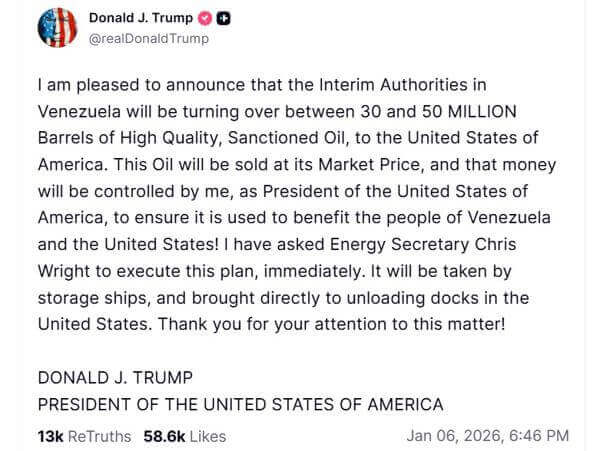
In a typically rambling Truth Social post on Tuesday evening, Trump claimed that the U.S. would kick off its new era of extortion by simply taking 30 to 50 million barrels of heavy crude (value of roughly $2-3 billion) from Venezuela. This oil will be “sold at its market price,” and “that money will be controlled by me, as President of the United States of America, to ensure it is used to benefit the people of Venezuela and the United States,” just in case you feared that someone incompetent or corrupt might be put in charge of the operation. Not mentioned: Whether anyone in Venezuela, like “interim authority” President Delcy Rodríguez, had signed off on said plan, or even been informed of it. Something tells us that this is one of Trump’s vintage “Just say that people have agreed to this and dare them to disagree publicly with you under threat of airstrike” moments.
Lost in the hubbub over violations of international law and United Nations charter in the abduction of Maduro, or the fact that Cuba will almost certainly be starving to death within a few weeks without Venezuelan oil we will in no way be selling/giving to them, is the reality of just how challenging it will be for U.S. companies to actually get at said oil, or whether it makes any sense for them to do so. Despite the insistence of The White House that “All of our oil companies are ready and willing to make big investments in Venezuela that will rebuild their oil infrastructure,” the actual corporations in question are singing an entirely different tune in their candid quotes to journalists, effectively saying that the Venezuelan market represents so much doubt, risk and danger that there’s little appetite or interest in throwing billions of dollars at it in the hope of future gains.
“Just because there are oil reserves – even the largest in the world – doesn’t mean you’re necessarily going to produce there,” said an unnamed industry source to CNN. “This isn’t like standing up a food truck operation.”
The Difficulty of Getting Venezuelan Oil
It should absolutely be noted that although Venezuela is frequently cited as possessing the “largest oil reserves” on Earth, this is a purely theoretical term, and one that is disputed by some geologists and economists. They claim oil reserves (which is to say, oil still in the ground) of more than 300 billion barrels, slightly more than Saudi Arabia’s roughly 270 billion, but as recently as 2007 the estimated number from Venezuela itself was only 100 billion. The actual pace of extraction of that oil, meanwhile, has cratered since the 1990s, when Venezuela was producing 3 million barrels per day–today, that figure is less than 1 million, less than the production of North Dakota in the United States.
Why does Venezuela produce so little oil despite the huge reserves? Well, it comes down to governmental mismanagement, kleptocratic corruption and international sanctions, which decimated the potential customers for Venezuelan oil. The infrastructure of the industry was thus allowed to rot, and has since become dangerously unstable and in need of massive capital infusions just to keep production at its relatively lowly state. Energy consulting firm Rystad Energy published estimates on Monday stating that just to maintain current production, Venezuela would need an estimated $53 billion in investment over the next 15 years. To actually return to its past production? That would take an estimated $183 billion in investments. The Trump administration is quick to promise that American companies will spend that cash, but why should they in order to reenter a notoriously volatile country with an uncertain leadership that could very well try to seize U.S. oil assets all over again? Who knows what kind of political state Venezuela will be in, a year, a decade, or even a week from now?
Then there’s the dollar sign-shaped elephant in the room: Oil is cheap right now, and it’s been getting cheaper still (20% decrease in the last year), which means that the vast majority of those massive “reserves” in Venezuela would cost far more to extract and refine than they would be worth to sell. Even Trump’s announcement yesterday of the U.S. seizure of Venezuelan oil resulted in another immediate dip in oil prices. This decline, currently putting the price of an average oil barrel at less than $60, has been driven by steadily increasing global supply, thanks to increased production from non-OPEC nations such as Canada, Guyana, Brazil and the United States itself. Only 20 years ago, the U.S. produced less than 10% of the world’s oil. Today, it’s more like 22%, making us the single largest oil producer. It’s been a decade since we passed by Saudi Arabia! This increased production and decreased reliance on the OPEC cartel has led to consumer outcomes like gas prices that are currently the lowest they’ve been since 2020, despite all the years of inflation since then.
Oil companies know what this means: Thanks to advances in oil-acquisition technology, the world is in an oil supply glut. Regardless of anything related to Venezuela, oil companies are likely to intentionally decrease production in 2026 in an attempt to stop oil prices from falling any lower, in an attempt to protect their profits. It’s yet another reason why oil corporations (other than Chevron, already operating in Venezuela and poised to benefit) will likely be leery of sinking huge investments into the country; the world simply doesn’t need that oil very badly, and the demand for it isn’t there.
Trumpian imperialism in action: kidnap the head of the regime, leaving the rest of it in place so as to access the oil reserves for the US companies. Then realize the oil is actually quite expensive to extract, so go ahead and SUBSIDIZE the oil companies. Perfect.
www.nbcnews.com/politics/don…
— Chris Hayes (@chrislhayes.bsky.social) Jan 5, 2026 at 6:17 PM
So Why Does Trump Want That Oil?
What does the Trump administration actually gain, then? Well, for one, if the U.S. is now suddenly going to be “indefinitely” overseeing the sale of all Venezuelan oil, per energy secretary Chris Wright, then the federal government can unilaterally decide not to sell that oil to U.S. rivals. Beyond purposefully starving Cuba to death in the immediate future in an attempt to induce more regime change, Trump and co. have reportedly demanded that Venezuela cut its economic ties to Russia and China, the latter of which was the destination of up to 80% of all exported Venezuelan oil. It’s hard to say what kind of effect that this would actually have for China, given that imported oil from Venezuela represents only a drop in the bucket for them, somewhere around 4% of China’s total oil consumption.
So where does all of that Venezuelan oil go? The U.S., as a whole, doesn’t really have much domestic use for it–a very small amount of U.S. electricity, around .5%, comes from oil-burning power plants, for instance. Moreover, the type of heavy, viscous oil primarily produced in Venezuela isn’t ideal for those power plants in the first place.
The one area of exception is in U.S. oil refineries based in the Gulf Coast region, many of which were initially built to handle the heavier type of Venezuelan crude oil back when the country was still producing far more barrels per day in the 1990s. Venezuelan oil purchased by the United States and shipped to these refiners could result in savings that could continue to drive down the price of gasoline … assuming that the refiners and gas companies didn’t just pocket the new profits for themselves. Still, this is a relatively small niche of the U.S. market, and the only one that has much of a direct and immediate use for Venezuelan oil.
Valero Energy is up more than 9% today. Why? Because it owns Gulf refineries built for Venezuelan heavy crude.
This is the same reason why MAGA billionaire Paul Singer profited from the U.S. military raid.
More details here: popular.info/p/venezuela-…
— Judd Legum (@juddlegum.bsky.social) Jan 5, 2026 at 6:59 PM
All of this is contingent upon massive investment into the Venezuelan oil industry that we are now “indefinitely overseeing” (without any legal justification), even to maintain existing levels of production, in a global setting that is already too full of oil. What if U.S. companies simply aren’t interested in taking that risk? Would Trump, fearful of being seen as having failed, offer massive federal incentives to U.S. oil companies to reenter the Venezuelan industry, effectively transferring the cost of the process back onto U.S. taxpayers? Uh, does a Venezuelan bear shit in the woods?
In the end, it’s a perfectly Trumpian thing to do to proudly tout the 50 million barrels of oil you’re extracting from Venezuela, and the roughly $3 billion it represents on the open market, while the same action also implies a potential cost to Americans of $180 billion to be able to continue using that market in the future. Who would have thought that the guy falling asleep during every Cabinet meeting might not be a master of economic mathematics?
 Keep scrolling for more great stories.