

SCOTUS Rules Telehealth Abortions Safe, For Now
“Of course, we are relieved that the stay allows telehealth providers to continue to mail abortion pills,” Elisa Wells, co-founder of Plan C, told Jezebel. “But we remain concerned about the final outcome of this case, which bases its claims on bogus claims about mifepristone’s safety.”
Photo: Getty Images Abortion Supreme Court
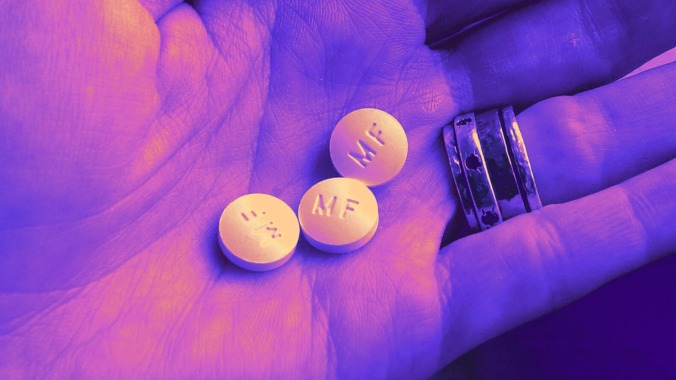
You know, it takes a lot for Justice Samuel Alito to singlehandedly make a panel of judges look like a bunch of crazy zealots, but times are weird.
Over the weekend, the 5th U.S. Circuit Court of Appeals almost implemented what would have looked like a sudden and national abortion ban—and put a full stop to all telehealth abortions across the entire country—when the Supreme Court temporarily blocked the decision just two days later.
“All people should be able to reliably obtain essential reproductive health care, including abortion care, without interference from judges or politicians.” Julie Burkhart—who runs Wyoming’s only abortion clinic (Wellspring Health Access)—told Jezebel in a statement. “Americans deserve better than to have their right to the full spectrum of health care options taken away or restored on a whim.”
Things kicked off when the appeals court’s three-judge panel unanimously decided to halt telehealth abortions across the nation, accepting a request made by Attorney General Liz Murrill (R-La.) earlier this year to impose an injunction on such care while she continues taking the FDA to court over its 2023 decision to remove the in-person requirement for mifepristone—the first of two pills taken in an abortion medication. The decision was as extreme as it sounds, and threatened to put a screeching stop to all telehealth services across the country—even in places where abortion is still protected.
The Friday ruling was immediately followed by an emergency appeal to the Supreme Court by two mifepristone makers, Danco Laboratories and GenBiopro. (Both of these are defendants in the FDA lawsuit.) And on Monday, Circuit Justice Samuel Alito restored broad access to mifepristone, through an administrative stay—likely until the full court can issue its own ruling—that will put the appeals’ court decision on hold until May 11.
BREAKING: Justice Sam Alito issues an administrative stay of the Fifth Circuit’s mifepristone ruling through 5p ET May 11, setting briefing for this week.
The stay means the mifepristone can be mailed currently. The FDA’s 2023 REMS is in effect during the stay.
— Chris Geidner (@chrisgeidner.bsky.social) May 4, 2026 at 3:58 PM
Now, for all this, a big fat round of festering tomatoes are in order for Murrill, who’s also the idiot that compared abortions to guns; called abortion providers “drug dealers”; and once lied to the public that abortion pills are tainted with fentanyl. In her case against the FDA, her argument has been that because mifepristone can be prescribed through telehealth, it’s allowed people to “poison women” with abortion pills, and coerce them into having unwanted abortions.
Working with her on this case is Alliance Defending Freedom’s Erin Hawley, the wife of anti-abortion Slenderman Sen. Josh Hawley (R-Mo.)—who amplified a bogus “study” from a far-right group to get the FDA to re-review the pill in September. (A re-review that’s been so shady, it’s since landed the administration with at least two lawsuits.) But since then, FDA Commissioner Marty Makary has reportedly started to slow-walk this study until after the midterms, likely because the GOP’s freaking out about its narrowing hold onto the House and Senate. It’s probably for this reason that in January, the administration also asked Louisiana to stall the case until the study was done.
Terrific thread. I’ll just add:
1. I think there’s a good chance the Supreme Court will stay this decision, allowing providers to keep mailing mifepristone for the time being.
2. The Trump administration didn’t want this! Its plan was to wait until after the midterms to crack down on mifepristone.
— Mark Joseph Stern (@mjsdc.bsky.social) May 1, 2026 at 11:52 PM
So, well, we’ve all dodged the bullet that could have obliterated abortion access—for now. Still, providers are worried about what SCOTUS could decide—or replace its block with—come May 11.
“Of course, we are relieved that the stay allows telehealth providers to continue to mail abortion pills, which we know from more than 100 studies are very safe, whether prescribed in a clinic or by telehealth,” Elisa Wells, co-founder of Plan C, told Jezebel. “But we remain concerned about the final outcome of this case, which bases its claims on bogus claims about mifepristone’s safety.”
Telehealth abortions accounted for nearly 27% of abortions in the first half of 2025 across the country, and at least 91,000 abortions in all of 2025. It’s been an especial lifeline for people living under abortion bans, who can receive care through shield laws—which allow doctors in states where abortion isn’t banned to prescribe patients in states where it is.
And, yes, here’s your weekly reminder that mifepristone is safe—safer than Viagra and Tylenol—and a January study from JAMA found that over a decade’s worth of FDA research into its safety was based on real, actual science, and not politically motivated. (Another JAMA study published in April also emphasized there’s no real reason it shouldn’t be an over-the-counter pill.)
If SCOTUS were to uphold the appeals’ court decision, it could issue one of the biggest blows to abortion access since the Dobbs ruling. “We’re now going to see, I think in a way we haven’t before, what the nation will look like when abortion bans are actually in effect,” Mary Ziegler, who wrote Personhood: The New Civil War Over Reproduction, said to PBS News. “This is going to be a pretty significant change in terms of how people experience abortion access, probably as significant as anything we’ve seen since Roe was overturned.”
 Keep scrolling for more great stories.