

Trump Admin Suddenly Wants Louisiana to Drop Abortion Pill Lawsuit. I Wonder Why…
Hint: The answer starts with “mid” and ends with “terms.”
Photo: Getty Images AbortionPolitics
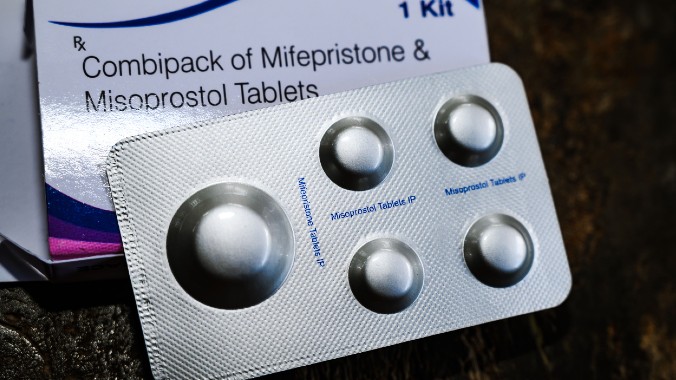
The Department of Justice on Tuesday hit the panic button over a Louisiana lawsuit targeting the abortion pill mifepristone, and asked a federal court to stall the case until the FDA’s own review is done or—in other words—until the GOP is safely out of a perilous midterms season. Sen. Josh Hawley (R-Mo.) is probably somewhere screaming, kicking, crying, and vomiting right now.
“[This] filing is nothing more than a smokescreen to delay changes to mifepristone’s approval until it is more politically convenient for this administration to try and take away the right of every single person in this country to make their own decisions about their lives, bodies, and futures,” Planned Parenthood Action Fund President and CEO Alexis McGill Johnson told Jezebel in a statement. “Don’t get it twisted: The Trump administration does not stand with the vast majority of Americans who support access to mifepristone.”
The Louisiana case “would waste judicial resources because [the] FDA’s own review may eliminate any need for the Court’s,” the DOJ argued in its filing, adding that allowing the lawsuit to progress before its own study is finished would “threaten to short circuit” its regulatory and scientific work. Nice try, but no one believes that this filing is anything other than the Trump administration panicking about its precarious GOP majority in the House (218-213) and Senate (53-45)—and trying to downplay its anti-abortion agenda until after November.
The state’s anti-abortion Attorney General Liz Murrill (R) sued the FDA in October, asking the court to revive federal restrictions on mifepristone by reinstating the previous requirement that patients can only get the pills in person. (The FDA approved the pill to be prescribed via telehealth in 2021.) In the first half of 2025, 27% of abortions were obtained via telehealth services, according to the Society of Family Planning—making it clear why the GOP is so obsessed with getting rid of the abortion pill.
According to Politico, the DOJ’s brief argues Louisiana’s case lacks standing; that it may “prove as unnecessary as it is disruptive” because the FDA already plans on imposing many of the restrictions the Pelican State is demanding; and that it could set a precedent for progressive states to file alternative lawsuits to loosen mifepristone requirements.
It also disputes Louisiana’s claim that the FDA’s current mifepristone policies cause “sovereign harm” to the state because it allows Louisianians to order mifepristone from out-of-state providers, and suggests that instead of suing the Trump administration, the states should sue the doctors prescribing pills across state lines. Of course, Murrill is already doing that, and getting blocked because shield laws—which allow out-of-state providers to provide medication abortions to people in abortion-banned states—exist.
This is the latest of the Trump administration’s attempts to awkwardly teeter around its once-thunderous plans to eliminate access to mifepristone. To recap: in December 2024, Hawley promised anti-abortionists that then-incoming Secretary of Health and Human Services Robert F. Kennedy Jr. would restrict abortion pills; in April, he followed up by amplifying a “bogus study” by a far-right think tank claiming the pill had “adverse effects” (it doesn’t); in June, FDA Head Marty Makary agreed to comply and re-review the pill; in August, over 20 anti-abortion GOP AGs ramped up the pressure; and, in September, Makary and RFK confirmed the pill would, officially, be re-reviewed. Makary seemed to throw a wrench in the works in December, though, and reportedly asked the FDA to stall the review until after the 2026 midterms—likely because he and Trump know destroying reproductive rights isn’t popular with voters. At all.
If the DOJ’s request to hit pause is granted, the Trump administration reportedly plans to inform the court within 14 days of its decision to modify current regulations around mifepristone because of its ongoing review.
 Keep scrolling for more great stories.