

America Had Its Worst Non-Recession Jobs Year Since 2003
Post-April job growth in 2025 was basically flat outside a handful of industries
Photo by The White House Splinter Job Markets
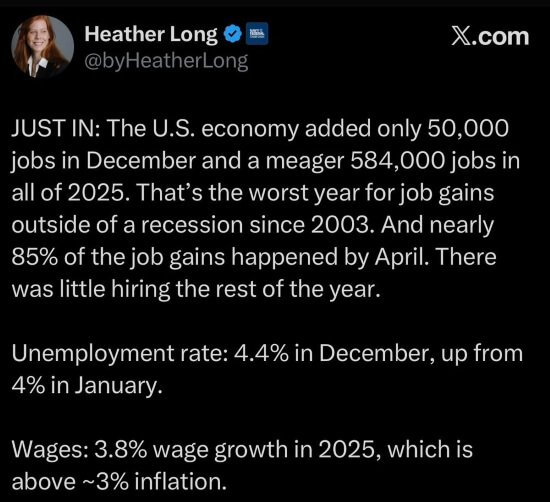
The Bureau of Labor Statistics released the last jobs data for 2025 today (and Trump released some last night in a stunning breach of protocol I’m sure no one made money off of in the insider trading administration), and this batch hits the sweet spot of ensuring that no one will change their prior beliefs about the economy. Think the doomers are just repeating lies they hear on social media and the low jobless rate is what the economy really looks like? You’ve got a 4.4% unemployment rate to back your assertion up. If you think we’re in a deep recession and the Stancilites claiming it’s all vibes are out of their minds? You have a point because America’s job market basically stalled out after April. 2025 was a horrible year for hiring.
I spent most of 2025 writing about America’s growing jobs problem, and how we are in a complex state of affairs where we are outperforming our peers as the economy is being powered by the consumer spending of America’s most well-off citizens, gargantuan AI investment propping up the stock market and creating additional consumer spending through the stock market’s wealth effect, as well as widespread wage growth outpacing inflation. Everyone in this never-ending fight around the economy has firm data-based ground to stand on, and all of us with traditional economic or finance training who have had the certainty beaten out of us are pulling our hair out watching people without that training claim to be dead-certain as to what a bunch of complex and conflicting economic data says. Economic sentiment indicators suggest we are presently worse off than the 2008 Great Financial Crisis or the stagflationary malaise of the 1970s where the Misery Index reached all-time highs, a preposterous assertion at odds with all of the data, but surveys have made it crystal clear that this is how many people feel in spite of facts like a year filled with 0.8% wage growth above inflation. Something serious is going on that’s not just in people’s heads.
And for those of you wrapped up in Trump conspiracies (I don’t totally blame you if you are, but you do need to go touch grass), understand that Bureau of Labor Statistics data is very hard to rig because so much of it is rooted in data and responses that come from businesses, and there’s no evidence yet that it has been manipulated despite Trump’s stated desire to do so. If you believe that the data is farcical and we are actually in the depths of a new Great Depression, you are simply very very wrong, proven by the next likely Fed Chair saying that the latest data is not sufficiently rigged to the regime’s liking.
FOX: Revisions — October is down 68,000 jobs. November is down 8,000. What do you make of that?
HASSETT: We still have to get the BLS numbers to be more reliable
— Aaron Rupar (@atrupar.com) January 9, 2026 at 9:51 AM
One problem with the online debate around the economy is it is inherently privileged, and it misses the point that Fed Chair Jerome Powell made at the September FOMC meeting when he said the Fed cut rates because of Trump’s immigration policies’ negative effects on the labor market. There are a lot of people with college degrees struggling to find work who understandably think that their experience explains the broader job market malaise, but this chart of dwindling construction employment really drives home the fact that Trump’s terror campaign executed by a gestapo who are murdering American citizens is crushing the economy. ICE and CPB’s racist operations, more than any other policy of Trump 2, are harming economic growth, according to the last legitimate Chair of the Federal Reserve.
US construction job growth has ground to a practical halt over the last year, with the country losing jobs in homebuilding as the number of units under construction declines, while nonresidential job growth slowed significantly
— Joey Politano🏳️🌈 (@josephpolitano.bsky.social) January 9, 2026 at 8:37 AM
Immigration is an economic superpower. Demographics of countries do matter beyond the realm of the MechaHitler CSAM site’s unhinged white supremacist discourse, because you must take out debt to invest in your society, and you need to have investors willing to buy that debt. This is called the bond market, and an aging society is roiling bond markets in places like the EU and Japan, as it is an open question what a 20- or 30-year EU or Japanese bond should really be worth given how different those countries will look like by the time it matures. The United States has never had this problem thanks to immigration ensuring we always had a youthful population, and buying a 30-year U.S. Treasury Bond is one of the safest investments you can make, literally defined as “risk-free” in finance. It’s the entire basis of your mortgage rate and the trillion-dollar housing market.
Immigration keeps your society young, and allows you to have enough of a qualified workforce to both keep your economy humming and support the older people aging into their retirement benefits. Trump is throwing that all into question, making us look more like Europe and Japan; older, less dynamic societies with a cap on intrinsic economic growth. The central problem with discussions around the economy is that our expectations are anchored to a world built by zero percent interest rates (ZIRP) that simply doesn’t exist anymore and likely never will again. We now live in a reality defined by inflationary fears and low growth as we are still recovering from an unprecedented global supply shock in 2020, and it is warping both the economy and our expectations in ways we are still trying to wrap our heads around.
But one thing became much clearer in the second half of 2025: the working class is losing under Trump, and there is very likely a correlation between the two charts below and Trump’s collapsing polls.
The US continues to lose manufacturing jobs—payrolls are down 81k over the last year, & another 5k jobs were lost in November
Transportation (especially auto manufacturing), wood, & electronics/electrical manufacturing are the biggest losers, but few subsectors are doing well
— Joey Politano🏳️🌈 (@josephpolitano.bsky.social) January 9, 2026 at 6:51 AM
Nearly every industry lost jobs or flatlined in the past year
— Catherine Rampell (@crampell.bsky.social) January 9, 2026 at 7:18 AM
Trump is going to do all he can to try to goose economic growth this year, but there are so many structural problems in the economy and problems of his own creation, it’s unlikely he gets exactly what he wants. For example, he just pledged to buy $200 billion in mortgage-backed securities (MBS), claiming this will lower mortgage costs. That is 1.8% of the total $11 trillion MBS market, but even if his drop in the bucket did have an impact on interest rates, our housing problem is a supply and a demand one at its core, and if we are struggling to build inventory because the gestapo are hunting the people who largely build houses in America, then it’s very possible that any savings Trump creates through the MBS market would just be reversed as they get passed through to higher housing prices. This is a good thread from Parker Ross, Global Chief Economist Arch Capital Group, detailing that potential passthrough dynamic.
Trump also wants to lower interest rates to around 1% or less, essentially making that a requirement of the next Fed Chair. This is reflective of a wrong yet firmly held belief by noobs in the stock market who are making it look more like crypto by the day, assuming that the Federal Reserve controls the whole world through interest rates. This is part of the legacy of ZIRP, the emergency zero percent interest rate policy we established in the wake of the 2008 crisis and then held in place for far too long. It enabled tech fascism and gave them immense (paper) wealth unseen him human history, and encouraged real estate scammers like Trump to believe that cheap debt and low interest rates was what made the economy go round. ZIRP made America lose touch with what healthy economic growth looks like, and refocused our economy around speculation and short-term sugar highs enabled by low interest rates, causing noobs like Trump to wrongly believe that there’s an economic growth button at the Fed that you can just press whenever you want.
What the 1970s taught us is that there is good economic growth and bad economic “growth,” called inflation. Trump is trying to repeat the worst mistakes of the 1970s in his bid to bend the 30-year U.S. Treasury to his will, but the bond market does not just blindly follow the Fed Funds Rate as that decade proved. It is very possible that Trump drops the Fed Funds Rate to 1%, and broader interest rates rise in response. Running an economy too hot by lowering interest rates to create artificial growth can actually bring inflation raging back, raising mortgage rates, and forcing the Fed to hike interest rates again to try to tamp down on inflation, creating a cycle of lower growth and higher inflation alongside rising unemployment, a set of dynamics called stagflation that was once thought to be impossible until the 1970s proved otherwise. It was a horrible time for the economy, and our central issue in our present interminable economic debate is that many of the people who rightly identify our economic problems look at them through the lens of a straightforward cataclysm of 2008, instead of the recessionary clusterfuck of 1973. There’s a reason why 2008 was considered a once-in-a-generation event, and expecting the unexpected is just bad economic analysis.
What waits around the corner for us in 2026 is anyone’s guess, but the lesson of 2025 is that hiring in America has basically frozen outside leisure and hospitality and private education and health services. The explosion in economic activity in the first two quarters of the year, combined with the net negative GDP in Q1 entirely due to a historic wave of exports only technically turning it negative, proves that a lot of firms have already taken a wait and see approach to Trump’s budding autocracy, and we are only two quarters into it. Those two quarters have seen good GDP growth, very bad job growth, and increased stagflationary dynamics, but little evidence of widespread job losses outside the unemployment rate for Black people which has increased dramatically this year, something you would unfortunately expect in a country that emboldened its most depraved and racist citizens in November 2024. This year is sure to bring many surprises, but the data suggests that serious job growth is unlikely to be one of them so long as Trump’s gestapo are terrorizing America’s cities.
 Keep scrolling for more great stories.