

Splinter: America Is a Hockey Country Now
Turns out that when you invest in the American people, good things happen.
Photo by Elsa/Getty Images Milan Cortina OlympicsSplinter
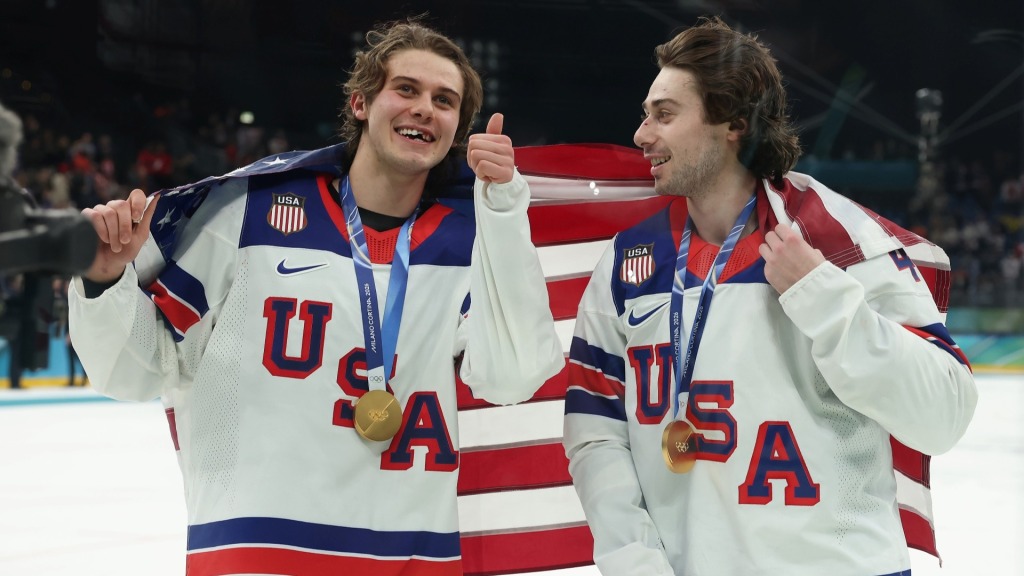
The day the 2026 Olympics drew to a close, the American men’s hockey team won its first gold medal since the game after Al Michaels famously asked the country if we believe in miracles in 1980. He had good reason to, given the immense talent on the Soviet team and the fact that after this gold medal performance, United States men’s hockey subsequently finished 7th, 7th, 4th, 8th, 6th, 2nd, and 8th in the winter Olympics all the way through 2006. The women won the first ever women’s hockey gold medal at Nagano in 1998, driven by an all-time great hockey player by any gender’s standards in Cammi Granato, but they could only muster three silvers and a bronze across the next four Olympics. The women’s team finally slayed the Canadian goliath at Pyeongchang in 2018 on Jocelyne Lamoureux’s legendary shootout winner clinched by Maddie Rooney’s gold medal save, then lost this galactic battle for the fate of the hockey universe in 2022 to Canada.
In the all-time leading American Olympic goalscorer’s last ride this year, Hilary Knight won the final battle over her generational rival up north in Marie-Philip Poulin. Knight’s entire career embodies the evolution of American hockey this century, as she began her Olympic career with back-to back silver medals in 2010 and 2014, then closed by winning two of her last three gold medal games over Canada, saving the United States one more time in one of her final shifts ever.
In 2009, USA Hockey launched the American Development Model (ADM) as a “nationwide reinvention of how hockey was taught at the grassroots level.” The goal was to build a proper hockey infrastructure in a very large country which had proven that there was far more widespread interest for this sport than in just a couple Canada-adjacent enclaves. In 1990, there were just 6,336 total registered female hockey players in the United States. By 2005, that had grown to over 52,000, and today it is over 100,000. In the 2024-25 season, there was a 5.1% increase in female hockey participation, the largest non-pandemic single-year jump ever, driven by states like Florida, which saw an 8.4% increase in all USA Hockey memberships.
The reason the women’s game is growing so much is primarily because there is a ton of untapped interest in women’s sports that goes well beyond Caitlin Clark. I am still gobsmacked at the PWHL game in Denver last year that set an American professional women’s hockey attendance record at the exact same time that the year’s most important event took place in our great unhinged football city, a Broncos playoff game. Women’s sports are big business, and it is just a matter of time before the PWHL launches a much more ambitious expansion with a dedicated TV partner.
Youth hockey as a whole is growing steadily too, with just under 400,000 American kids registered for the 2024-25 season. A gold medal American men’s hockey team led by a superstar from fucking Scottsdale and the only Jewish athlete in Olympic history to score a golden goal is a great example of the ADM tapping into America’s strongest muscle: our diversity.
Canada’s Olympic hockey defeat is driving right-wing influencers into the arms of socialism
— Luke LeBrun (@lukelebrun.ca) Feb 23, 2026 at 12:05 PM
For too long, hockey had been confined to the cold corners of America importing Canadian influence. That entire 1980 men’s gold medal winning team came from just four states: Wisconsin, Minnesota, Michigan, and Massachusetts. The latter three are still the main engines powering American hockey greatness, but the times they are a changin’. Hannah Bilka, who played 19:20 of pivotal ice time against Canada in the gold medal game last week, grew up in the hotbed of hockey that is, uh, Coppell, Texas. Defensewoman Cayla Barnes is from Eastvale, California, and captain Hilary Knight is from Sun Valley, Idaho–a town with a population of less than 2,000. There were almost twice as many students attending my alma mater UMass’ hockey game this weekend as the population of Sun Valley. Hockey is everywhere you look in America now, including of course the erotic fantasies of Heated Rivalry.
Meanwhile, the men’s team is captained by a star who grew up in Arizona and is now Toronto’s best hope to end their Stanley Cup curse, Auston Matthews. Carolina Hurricanes star defenseman Jaccob Slavin grew up in my neck of the woods out in Erie, Colorado, a state currently investing a bunch of money an hour north of Denver to build a 300-acre youth and minor league hockey complex. Both men’s and women’s 2026 Olympic teams had triple the home states represented (12) as the last gold medal men’s team did. There is a larger lesson to be gleaned from this Olympics that placed the United States of America atop the hockey world for the next four years. America’s best resource is our people.
What American Hockey Excellence Looks Like
The contrasts between the USA and Canada in men’s and women’s hockey are stark. On the women’s side, the stakes are established American greatness versus established Canadian greatness. There is nothing like women’s Olympic hockey in all of sports, and for my money it’s the main event of every winter Olympics. Both the American and Canadian teams are so far beyond the rest of the world, it’s not even worth discussing any scenario other than “what will the USA vs. Canada gold medal game look like?”
Canada’s Marie-Philip Poulin is considered the greatest player in the game and the top player of a generation, but Hilary Knight got the last laugh between the two mega-stars that have powered the best rivalry in sports for over a decade. She muscled her way to the front of the net one last time to make a key deflection for a late game tying goal that will reverberate throughout American Olympic history, forcing this galactic battle to overtime and setting up Megan Keller’s dirty dangle heroics to send one of the greatest hockey players ever into retirement with a gold medal and a new wife amidst a sapphic soap opera in the final. The women’s gold medal game is the personification of greatness, and it never disappoints on any front.
The men’s side is very different. The last time America and Canada played for a gold medal in 2010, Sidney Crosby scored one of the most famous goals in Canada’s history that left America with a broken hockey heart for 16 years. It was just the second time since 1980 that we had made the gold medal game, and it was the second time we lost to Canada’s best with our best. The NHL did not send players to the 2018 and 2022 Olympics where our college players finished 7th and 5th, so 2026 was the first big high-level test of the ADM on the men’s side.
And their counterparts up north were being talked about as perhaps the best Canadian hockey team ever going into the Olympics, making this one of the toughest gold medals for the men’s side to win. Prior to cooling down just before the Olympic break, the Colorado Avalanche were on pace to set the NHL single season points record, led by Canadian freakshows Nathan Mackinnon and Cale Makar playing the best hockey of their lives, as well as Makar’s rock-steady defensive partner in Devon Toews who joined him in Canada’s top defensive pairing. Add in the best offensive player alive by a wide margin in Connor McDavid, and Canada’s team is a terrifying collection of high-end talent before you even say Sidney Crosby’s name or get to the multiple #1 overall picks they recently added.
But the oddsmakers in the desert opened their Olympic lines with America as the favorites, reflecting how far American men’s hockey has come from a talent development perspective. The biggest gap between the Americans and the Canadians in the past has been the bounty of high-end talent up north like McDavid, Makar, Mackinnon and Crosby, and it seemed as if Canada would only add to that gap as recent #1 overall pick Macklin Celebrini’s coming out party arrived on Connor McDavid’s wing at this Olympics. Team Canada is so blessed with high-end talent that they even left one of them at home, telling Chicago Blackhawks fans that they think last year’s #1 overall pick is better than the previous year’s #1 overall pick in Conor Bedard. Hockey is a physical sport where mucking the game up can bring any skilled team down to earth, but one moment of brilliance can overrule 59 minutes of grit and grind, and that’s why Canada always wins. They have a million guys who can create a moment of brilliance. But now, we have these kinds of high-end players too, and more than just one like the 2010 team had in Patrick Kane.
Auston Matthews is firmly entrenched in the five-man debate for best forward in the NHL (Matthews, MacKinnon, McDavid, Germany’s Leon Draisaitl, and Russia’s Nikita Kucherov), and he is currently on a goalscoring pace that would shatter the NHL goals record if he plays the same number of games as the record-holder, Alex Ovechkin. Jack Eichel has all the skills to move from the bubble of that conversation and make it into a six-man one, and the only defenseman in the NHL who can almost wedge their way into the one-man conversation with a 27-year-old all-time great in Cale Makar is Quinn Hughes. Hughes is now an American legend in his own right after waving off a line change and then burying a winner in overtime against Sweden to send the U.S. to a very winnable semifinal against Slovakia.
Quinn’s brother Jack is not as uber-elite as the aforementioned group, but there’s still a reason he was the first American since Patrick Kane to go #1 in the draft and why New Jersey subsequently gave him a bunch of money and bet the franchise on him. He showed it all on Sunday by getting his teeth shattered and then scoring the most legendary American goal in 46 years. This is the definition of what a hockey player looks like, and he’s an American, damnit.
[image or embed]— Hockey Out of Context Loves Canada (@nhloutofcontext.bsky.social) February 22, 2026 at 9:32 AM
Hughes is also proof that the players filmed dancing with FBI Director Kash Patel and denigrating their far more accomplished female Olympic counterparts while on the phone with Trump do not represent the entire team. Hughes came out in defense of the NHL’s Pride Night that many other bigoted NHL players ruined in 2024, saying “how we grew up, my family really supports [LGBTQ+ causes].” The Tkachuck brothers are nearly universally reviled for many good on and off ice reasons, and it’s a choice to focus on them as the supposed faces of the American hockey team rather than the Hughes brothers who are better and who scored two of the most important goals in this country’s history.
Speaking as the sports are political whether you and RGIII like it or not guy, I do understand the discomfort of seeing guys you rooted for 30 minutes ago embrace the fascist make a wish kid, as well as the dismay of hearing them talk shit about a woman’s team who earned the right long ago to complain about a shambolic men’s team dragging USA Hockey down, but do not miss the forest for the trees here and let Trump ruin the Olympics. He has an approval rating in the 30s. There are more athletes like Jack Hughes in America than the clips from the postgame celebration Kash Patel barged into would lead you to believe. Not to mention, if you think Canada is the “good” hockey program because everything is national politics now, there’s an entire Wikipedia page dedicated to the Hockey Canada sexual assault scandal that is overflowing with disturbing details. Hockey itself has many problems well beyond the sport that it must sort through, and they all track along the lines of social issues that both Canada and the United States’ imperial projects struggle with, demonstrating how sports are indeed political whether you and RGIII like it or not.
American Hockey’s Redemption Arc
The main reason the bookies took American hockey as seriously as Canada is because the greatest hockey goalie alive* grew up in the United States (*NHL playoffs not included). Connor Hellebuyck is in the midst of one of the best four or five-year stretches of any netminder in hockey history, winning MVP and Vezina and damn near every trophy except for the two that matter most. Hellebuyck’s Winnipeg Jets have been dispatched in short order during every playoff run he has guided, and Hellebuyck has even been pulled in some of these lopsided playoff defeats. He is very much a Sisyphean figure, in that he has done the hard part by generating immense greatness in relative obscurity in the NHL’s smallest media market, but he has not got the job done in the small samples where the eyes of the world are on him—and he has been outright bad under pressure at times.
On Sunday, Hellebuyck was the best player on the ice on a day where the near-best versions of Cale Makar and Nathan Mackinnon showed up (that will be a game Connor McDavid wants to forget, however, and Canada really missed Sidney Crosby’s steady hand). Hellebuyck not only saved America’s bacon time and time again under relentless Canadian pressure, including one all-timer of a save on the goal line against Toews that we need to build a statue of somewhere, but he even got the secondary assist on America’s golden goal.
Connor Hellebuyck made a PADDLE SAVE on Devon Toews 😱
#MilanoCortina2026
— TSN (@tsnofficial.bsky.social) February 22, 2026 at 8:09 AM
Connor Hellebuyck erased years of anguish where he was only known to the casual viewing public as a high-profile choker—hockey’s answer to Clayton Kershaw—and now he is an American Olympic hero forever who made 41 saves and outscored Connor McDavid in a gold medal game. While he did not come up through the ADM pipeline, Hellebuyck was called the “perfect example” of the USA Hockey developmental process by a USA Hockey goalie manager in 2020. He patiently went from developmental and junior leagues to UMass-Lowell and then to the NHL, making sure he was learning on the ice each step of the way and not sitting on the bench in a league he wasn’t ready for. He is proof that our theory of hockey is good enough to win a gold medal.
Zero hockey fans would have ever had Nashville developing A+ hockey crowds on their bingo card, but the city has imbued Predators games with their brand of fun and joy and created one of the most unique and intimidating atmospheres in professional sports. Vegas is doing their version of it now too, and in 31 years of embracing a relocated Canadian franchise, my crazy football town has made Denver into one of the toughest places to play according to NHL players. No one would have believed you a decade ago if you said that the greatest hope in a generation to end Toronto’s hockey curse would emerge from the surface of the sun in the American southwest, but this is the hockey world that America is building, and it’s beautiful. Hockey is for everyone; the guy who scored the golden American goal firmly believes it, so don’t let any dipshit Tkachuck bro tell you otherwise. These dual Olympic USA Hockey triumphs are ultimately about all of us, and how USA Hockey invested in Americans and struck gold.
 Keep scrolling for more great stories.