

Chappell Roan Was Today-Years-Old When She Learned About Brigitte Bardot’s Racism
After the death of the film star, animal rights activist, and raging racist was announced on Sunday, Roan posted a sweet tribute—then quickly walked it back.
Photos: Getty Images Celebrities
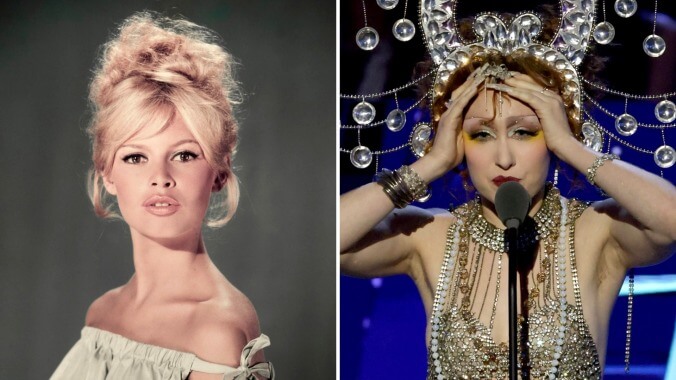
Brigitte Bardot was a famous French film star whose free-spirited and sex positive roles challenged and pushed the culture (and feminism) forward; an animal lover who stepped away from the limelight at the height of her fame to become an animal rights activist; and a raging racist who was several times convicted and fined by French courts for her horrific comments about minorities. Women can really do anything they set their minds to.
On Sunday, the Associated Press reported Bardot had died at 91 years old. The Brigitte Bardot Foundation told the outlet that she passed away at her home, declining to say exactly when or from what cause. In response to the news, Chappell Roan posted a sweet tribute to Bardot on Instagram, saying Bardot was her inspiration for “Red Wine Supernova,” which was an interesting tidbit in and of itself. But she quickly backtracked after I’m sure thousands of her followers pointed her to Bardot’s hateful rhetoric and extremely far-right politics.
“Holy shit i did not know all that insane shit Ms. Bardot stood for,” Roan wrote in an Instagram Story, after her deleting her earlier one. “obvs i do not condone this. very disappointing to learn.”
Chappell Roan shares follow-up story after deleting Brigitte Bardot tribute post:
“Holy shit i did not know all that insane shit Ms. Bardot stood for obvs I do not condone this. very disappointing to learn.” pic.twitter.com/ByacETSPnv
— Pop Base (@PopBase) December 29, 2025
Born on Sept. 28, 1934, in Paris, France, Bardot first appeared on the cover of Elle when she was 14. But her career made international headlines in 1956 when she played a teen bride who danced on tables naked in And God Created Women—which was directed by her first husband, Roger Vadim, who wrote the film for her after they met in 1952. She went on to star in nearly 50 films (and marry three more men), becoming the most famous face of post-war French cinema. In 1959, Simone de Beauvoir called her a “locomotive of women’s history” and “the most liberated woman in post-war France.”
But she retired from acting at age 39 to fully throw herself into becoming an animal rights activist. She condemned the slaughtering of baby seals in the Arctic, the killing of dolphins in the Faroe Islands, and spoke out against eating horse meat, hunting turtle doves, and animals being used in lab experiments. France awarded her the Legion of Honor—the country’s highest honor—in 1985 for her activism.
“Man is an insatiable predator,” Bardot told the AP in 2007. “I don’t care about my past glory. That means nothing in the face of an animal that suffers, since it has no power, no words to defend itself.”
She might have left a lovely legacy had she just continued with her staunch animal rights activism, but instead, she became an outspoken supporter of far-right politics and politicians. Her fourth husband, Bernard d’Ormale, had been an advisor to the racist and antisemitic Jean-Marie Le Pen, the leader of France’s far-right National Front (now known as the National Rally party, led by his daughter, Marine Le Pen, who is equally far-right but fired her father and renamed the party to seem less far-right).
Bardot declared her support for the senior Le Pen in her 1996 memoir, outraging her fans. She then supported his daughter’s presidential bid in 2012 and 2017, having described her as the “Joan of Arc of the 21st century” who she hoped would “save” France.
In 2008, a French court fined Bardot $25,000 for claiming Muslims in France were “destroying our country,” and in 2022, she was fined for a sixth time (this time for $47,000) for describing people from a French overseas territory as “degenerates” who had “kept their savage genes.” She frequently targeted Muslims and immigrants. The Guardian writes that in her final book, Mon BBcédaire (My BB Alphabet), published just weeks ago, Bardot wrote that her country had become “dull, sad, submissive, ill, ruined, ravaged, ordinary and vulgar” and that Le Pen’s party was the “only urgent remedy to the agony of France.”
In the aforementioned memoir, she also wrote that she “wasn’t made to be a mother” and “wasn’t adult enough to take care of a child,” though she’d already given birth to her son, Nicolas, with her second husband, Jacques Charrier, in 1960. She described her pregnancy as feeling like “a tumor growing inside of me.” Both her son and her ex sued her for the memoir’s “hurtful remarks” and received $36,000 in damages. Nicholas was raised by his paternal grandparents after Charrier and Bardot divorced in 1962, and was estranged from Bardot for most of his life—though they eventually reconciled and she met her grandchildren and great-granddaughter.
Bardot also hated the #MeToo movement, describing it as “hypocritical and ridiculous” in 2018. One week after 100 prominent French women signed a letter calling #MeToo a “witch hunt,” she told a French magazine that she’d never been sexually assaulted. “I thought it was nice to be told that I was beautiful or that I had a pretty little ass,” she said. “This kind of compliment is nice.”
So, rest in peace, Brigitte Bardot—a 1960s icon, a 1980s animal-rights hero, and from the 1990s onward, a far-right villain. And let this be a reminder: always Google your muses before writing a song inspired by them.
Like what you just read? You’ve got great taste. Subscribe to Jezebel, and for $5 a month or $50 a year, you’ll get access to a bunch of subscriber benefits, including getting to read the next article (and all the ones after that) ad-free. Plus, you’ll be supporting independent journalism—which, can you even imagine not supporting independent journalism in times like these? Yikes.
 Keep scrolling for more great stories.