

Can You Sue Your Nation for the Effects of Climate Change? This Guy Is Determined to Do So.
A slowly winding case before the European Court of Human Rights could result in the first individual recognized as a climate change victim.
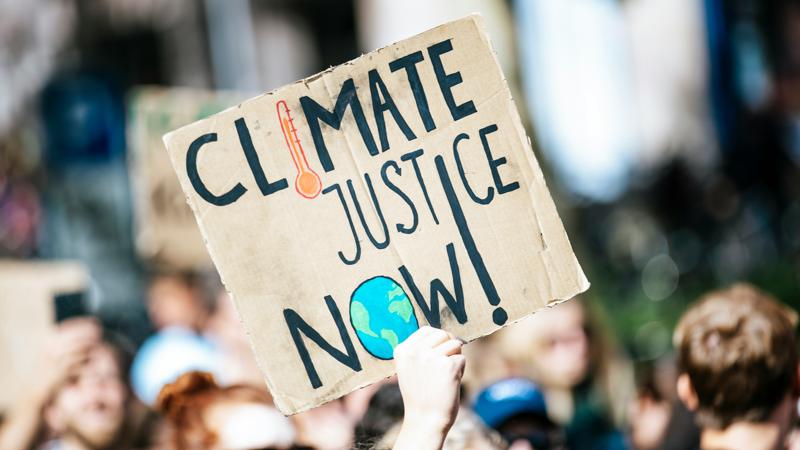
Photo via Unsplash, Markus Spiske Splinter climate change
No one on Earth can really make the claim that they’re entirely untouched by the butterfly effects of climate change. We physically experience it every day when we step outside our doors, and anyone participating in the teetering global economy, as we all must, is beholden to climate on some level. You really think that a “super El Niño” and skyrocketing ocean water temperatures won’t have some tangible effect on your life before long? They will, I promise you. But with that said, some people have experienced climate change in a way that is much more dramatically personal and direct: One Austrian man, in fact, has his ability to physically move tied directly to the temperature, thanks to a debilitating neurological condition that actively reacts to the weather. For the last five years, he’s been attempting to become the first individual recognized as a direct victim of the consequences of climate change, by suing his own nation, alleging that they failed to protect vulnerable people like himself.
Suffice to say, this is a case that is rife with complexity and important precedents that could be set by any decision, and it has thus been moving at a snail’s pace ever since the victim first filed it with the European Court of Human Rights in 2021. That man’s name is Mex Müllner. The former energy consultant from Lower Austria suffers from multiple sclerosis and a rare condition called Uhthoff’s syndrome, which effectively tethers his daily mobility to the temperature around him–the warmer it gets, the less able to move he becomes as his nerves fail to properly function. Let’s just acknowledge how truly horrifying this sounds. According to court filings, at 77 degrees Fahrenheit, Müllner’s “mobility deteriorates and he can no longer walk.” When it gets as hot as 85 degrees Fahrenheit, he experiences near paralysis and is confined to a power wheelchair. As he describes it, “the speed of nerve conduction decreases when it’s hot–as a result signals no longer reach the muscles and the movements I would like to make no longer happen.” Rather incredibly despite this, Müllner and his wife still live in a home without air conditioning, a “passive house” they built that is designed to maintain a constant temperature of 68 degrees all year long.
Immobilized by heat wave, handicapped man sues Austria in rights court
Immobilized by heat wave, handicapped man sues Austria in rights courtIf the court rules in his favor, Mex Muellner will be the first individual recognized as a direct victim of the consequences of climate change, VIENNA (AFP) — Sweating out the latest heat …
— BYTESEU (@byteseu.bsky.social) 6:26 AM · Jul 7, 2026
Setting aside that fascinating architectural detail, Müllner’s case with the European Court of Human Rights has moved at a snail’s pace because although it was the first of its kind, it was almost immediately followed by many, many other cases–too many for the court to consider one at a time. This wave of climate change/climate justice litigation caused the court to choose several “pilot” cases to be used to essentially set precedent, while Müllner’s was set aside or put on procedural hold while climate jurisprudence was built around it. Among other things, a question that needed to be answered was whether the European Convention on Human Rights could be applied to the topic of climate change in the first place.
The court’s first decision on one of those cases, 2024’s Verein KlimaSeniorinnen v. Switzerland, effectively established that it could. In that decision, the ECHR ruled that the nation of Switzerland did indeed have a “positive obligation” under Article 8 to protect its vulnerable citizens from the effects of climate change, and it ultimately issued a “condemnation” of the country and mandated policy changes for the Swiss, such as the creation of a “carbon budget.” It’s very questionable how much genuine power a body like the European Court of Human Rights has to enforce their rulings in such a decision, but Switzerland has claimed that it is complying.
Notably, however, the 2024 case did not establish that an individual person could claim that they were personally the victim of climate change-related effects. That’s what Müllner’s case is attempting to achieve–if the court rules in his favor, he would be the first individual ever recognized as a direct victim of the consequences of climate change as a result of his country’s failure to take appropriate action from a human rights perspective. Or as he put it: “The government should do more. It could have done more.” The court ruling in his favor would set a massive precedent for other lawsuits in national courts in the 46 other countries that fall under the jurisdiction of the European Court of Human Rights, not to mention the climate policy of the European Union as a whole.
The case of Mex Müllner could hardly be more relevant at this particular moment, given that Europe has been gripped by a deadly heat wave of terrifying proportions, one that has already been linked to as many as 20,000 deaths. Scientific studies, meanwhile, have concluded that all other things being equal, the severity of this current heat wave would have been effectively impossible to achieve without the compounding effects of climate climate. As Müllner put it, things have gone from being merely too hot for someone with his rare health condition to “too hot for everyone,” and the only path of justice is “to bring global warming under control.” Sadly, that may be a bit easier said than done.
“I don’t want the Austrian government to install air conditioning in my home,” Müllner said. “I want a solution that preserves the world, that will maintain the planet as a livable place for humanity.”
It’s a noble sentiment. Whether countries can be legally cajoled into adopting policy that at least makes an earnest attempt to protect their citizens remains to be seen.
 Keep scrolling for more great stories.