

Danish Women Are Fashion-Bombing Statues to Protest Most Statues Being Dead Guys
Women are knitting and crocheting clothes for the few female statues to make a wholesome statement about the country's monuments.
Photo: Instagram @maren_uthaug Politics
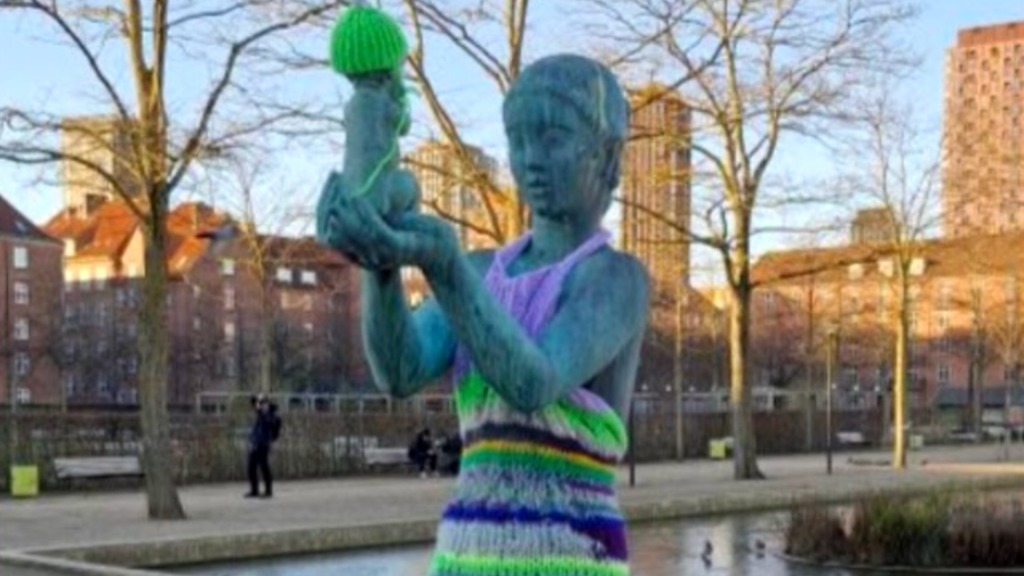
In perhaps one of the most wholesome forms of protest imaginable, Danish women are reportedly knitting and crocheting clothes for statues to make a statement about the country’s monuments—specifically, how they disproportionately represent men. The women who have gotten a statue are usually fictional and usually naked. According to the New York Times, which reported on the movement Thursday, it began with a Copenhagen-based artist named Louise Moerup.
Moerup first noticed the disparity while walking with her son through the city’s Enghave Park, where a naked statue of Venus stands holding her baby. She decided to stage what she calls a “knitted intervention,” and made a striped halter dress for the statue. While she had no issue with Venus being nude, she told the NYT that “knitting the dress was my humorous way to make people look twice and notice what’s missing.”
What’s missing? Women! A report released in February by Denmark’s Museum of Art in Public Spaces found that 484 monuments in the country depict historically significant men, compared with just 43 depicting women. Meanwhile, over 120 public sculptures are of naked women from literature and mythology.
Moerup sent the photo of the newly clothed Venus to comics writer Maren Uthaug, who shared it on social media and encouraged her followers to join what she called “a little activist feminist handicraft.” Speaking to the NYT, she called the aftermath “amazing.” “Every day, there are more and more and more women sending me pictures.”
Naturally, not everyone has been thrilled. Uthaug says she’s received thousands of complaints, including one from a guy who said, “Shame on you for covering up beautiful women’s bodies.”
There’s also been some political pearl-clutching. Parliament Member Katrine Daugaard called the knitting “vandalism” and asked Culture Minister Jakob Engel-Schmidt to do something about it. “I answered, quite frankly, that I don’t see this as a problem,” he told the NYT. Instead, Engel-Schmidt set up a committee to create a list of women who deserve public commemoration in late February.
Around the world, statues overwhelmingly depict men. In 2019, Statista reported that just 7% of statues in the U.S. portray historical women, compared to men. Even New York’s Central Park didn’t unveil its first statue depicting real women until 2020—honoring suffragettes Sojourner Truth, Susan B. Anthony, and Elizabeth Cady Stanton.
Some organizations, like Statues for Equality, aim to adjust the disparity by building more bronze statues depicting real women from history, aiming to reach complete gender equality of public sculptures across the globe by 2030. While they don’t currently operate in Denmark, in July, they unveiled in Australia a statue of Nova Peris, the country’s first indigenous woman who was elected to parliament.
“It’s important that when young girls and women walk around Aarhus, that we also feel represented in the public environment,” one woman who knitted a dress told the NYT. “Not only as beautiful bodies without clothes, but as individuals with agency and power.” Women with agency and power? What a truly foreign concept.
Like what you just read? You’ve got great taste. Subscribe to Jezebel, and for $5 a month or $50 a year, you’ll get access to a bunch of subscriber benefits, including getting to read the next article (and all the ones after that) ad-free. Plus, you’ll be supporting independent journalism—which, can you even imagine not supporting independent journalism in times like these? Yikes.
 Keep scrolling for more great stories.