

Every Day, the Chocolate We Eat Gets Worse. Some of It Is No Longer “Chocolate.”
Even as cocoa prices fall, companies are learning a scary lesson: Americans don't notice when you give them fake chocolate.
Photo via Unsplash, Tetiana Bykovets FoodSplinter Chocolate
From a consumer perspective, there are few things that portend a worse outcome than a company knowingly making its product worse in order to save a few bucks, and finding out that just as many customers will still buy it anyway. This scenario, in a nutshell (beanshell?) has been the dominant story in the world of chocolate for the last few years, with the enshittification of the entire segment the end result of crop failures and cocoa bean scarcity that sent the price of cocoa soaring to stratospheric heights in 2024 and 2025. More recently, those prices have steadily come back down to Earth, but guess what hasn’t changed back to how it was before? The chocolate. In fact, many of the world’s biggest sellers of chocolate-dependent treats are instead pushing forward on the embrace of cheaper replacements, increasingly convinced of the fact that consumers simply don’t know enough to notice or care. And they’re probably right.
Climate change is of course largely to thank for the scarcity of cocoa beans that led prices in 2025 to peak at more than $10,000 per ton, almost five times what the price was in the summer of 2022. Unlike oddball, climate-adjacent stories such as an uptick in mushroom poisonings or a deadly rash of Japanese bear attacks, the climate vector in cocoa is far easier to understand at a glance. Longer droughts, extreme heat, unpredictable rainfall and insect-driven infection amplified by climate change have all played a part in decimating cocoa yields, with one nonprofit research group’s 2025 study finding that most of West Africa’s cocoa-growing regions now experience six additional weeks of extreme heat per year over the last decade. No doubt there are other factors as well, like the Donald Trump tariffs just struck down by the U.S. Supreme Court, but it doesn’t take any grasp of economics to understand why chocolate prices went through the roof.
Less chocolate in your chocolate: major manufacturers explore ways to cope with cocoa shortages due to upheaval and climate change. www.confectionerynews.com/Article/2026…
(Note that one approach, alkalinizing the cocoa, undermines the antioxidant health benefits of chocolate.)
— Honest Chocolates (@honestchocs.bsky.social) Jan 20, 2026 at 6:16 AM
Naturally, this could only result in candy purveyors raising prices and passing that cost onto the consumer, or reformulating their product to make it more cheaply. And surprise, it’s the latter that has been widely employed by the likes of Mars, Ferrero, Lindt and especially The Hershey Company. None of them understandably want to jack up prices and reposition their wares as “luxury” items to sticker-shocked consumers who are already sensitive to inflation, and the alternative is fake chocolate.
Or is it “fake”? It can be hard to know what exactly to call the substances that are now found coating many major candy bars such as Butterfinger, Baby Ruth, Almond Joy, Mr. Goodbar or Rolos. Food scientists refer to it as “compound chocolate” coating, because it’s made from actual cocoa powder, but replaces the more expensive source of fat (cocoa butter) with cheaper, lower-quality vegetable fats. When Hershey brands such as Mr. Goodbar or Almond Joy made the switch in recent years, their labels subtly changed from claiming that they were “milk chocolate,” to “chocolate candy,” which strikes me as particularly insidious phrasing. A more obvious indicator is another word that many companies use: “Chocolatey” coating. Wondering how much this scourge had infiltrated my own home, I took a look moments ago at several packages of Girl Scout Cookies, only to find the inevitable: Both my Thin Mints and Peanut Butter Patties are also made with compound chocolate, rather than the real thing. I can hardly pretend to be surprised. Even in candies that continue to use real chocolate, meanwhile, cost-cutting measures have sometimes been employed, such as the milk chocolate coating of a Snickers bar becoming slightly thinner over time. Some products even mix real chocolate and compound chocolate in a single cookie or candy.
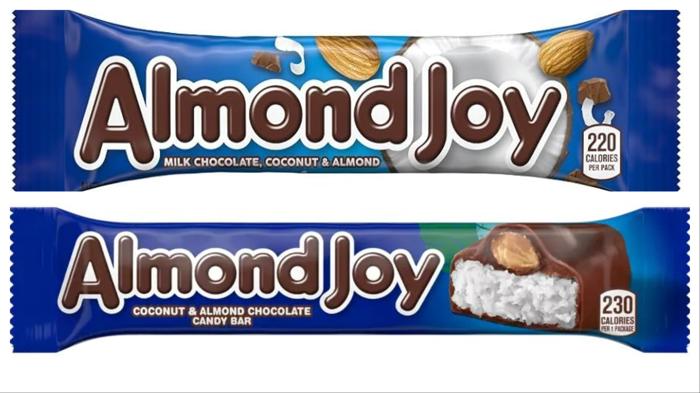 Before: “Milk chocolate.” After: “Chocolate candy.”
But wait, it gets worse! Not content to merely replace one key element of chocolate, food scientists and entrepreneurs have teamed up to create products such as “a chocolate that’s made without cocoa using AI technology to reverse-engineer the recipe.” I was just thinking that we really needed to get AI involved in there somewhere. This company, NotCo, specializes in an entire range of plant-based fake foods, with CEO Matias Muchnick raving to Today at the end of 2025 that “we have trained an algorithm to replicate exactly the favorite chocolate that you always loved,” sounding not at all like an ancient creature that preys on human hopes and dreams. Said fake chocolate, if you were wondering, is ultimately assembled from ingredients that include carob, shea butter and malt extract, with the savvy entrepreneur saying that it could save manufacturers in the ballpark of 30%. Check out the grandiosity of this gloating quote: “I think we have a high chance of being the ones that actually saved chocolate for the rest of humanity.” Wow, “saving chocolate” by destroying it. Talk about your world-class achievements in CEO douchebaggery.
Real chocolate, meanwhile, seems to have few allies in the face of corporate greed, although even real chocolate is still plagued by the problem of child and slave labor despite assurances from the candy world’s megacorps that they would fight the practice. Still, considering their focus on “real food,” you might think this would be the kind of cause that the MAHA movement could actually get behind, but in this case their deeply impractical attitude toward sugar probably eschews even ethical chocolate advocacy. Antioxidant-rich dark chocolate doesn’t even really fit in the MAHA mindset, given that RFK Jr.’s new dietary guidelines explicitly tell parents that they should withhold any food with added sugars from children until after the age of 10, presumably raising an entire generation of eating disordered kids in the process. I wouldn’t expect any help from a Health and Human Services Secretary that spends decades criticizing and prosecuting cases against a herbicide, only to instantaneously flip sides and embrace it after Donald Trump tells him to do so.
The grandson of the inventor of Reese’s Peanut Butter Cups is lashing out at The Hershey Co., accusing the candy company of hurting the Reese’s brand by shifting to cheaper ingredients in many products.
— The Associated Press (@apnews.com) Feb 19, 2026 at 5:00 PM
The more naive among us would likely hope that as cocoa prices continue to decrease and normalize, that major manufacturers would quietly reformulate their products again, this time to bring some legitimacy back to them, but this is wishful thinking. Prices may be normalizing, but the root causes of climate change aren’t going away, and the problems they pose to daily life on our planet only become more pronounced. In the U.S., farmers are struggling to grow the staple crops our American diet expects, and even the food we do grow is actually becoming less nutritious over time. Cocoa growers in West Africa continue to face conditions that are borderline intolerable, and so the likes of The Hershey Co. continue to press onward, slowly extending fake chocolate into new flagships, wary of the possibility of consumer blowback. Just this week, Brad Reese, grandson of the inventor of the Reese’s Peanut Butter Cup, lashed out at The Hershey Company for using compounded chocolate and “peanut butter creme” instead of real milk chocolate and peanut butter in limited time offerings like Reese’s Valentine’s Day hearts and Easter eggs, no doubt monitoring consumer feedback to see if they can extend the same penny-pinching into the flagship peanut butter cups. “I felt embarrassed to even wear anything that says Reese’s on it,” he said.
The irony is of course that at the end of the day, it’s the multinational corporations that are more acutely aware than any of us of the effects of climate change, because they can feel those effects in their pocketbooks. And they sure as hell are overjoyed when they change a product, stripping out real chocolate for a cheaper substitute, and find that just as many people are still willing to buy the latest step in our culture-wide enshittification.
On an earnings call last year, Hershey CFO Steve Voskuil was asked about how reformulations could affect sales or the company’s image. His reply says it all: “It’s a place we look at, we test, and in some parts of our portfolio, over time we’ve made some changes. There’s been no consumer impact whatsoever.”
 Keep scrolling for more great stories.