

George R.R. Martin Needs to Learn from Recent HBO History
If I learned anything from Game of Thrones, it's that the king has got to have a legitimate heir.
Photo: Gerald Matzka/Getty Images BooksEntertainment
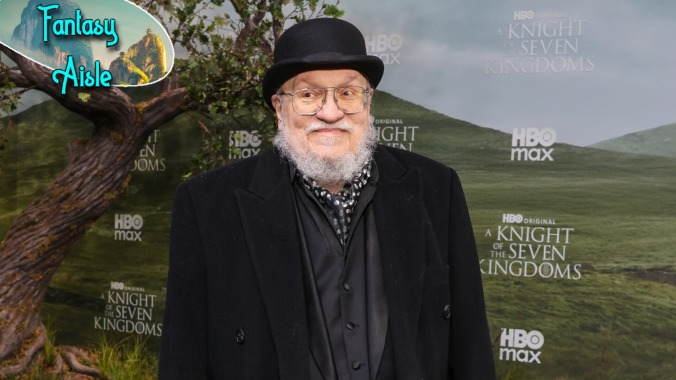
This is Fantasy Aisle, a monthly column about everything related to horny dragon books.
Game of Thrones author George R.R. Martin recently gave a candid interview to The Hollywood Reporter, before the premiere of HBO’s latest GoT spinoff, A Knight of the Seven Kingdoms. As always, the subject of his unfinished A Song of Ice and Fire books came up. (That’s the series the show is based on, for those unfamiliar.) Though Game of Thrones (the HBO adaptation) saw the story through to an end, the final two books remain unwritten. And in the new interview, Martin confirmed that, should he die before he writes those last two, “My work won’t be finished.” And while it is his prerogative how to handle his magnum opus, he is wrong on one point: Even if he dies before they’re done, those books will be finished—just not by him and almost certainly not in the way he wants. Martin should take one lesson from GoT and publicly, clearly name a successor, ASAP. Otherwise, he will leave his kingdom in a whole lot of trouble.
Whether he meant to or not, Martin founded a media empire. The original show was nominated for 59 Emmys and almost every main cast member went on to post-Thrones success. Besides the books and the HBO show, the fantasy world he created has more TV shows constantly “in development,” including a potential Jon Snow and/or Arya Stark sequel, according to the THR interview. There are Game of Thrones card games, board games, video games, and enormous amounts of merch.
In terms of cultural significance, GoT ranks alongside Harry Potter and the Marvel Cinematic Universe. Whether it’s Blake Lively calling herself “Khaleesi” or the fact that we may one day have a President Arya, the series is permanently embedded in our cultural consciousness.
Martin is 77, with not one but two enormous books left to write, The Winds of Winter and A Dream of Spring. The most recent book in the series, A Dance with Dragons, came out in 2011. With 15 years and counting between books, the odds of both being done anytime soon are not great. He mentions in the interview that he has “around 1,100” pages of Wind of Winter complete. This is, hilariously, the same amount of pages he has been citing for at least two years. So, if you’re holding your breath on those books, it’s time to exhale.
Warner Bros. owns the film and television rights to the series, and it will almost certainly continue to spin off related properties: sequels, origin stories, maybe even reshooting the final episodes—it’s all on the table. (OK, reshoots are probably not on the table but why not, literal millions of us are begging!!) That’s because, like any franchise, if there’s money to be made, someone will figure out how to get it into their pockets, no matter what it does to the integrity of Martin’s original story.
And look, I do think people should stop asking Martin about his own death. It’s morbid and frankly rude! Plus, at this point, after what he’s given us, he doesn’t owe fans anything: not the text of his will, not two books—not even one.
But I do think he owes himself, and the world that he created. In the THR interview, Martin refers to the characters as his children. Children, like art, hopefully outlive their creators. And, while it’s a painful exercise, responsible parents make plans for what happens to their children if they die. If they don’t, the kids wind up wards of the state. And in the case of Westeros, “the state” is most likely Warner Bros. or whatever horrifying three-headed beast a studio sale or merger produces in the coming years.
Though that’s the nightmare scenario for me as a fan—that the books get finished by some random, pliant stooge chosen by studio execs—it’s most likely that Winds of Winter and A Dream of Spring will never be finished, and HBO’s conclusions for Sansa, Jon, Dany, et al., will remain canon, which Martin worries about in the interview. (Whether we like it or not, right now, Bran Stark and Samwell Tarley casually inventing democracy is the only ending we’ve got so far, no matter how dumb it is.)
Meanwhile, a franchise creator naming (or at least accepting) a creative steward is pretty common practice, and there are lots of ways to do it. Kevin Feige was running the show creatively at Marvel Studios while Stan Lee was still around. Dave Filoni, a protege of George Lucas, has been the chief creative force behind Star Wars for years; Lucas is still very much alive. Robert Jordan left his wife (who was also his editor) with the task of naming a successor. After he died, she chose Brandon Sanderson to finish up Jordan’s Wheel of Time novels, cementing Sanderson as one of the foremost fantasy writers of his generation.
It’s not just fantasy series that use this practice. The Sagrada Familia is still being built over 100 years after Gaudi’s death! Death happens; it’s why authors and architects alike make blueprints. You can’t leave a cathedral unfinished in the middle of the city; someone, whether you like it or not, will see it through.
The question of succession and creative stewardship is a problem Martin has already encountered. The juiciest parts of the THR interview are about his contentious relationship with Ryan Condal, the showrunner of HBO’s House of the Dragon. (HotD is the first GoT spinoff and is poised to enter its third season.) Martin told the magazine that their relationship is “abysmal,” due to serious creative differences.
As if that wasn’t bad enough, Condal was only made the sole showrunner for HotD when Miguel Sapochnik, a major contributor to the original Game of Thrones series, left the job in the show’s first season. Condal and Martin then publicly fell out over choices Condal made in the second season, a thing I have complained about at length. Martin wrote and deleted a blog post in 2024 specifying his complaints, but they more or less boil down to Condal and his team refusing to take the long view, and changing details and plot points that seem fungible in the course of a single episode or season. According to Martin, these details matter in the context of the larger story.
Fighting for the integrity of your overall vision is what an artist is supposed to do. But who will do it when Martin is gone?
Ultimately, Martin is going to do whatever he wants. Maybe he has those books already finished and is pulling one beautiful, colossal prank on us all. Hey, a lady can dream.
But really, if I learned anything from GoT, it’s that the king has got to have a legitimate heir. If they don’t, some random bastard will come along and fuck up the kingdom for good.
Like what you just read? You’ve got great taste. Subscribe to Jezebel, and for $5 a month or $50 a year, you’ll get access to a bunch of subscriber benefits, including getting to read the next article (and all the ones after that) ad-free. Plus, you’ll be supporting independent journalism—which, can you even imagine not supporting independent journalism in times like these? Yikes.
 Keep scrolling for more great stories.