

Like what you just read? You’ve got great taste. Subscribe to Jezebel, and for $5 a month or $50 a year, you’ll get access to a bunch of subscriber benefits, including getting to read the next article (and all the ones after that) ad-free. Plus, you’ll be supporting independent journalism—which, can you even imagine not supporting independent journalism in times like these? Yikes.
It’s a Gorgeous Day to Stream a 19th-Century Suffragist Banger
The 1882 song set to “Auld Lang Syne” roasts terrible men, and still, unfortunately, slaps.
Photo: Folkways Records and Service Corporation EntertainmentIn DepthMusic
Copy to clipboard
0
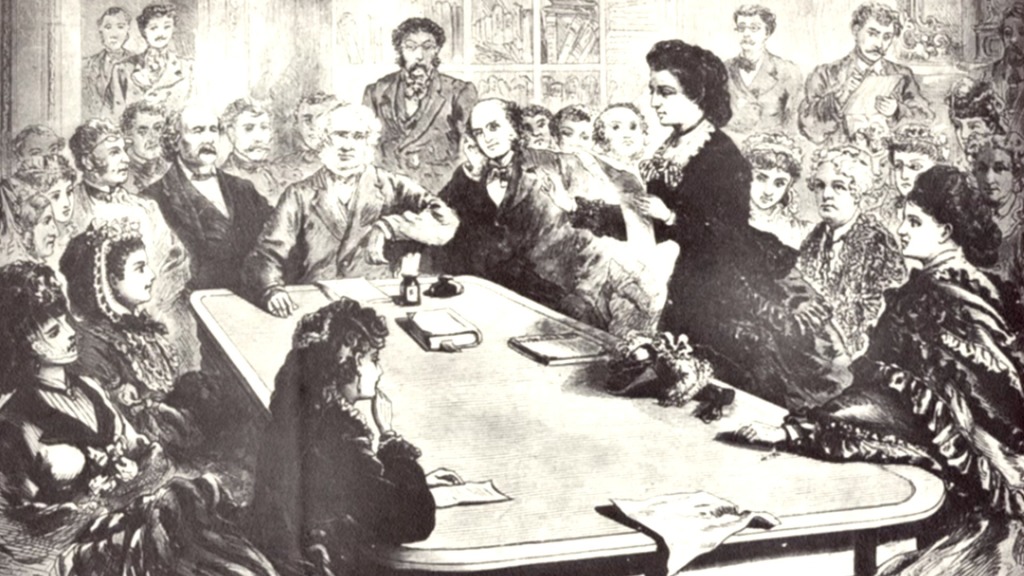
Call it research, call it digging for inspiration, call it a yearning to be led by literally anyone from any point in time, but I’ve been falling down suffragist rabbit hole after suffragist rabbit hole. And these babes knew how to write a fucking banger.
There’s one banger, in particular, that I’ve even added to my seasonal Spotify vibes playlist because it stuck onto my brain waves like a piece of Laffy Taffy. “Keep Women in Her Sphere” is a cheeky and subversive call out of the drunk and bull-headed men who don’t believe in a woman’s right to vote, but ends with the tale of a lovely man who does believe in a woman’s right to vote. Whoever inspired the third man, I hope he is resting in the sweetest peace.
The lyrics were published in The Woman Suffrage Campaign Song Book in Lincoln, Nebraska, in 1882, and are set to the melody of “Auld Lang Syne.” I actually first heard the song thanks to Jezebel staff writer Danielle Han’s deep dive into Robert Burns, or “The Scottish Poet Who Gave Us ‘Auld Lang Syne’” and how he “Was Kind of a Dick.” Since you surely already know the melody, here’s the first two verses.
I have a neighbor, one of those
Not very hard to find
Who know it all without debate
And never change their mindI asked him”What of woman’s rights?”
He said in tones severe–
“My mind on that is all made up,
Keep woman in her sphere.”
144 years later, and here we are. Our neighbors are easier to locate than ever; some even have podcasts, so we wouldn’t even need to run into them on the street. In 2026, instead of opposing women’s suffrage, they voted for Trump and oppose a woman’s right to control her body. Frankly, I assume they probably oppose a woman’s right to vote, too. Time is a cyclical devil with a terrible sense of humor.
The song appears on an entire 16-track album of suffragist songs, aptly titled, Songs of the Suffragettes, which was recorded in 1958 and sung by folk singer Elizabeth Knight—not to be confused with the British suffragist, Elizabeth Knight who was once thrown in jail for asking the Prime Minister why he “promised manhood suffrage in answer to a demand for votes for women,” according to this obituary.
In the next two verses, we meet a real piece of shit:
I saw a man in tattered garb
Forth from the grog-shop come
He squandered all his cash for drink
and starved his wife at homeI asked him “Should not woman vote”
He answered with a sneer–
“I’ve taught my wife to know her place,
Keep woman in her sphere.”
The handbook, which is archived in the Library of Congress, lists D. Estabrook as the lyricist. There doesn’t seem to be true confirmation on who this is, but G. Estabrook was the pen name used by Caroline Augusta “Gussie” Clowry, a composer and singer who became the first American woman to publish an opera, The Joust. Her dad was Experience Estabrook, who was the first attorney general of the Nebraska territory. She might literally have nothing to do with the song, but if she does, then…that’s who wrote it. And if she doesn’t, congratulations, you just learned another neat fact about American history.
In our final verse, we meet a Nice Man, who seems to truly believe men and women should be treated the same. Don’t tell him about Pete Hegseth!
I met an earnest, thoughtful man
Not many days ago
Who pondered deep all human law
The honest truth to knowI asked him, “What of woman’s cause?”
The answer came sincere —
“Her rights are just the same as mine,
Let woman choose her sphere.”
Letting women do whatever they want? What a novel, revolutionary, and still apparently too-futuristic idea.
Join the discussion...
 Keep scrolling for more great stories.